

Late November is when the porch starts telling the truth. The rockers are empty, the siding looks a little more weathered than it did in October, and last year's cedar wreath has faded to a tired brown. A catalog can make farmhouse Christmas decor outside look effortless, with clipped garlands against spotless brick and lanterns sitting perfectly in dry mulch. Real homes have soaked planters, frozen urns, slippery steps, and wind that pulls at anything lighter than a fence post.
The difference between pretty on installation day and still attractive after weeks of rain, snow, and freezing nights comes down to more than taste. You need a clear palette, sensible outdoor zones, materials suited to exposure, and anchors strong enough to keep the display where you put it. Outdoor decorating has a long history, from greenery traditions documented as early as about the 1500s to outdoor Christmas trees recorded in the United States in 1904, 1909, and 1912, with exterior eave lighting becoming increasingly common by the 1960s (historical milestones in outdoor Christmas decorating).
Table of Contents
- The Bare Porch Problem and What Comes Next
- Defining the Farmhouse Christmas Look Outdoors
- Planning Your Outdoor Zones Before You Buy
- Choosing Materials That Survive the Season
- Lighting Plans That Look Warm Without Blowing the Budget
- Anchoring and Weatherproofing for Real Conditions
- Pulling It All Together in One Cohesive Theme
The Bare Porch Problem and What Comes Next
A bare farmhouse porch doesn't need a shopping cart full of decorations. It needs a composition that can handle the conditions around it. Start with the faded wreath on the front door, then add a pair of planters, a weathered sign, and two lanterns. In a styled photograph, that combination looks finished in minutes. In a real yard, the wreath may collect rain, the sign may wick moisture through its back, and the lanterns may tip when a gust catches the door.
That gap causes most outdoor displays to fail. A piece doesn't have to break to look wrong. A burlap bow darkens, a wooden plaque swells along its edge, or a strand of lights sags after water enters a connection. By the time the family notices, the display feels less like a welcoming farmhouse entry and more like a pile of seasonal items waiting for storage.
Practical rule: Choose every outdoor piece for the weather it will receive, not for the room where you first saw it photographed.
A covered porch can support softer layers, including plaid cushions, fabric bows, and fuller greenery. An open yard needs low profiles, ballast, and weather-resistant finishes. The front walk needs clear sightlines and lighting that remains visible when snow or wet leaves cover the ground. A single look applied everywhere usually creates mismatched scale and unnecessary spending.
The most reliable approach follows four decisions:
- Define the look: Keep the palette and motifs restrained so the exterior feels intentional.
- Zone the property: Give the entry, porch, walkway, and yard different jobs.
- Select durable finishes: Spend on powder-coated metal, sealed wood, and outdoor-rated lighting where exposure is highest.
- Anchor the display: Treat wind protection as part of the design, not as an afterthought.
For a visual starting point, this farmhouse Christmas porch decor guide can help you identify the pieces that belong at the door before you decide how to secure them.
Defining the Farmhouse Christmas Look Outdoors
Farmhouse style works outside because it relies on texture, repetition, and familiar materials, not a crowded color scheme. Begin with weathered white, barn red, fresh evergreen, raw or stained wood, galvanized metal, and black iron. You don't need every color in every zone. Two or three dominant tones will read more clearly from the street.
Motifs should feel simple and useful. Stenciled lettering, buffalo plaid, ticking stripes, vintage trucks, stars, pine bundles, and uncomplicated snowflakes support the look without turning the porch into a themed display. Burlap, linen, cedar, pine, and galvanized tin provide the visual weight. Glitter and highly reflective plastic can work as small accents, but too much of either tends to compete with the natural texture that makes farmhouse styling feel grounded.

Use a practical outdoor checklist
Build the exterior in this order rather than buying disconnected pieces:
- Entry sign: Choose one readable message or silhouette, preferably in a finish rated for outdoor use.
- Porch greenery: Add a wreath, swag, or garland to bring natural texture to the door and rail.
- Lanterns: Use matching or related lanterns to create structure beside steps or seating.
- Tree or topiary: Place a small evergreen in a protected porch corner, not in an exposed wind channel.
- Planters: Repeat the greenery in urns, galvanized tubs, or sealed wooden boxes.
- Focal lighting: Select one warm source that gives the eye somewhere to land after dark.
The checklist matters because farmhouse Christmas decor outside can become visually noisy very quickly. If the wreath, sign, planters, and lights all demand attention, the entry loses its calm, lived-in quality. Readers who want a more detailed installation sequence can also use this step-by-step porch decorating resource as a planning reference.
Planning Your Outdoor Zones Before You Buy
A porch and a yard may share the same color palette, but they don't share the same weather load. Divide the property into four zones before purchasing anything. This prevents you from putting delicate porch pieces at the end of the driveway or using tiny walkway accents where a visitor needs clear visual guidance.
Assign each zone one job
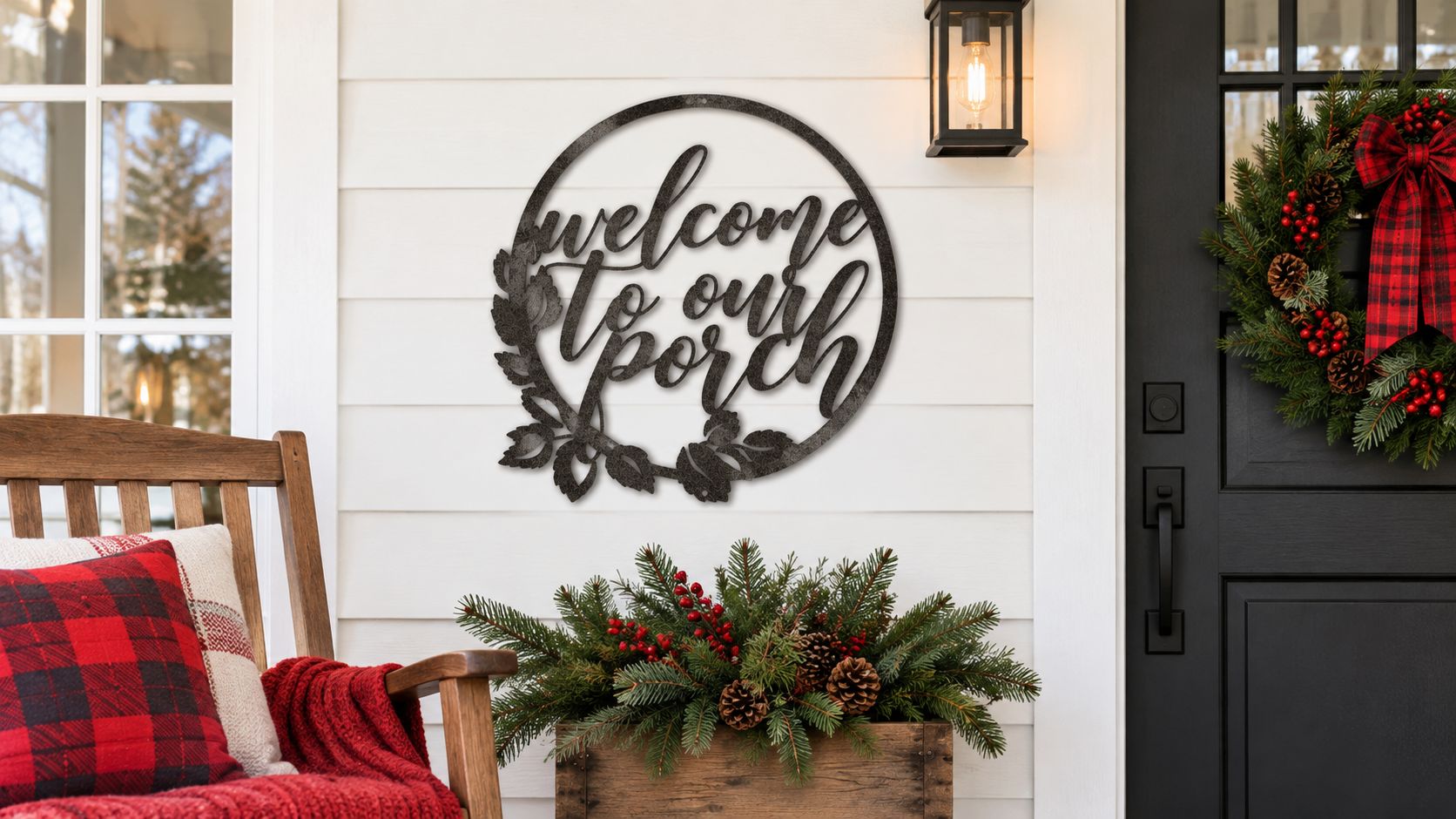
The siding and entry face is the photo zone. It has high visibility and usually moderate exposure, so it suits a wreath, porch sign, window candles, or a narrow garland around the door. Keep lettering large enough to read from the drive, and avoid placing a tall piece where it blocks the handle, door swing, or house numbers.
The porch is the living zone. It can handle layered textiles, lanterns, a small tree, and a bench arrangement because the roof offers some protection. Still, covered doesn't mean waterproof. Wind-driven rain can reach the back of a sign and moisture can sit beneath a planter, so leave room for drainage and inspection.
The walkway and drive edges are the guidance zone. Low lanterns, stake lights, and restrained greenery work better than wide ornaments or tall cutouts that narrow the path. Snow, leaf cover, and foot traffic make this the wrong place for fragile filler pieces.
The yard is the display zone. It has the greatest exposure, fewer convenient outlets, and more opportunity for wind lift. Use silhouettes, reindeer, trees, or a single large statement only when you can anchor it properly. The global Christmas decorative products market includes outdoor items such as illuminated metal silhouettes, reindeer, sleigh displays, inflatables, and exterior garlands, with outdoor decor representing about 27.0% of global revenues in 2025 (Christmas decorative products market context).
| Zone | Exposure | Best-Fit Decor |
|---|---|---|
| Siding and entry face | Moderate, highly visible | Wreaths, signs, window candles, narrow garlands |
| Porch | Sheltered but exposed to driven rain | Lanterns, textiles, small trees, layered greenery |
| Walkways and drive edges | Snow, foot traffic, splashback | Low lanterns, stake lights, compact greenery |
| Yard | Open wind and limited power access | Anchored silhouettes, trees, one focal display |
A powder-coated sign such as Welcome to our Porch Metal Sign fits the entry zone because its laser-cut mild steel construction is powder coated for indoor or outdoor hanging. It's available in multiple listed sizes, and mounting hardware isn't included, so plan the attachment separately.
Choosing Materials That Survive the Season
Outdoor farmhouse decor should be selected by substrate first and appearance second. The same weathered finish that looks charming in a showroom can fail quickly if the underlying material absorbs water or the coating isn't designed for sunlight and temperature changes. Rain, ultraviolet exposure, and freeze-thaw movement each attack a different weak point.
Match the piece to its exposure
For signs and silhouettes, choose powder-coated steel or aluminum rather than metal with decorative paint alone. Powder coating creates a more dependable exterior finish, but inspect edges, cutouts, and mounting holes because exposed metal can still become a rust point. For wood, sealed or marine-grade plywood is a better choice than raw board. Untreated MDF and OSB can swell during a single wet week, which makes them poor choices for an exposed yard sign.
Lanterns need more than a rustic appearance. Galvanized or powder-coated bodies resist moisture better, while rubber gaskets help keep water away from electrical connections. Look for an outdoor rating, and treat IP44 as a practical minimum for splash resistance and IP65 or higher as a better choice for harsher winter exposure, based on outdoor decoration guidance (weather-resistant outdoor decoration materials).
Raw jute is attractive but absorbs moisture readily. Use outdoor-rated canvas or treated burlap for bows, sacks, and wraps, and keep soft goods in covered areas whenever possible.
Prep wood before it leaves the workshop
For a wooden plaque or cutout, use this workflow:
- Lightly sand every face and edge.
- Apply an oil-based exterior primer to all sides.
- Add two coats of exterior enamel, allowing proper drying between coats.
- Seal exposed edges and inspect the back before mounting.
- Recoat annually if the piece remains outdoors year-round.
Ask the seller whether the item is rated for outdoor use, what sealant or coating was applied, how long the finish is expected to last, and whether the hardware is stainless or zinc plated. A clear weather-resistant sealant or topcoat on exposed surfaces is particularly useful for porch signs, rustic plaques, lanterns, and yard silhouettes, as outlined in this guide to weatherproofing outdoor decorations.
| Material | Wet Weather Durability | UV Resistance | Approx. Cost Tier |
|---|---|---|---|
| Powder-coated steel or aluminum | High when edges and holes are protected | High with a suitable exterior coating | Higher |
| Sealed plywood | Moderate to high with complete edge sealing | Moderate, may need recoating | Moderate |
| Galvanized metal | High, though cut edges need attention | Moderate to high | Moderate |
| Outdoor canvas or treated burlap | Moderate in sheltered areas | Moderate, varies by treatment | Lower to moderate |
| Raw MDF or untreated OSB | Poor | Poor | Lower |
Save money on filler greenery and secondary accents. Spend more carefully on signs, lanterns, anchors, and any item that sits in full exposure. For metal-specific maintenance ideas, this outdoor metal wall art resource is a useful companion.
Lighting Plans That Look Warm Without Blowing the Budget
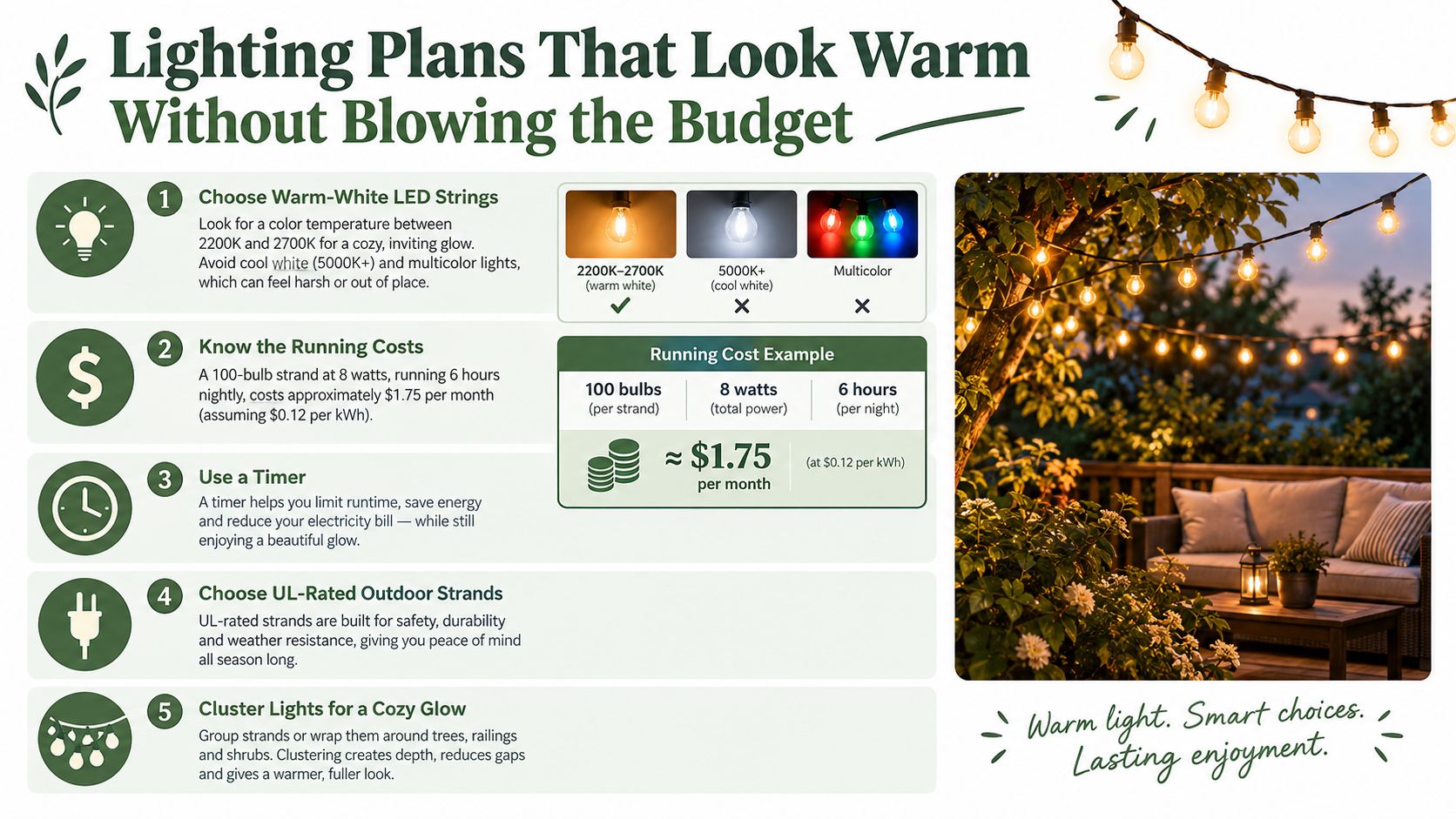
Warm light gives farmhouse Christmas decor outside its evening character, but adding more strands isn't the same as creating a better display. Choose warm-white LEDs in the 2200K to 2700K range instead of cool white or multicolor bulbs. LEDs also change the budget equation. EnergySage notes that LED holiday lighting can reduce December electricity costs substantially compared with incandescent options, while large displays still consume more than a simple wreath or lawn accent (holiday lighting electricity guidance).
Use light to define the property rather than cover every surface:
- Eaves: Outline the roofline only where it improves the house shape.
- Porch rail: Wrap the front rail or a single post, leaving the door area visually open.
- Walkway: Use stake lights at consistent spacing, with enough brightness to remain visible through wet ground or snowfall.
- Focal piece: Give one lantern, illuminated sign, or small tree the strongest concentration.
Solar lights are convenient and inexpensive to operate, but snow cover and short December days can leave them dim when you need them. They work well for pathway accents. Use plug-in LEDs for the door garland or primary porch feature, where reliable evening output matters.
Use the electrical setup as part of the design
Choose outdoor-rated strands with at least an IP44 rating for splash resistance, connect them to GFCI-protected outlets, and use a timer or smart plug so they aren't running through every daylight hour. Keep connections off wet mulch and away from downspout runoff. Read this guide to 2026 holiday lighting display tips for additional planning ideas around installation and display control.
A low-wattage plan can still look generous. One strand around the eaves, a shorter wrap on the porch rail, and a few solar stakes along the walk creates three layers without turning the yard into a glowing wall. Avoid assigning a precise monthly total unless you know the strand wattage, operating schedule, and electricity rate for that home.
Anchoring and Weatherproofing for Real Conditions
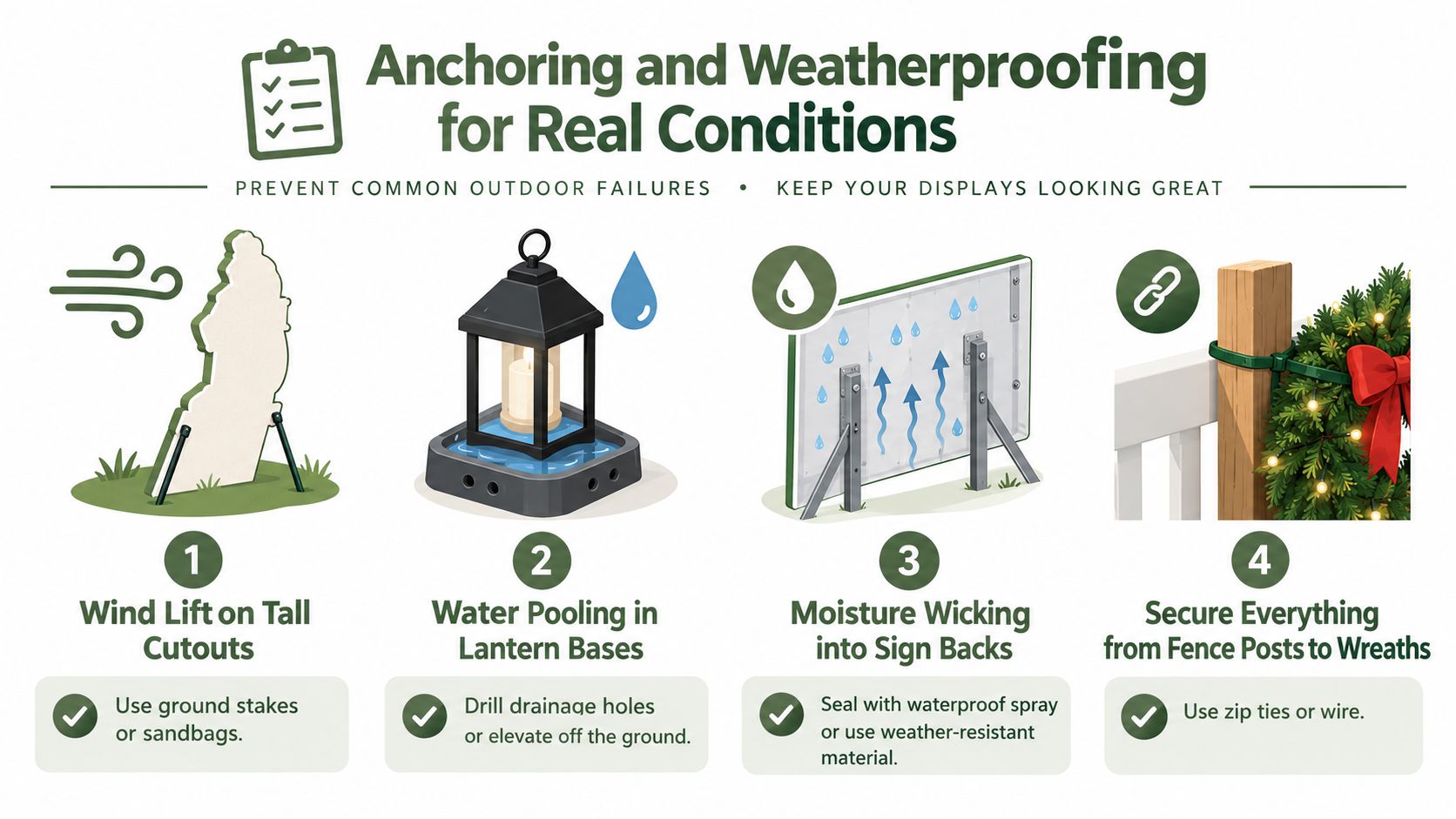
Wind is the main reason outdoor holiday displays move, tip, or disappear. A tall cutout catches lift like a small sail, a light lantern shifts across a slick porch, and water can collect inside a base or creep behind a sign. The fix isn't always a heavier decoration. Often, it's a better anchor and a lower profile.
Secure each shape according to its risk
Lightweight cutouts can use stakes driven as the ground allows. Lanterns and small porch trees benefit from sandbags, gravel bags, or concealed ballast at the base. Taller pieces need multiple tether points, using rope or twine to connect them to a porch rail, fence post, tree, or properly installed eye screw. Double-sided mounting tape belongs only on smooth, sealed surfaces, and it shouldn't carry the load of a heavy sign.
Keep open-yard displays low and compact. A layout under about 36 inches tall and away from fence corners or wind funnels generally presents less strain than a tall, isolated piece, making it easier to stabilize (field guidance on wind and holiday decorations). Deflate inflatables partially or fully during strong winds rather than trusting their built-in tethers alone.
For a metal sign, use pre-drilled mounting holes, stainless screws with rubber washers, and a bead of clear exterior silicone along the top edge. That bead helps stop water from traveling behind the panel. Don't seal the bottom so tightly that trapped moisture has nowhere to escape.
The guide to protecting metal from rust is useful when you're checking unfinished edges, fasteners, and exposed mounting points.
Run a five-minute pre-storm check
- Test the base: Push each stake and confirm it hasn't loosened in wet soil.
- Check the tethers: Look for frayed rope, loose knots, and pulled eye screws.
- Lift the lanterns: Make sure water isn't pooling beneath or inside the base.
- Inspect connections: Move light plugs and adapters above mulch and runoff.
- Remove vulnerable pieces: Bring in fabric bows, loose signs, and unanchored accents before severe weather.
A display that survives winter usually looks slightly less dramatic than the catalog version. That's a worthwhile trade. Stable, dry, readable decor remains attractive far longer than a tall arrangement that needs repair after every storm.
Pulling It All Together in One Cohesive Theme
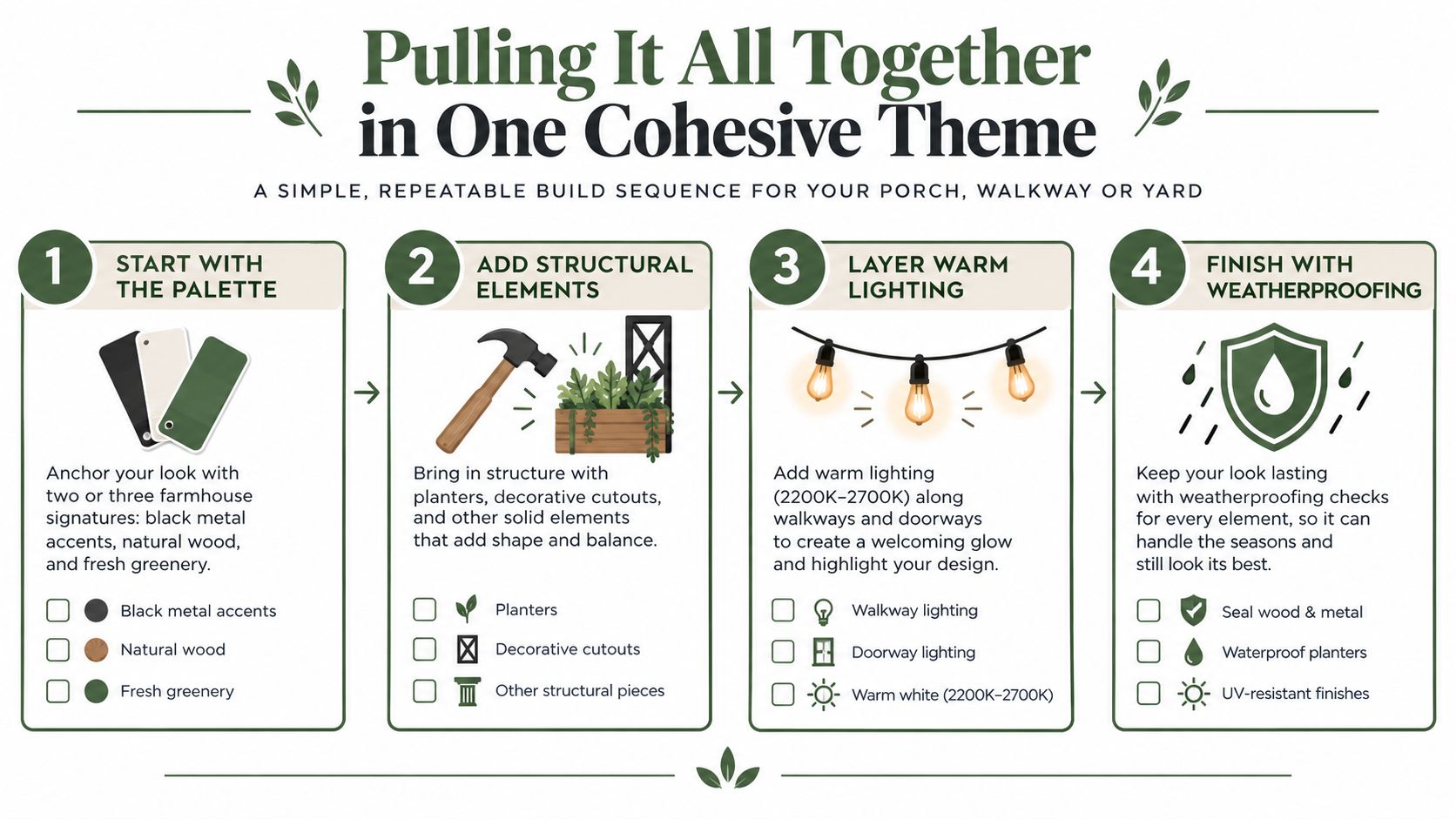
A cohesive farmhouse exterior doesn't come from matching every item. It comes from repeating a few signals at different heights and assigning each piece a job. Start with black metal, raw cedar, and warm white light, then introduce fresh greenery as the element that softens the harder surfaces. Barn red can appear in one sign, ribbon, or door detail, but it doesn't need to dominate the entire property.
Build from the ground upward
Begin with the pieces that establish movement and scale. Place path lanterns, a mailbox swag, or low planters first. These ground-level anchors show you where people walk and where the display needs breathing room. If a planter sits directly in a snow-clearing route, move it before adding greenery.
Next, add mid-level structure. A metal sign near the entry, lanterns beside the steps, or a plaid cushion on a covered bench creates the visual middle. Keep related finishes together. Black metal can repeat between a sign frame and lantern handles, while cedar or stained wood can connect a planter to a porch plaque.
Top-level pieces come last. Add a wreath, a door garland, a small tree, or a roofline accent only after the lower composition feels balanced. This order prevents the common mistake of hanging a large wreath first and then filling every empty space around it.
Give each zone a focal point
The entry might center on a lit garland around the door. The walkway could lead toward a large metal sign at a bend. The porch may work better with a small tree tucked into a covered corner, especially if the front door already has a strong wreath.
Use the exposure test before adding a decorative flourish. If a piece is tall, hollow, light, or made from absorbent material, it doesn't belong in an open wind path unless you can ballast and tether it. A low galvanized bucket of greenery can deliver the farmhouse note with less risk than a tall untreated wooden cutout.
A balanced plan usually needs fewer categories than shoppers expect:
- Palette: Limit the dominant colors and repeat them across zones.
- Structure: Place signs, planters, lanterns, and silhouettes before soft accents.
- Texture: Add cedar, pine, burlap, plaid, and aged metal in controlled amounts.
- Light: Use warm LEDs to trace the entry and guide movement, not flatten the whole facade.
- Protection: Inspect backs, edges, connections, and anchors before the first storm.
Make the final night walk
Before calling the display finished, check it from the street and from the path. Count the main colors, identify the focal light in each zone, and verify that the anchors aren't visible from the usual viewing angle. Walk past the house after dark and look for dark gaps where a visitor needs guidance, then remove any light or ornament that shouts louder than the doorway.
The best farmhouse Christmas decor outside feels collected rather than crowded. It welcomes people toward the door, uses natural materials where they can survive, and reserves fragile details for sheltered places. It also leaves enough empty space for the house itself to remain part of the composition.
Farmhouse World offers custom metal signs, rustic wall art, seasonal accents, and complementary pieces for entryways and outdoor farmhouse displays. Visit Farmhouse World to find a durable focal sign or coordinating accent, then finish your arrangement with the weatherproofing and anchoring checks above.


