

You've found a leaf-shaped metal panel that would fill the bare wall above your bench. In the product photo, it looks light, textured, and easy to hang. But will it feel too small at home? Will its edges rust on the porch? And can your wall support it without the panel twisting or pulling loose?
Leaf metal wall art works best when you choose it as a wall system, not just a decorative shape. The metal, finish, exposure, scale, and mounting all need to suit the same location. Start with those practical decisions, and the styling becomes much easier.
Table of Contents
- What Leaf Metal Wall Art Is and Its Main Types
- Metal, Finish and Size Compared
- Matching Leaf Art to Each Room and Style
- How to Hang Leaf Metal Art Safely
- Outdoor Durability, Care and Seasonal Checks
- Styling Leaf Art With Farmhouse Décor
- Choose Your Leaf Piece and Plan the Hang
What Leaf Metal Wall Art Is and Its Main Types
A single leaf panel hangs on a quiet wall. Morning light catches its raised edges; later, its shadow stretches across the paint. That changing outline is part of the appeal, but not every botanical metal decoration creates the same effect.
Leaf metal wall art is decorative metal cut, formed, or layered into leaves, ferns, eucalyptus stems, or branches. It may hang as a connected composition or as separate elements arranged together.
Recognize the main constructions
- Flat cut-metal leaves sit relatively close to the wall. Open spaces between stems let the wall color become part of the design, making these pieces useful when you want detail without much projection.
- Layered sculptural leaves have overlapping or bent elements. Their depth creates shadows, but it also means you need to consider clearance, cleaning access, and how the piece looks from the side.
- Printed or painted botanical panels show leaf imagery on a metal backing. You're choosing the image and surface finish rather than a leaf-shaped silhouette, so inspect close-up photographs before assuming the leaves are dimensional.
Botanical metalwork isn't a new invention. The Metropolitan Museum of Art documents leaf-shaped Tang-dynasty silver vessels and the wider history of botanical ornament, including European acanthus decoration. That tradition helps explain why leaf forms can feel at home beside both aged timber and cleaner contemporary furniture.
Understand the arrangement
A statement piece is a large work that anchors a wall. A cluster is a group of smaller pieces hung so they read as a unified arrangement.
A branch with widely spaced leaves may occupy substantial wall space while still looking airy. A dense panel of overlapping leaves can feel visually heavier despite having a similar outer outline.
Before shopping: Decide where the piece will hang, how much weather will reach it, and which finish belongs with the room.
Metal, Finish and Size Compared
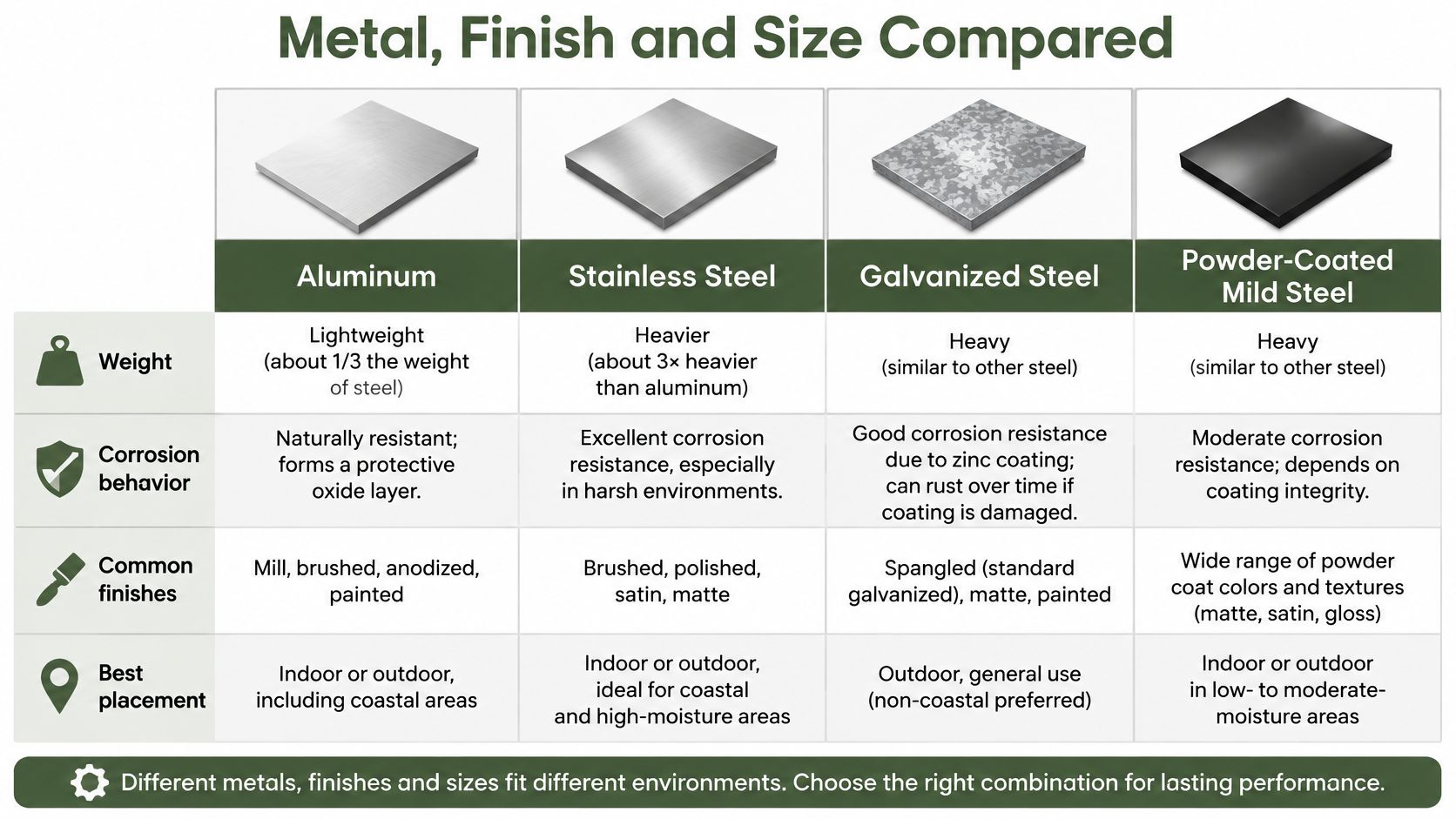
Read a leaf art listing in this order: metal first, then finish, then size. Colour names describe paint, not metal.
| Metal | Weight and feel | Corrosion behaviour | Common finishes | Best placement |
|---|---|---|---|---|
| Aluminum | Lightweight; easier to handle on larger panels | Forms a protective oxide layer, though it isn't immune to corrosion | Brushed, painted, anodized | Large indoor statement pieces |
| Stainless steel | Heavier than comparable aluminum; crisp appearance | Resists rust in humid air; grade and exposure still matter | Brushed, mirror-polished | Kitchens, bathrooms, humid rooms, covered exteriors |
| Galvanized steel | Strong and relatively heavy; often spangled grey | Zinc protects the underlying steel, including limited protection at damage | Raw zinc, painted | Porches, garden walls, ranch exteriors |
| Powder-coated mild steel | Strong and relatively heavy | Protection relies on an intact coating | Matte black, colored powder coat | Indoor walls and sheltered outdoor spots with regular checks |
Compare the underlying metal before comparing colors. A silver-colored finish could cover aluminum, stainless steel, or painted mild steel, and those behave very differently once moisture or weather reaches them.
Industry Research on the metal wall art market identifies metal wall art as a distinct market segment and lists aluminum and stainless steel among its principal materials. Market position tells you nothing about a single piece. The details that matter for one purchase are the actual alloy, the finished weight, the coating, and how the piece mounts to the wall.
Choose the surface you want to live with
Matte black gives an open leaf silhouette a clear outline against pale paint, which is why it suits busy rooms where the shape needs to read at a glance. Brushed finishes scatter reflections, so everyday fingerprints and fine scratches stay far less conspicuous than they do on mirror-polished surfaces.
Polished silver and gold tones catch more light and work well as brighter accents. Judge them from the doorway and from a seated position, since a piece that looks calm head-on can throw glare from an angle.
Check whether a copper finish is paint or solid metal before expecting patina. Painted copper holds its factory colour, while exposed copper develops surface changes as it ages. Grey paint deserves the same skepticism. It can mimic galvanized steel convincingly, so confirm the zinc coating in the materials line of the listing rather than trusting the shade.
Judge size and stiffness together
Sort pieces into three roles before you measure anything: accent, furniture companion, or wall anchor. An accent sits beside a doorframe or fills a gap in a gallery arrangement. A furniture companion lives above a console or bench. A wall anchor needs enough visual presence to balance a sofa or headboard on its own.
Make a paper outline of the complete composition, including the gaps between separate leaves, and tape it to the wall. View it from wherever you normally approach the room, then from your usual seat. Leaf art fools the eye more than most decor because the open spaces are part of the outline.
Long, narrow leaf tips can flex even when the central stem feels solid. As compositions grow larger, look for thicker material, folded edges, welded reinforcement, or extra mounting tabs. A heavier-looking photograph is easy to stage; a stiff panel needs structure you can see in the product details.
For dry interiors, aluminum and stainless steel are practical starting points. For walls that see weather, look for documented exterior protection, because a decorative powder coat on its own is an indoor finish.
Matching Leaf Art to Each Room and Style
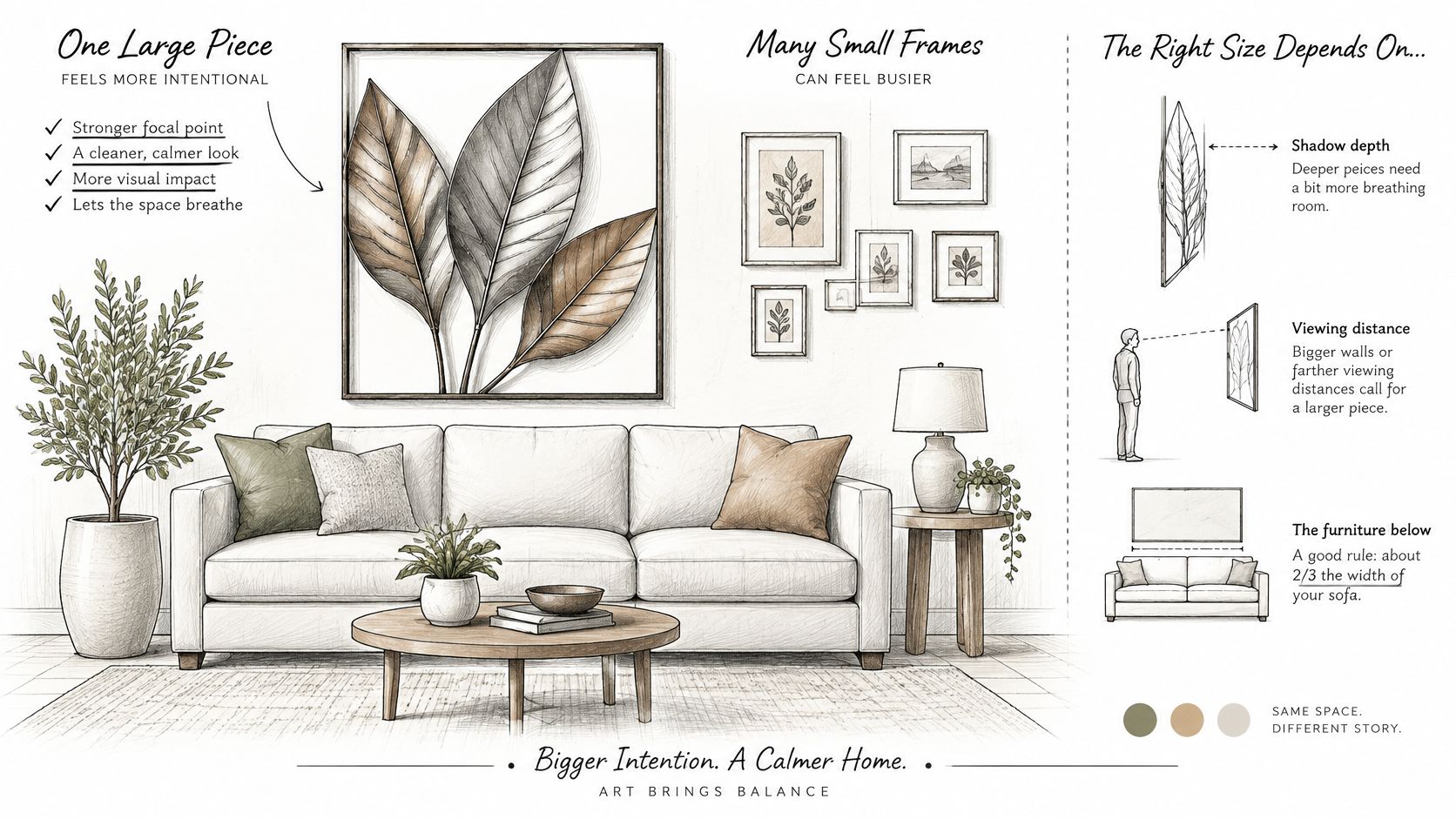
A large composition can look more deliberate than scattered small decorations, but bigger isn't automatically better. Lambo Arts' metal decor trend coverage describes interest in sculptural botanical pieces and statement works, while highlighting the importance of depth, shadows, and finish. Your viewing distance and furniture should still determine the choice.
| Room or wall | Size guide | Finish | Why it works |
|---|---|---|---|
| Entryway above a console or bench | Keep the composition within the furniture's outer edges | Matte black or galvanized | Establishes a clear arrival point without crowding the doorway |
| Above a sofa | Choose a composition narrower than the sofa but substantial enough to balance it | Brushed aluminum or copper tone | Connects the wall decoration to the seating |
| Bedroom above headboard | Keep the outline visually contained by the headboard | Brushed silver or matte black | Creates a quieter backdrop with controlled reflections |
| Dining room over sideboard | Balance the art with the sideboard and anything displayed on it | Copper or antique brass tone | Adds warmth alongside wood and tableware |
| Covered porch | Fit the clear wall space without intruding into doors or seating | Exterior-rated powder-coated steel or galvanized steel | Keeps the arrangement practical in a sheltered setting |
| Narrow stair wall | Use a slim vertical branch with minimal projection | Brushed aluminum | Follows the wall without obstructing movement |
Place the outline before choosing the height
Above furniture, treat the furniture and artwork as a connected arrangement. A panel hung far above a low console can appear to float away from it, even if the panel is centered perfectly on the wall.
Use painter's tape to mark the outer edges, then sit down and walk past. Check whether leaf tips overlap a lampshade, disappear behind a cushion, or seem crowded beneath a ceiling beam.
Let light reveal the shape
Side light from a window can reveal bent leaves and layered stems. A sconce aimed directly at the face may flatten that relief, while a glossy panel opposite a bright window can create an uncomfortable reflection.
Keep the manufacturer's intended layer spacing rather than bending leaves outward for deeper shadows. Decorative depth and mounting clearance serve different purposes, and changing either can affect stability.
Warm rustic rooms with wood and linen suit black or copper tones. Coastal farmhouse rooms often benefit from brushed aluminum or restrained silver, while stainless steel can complement cleaner modern farmhouse cabinetry.
For renters, confirm the finished weight and permitted hanging method before committing to the largest outline. A suitable wall position isn't useful if the lease or mounting system rules it out.
How to Hang Leaf Metal Art Safely
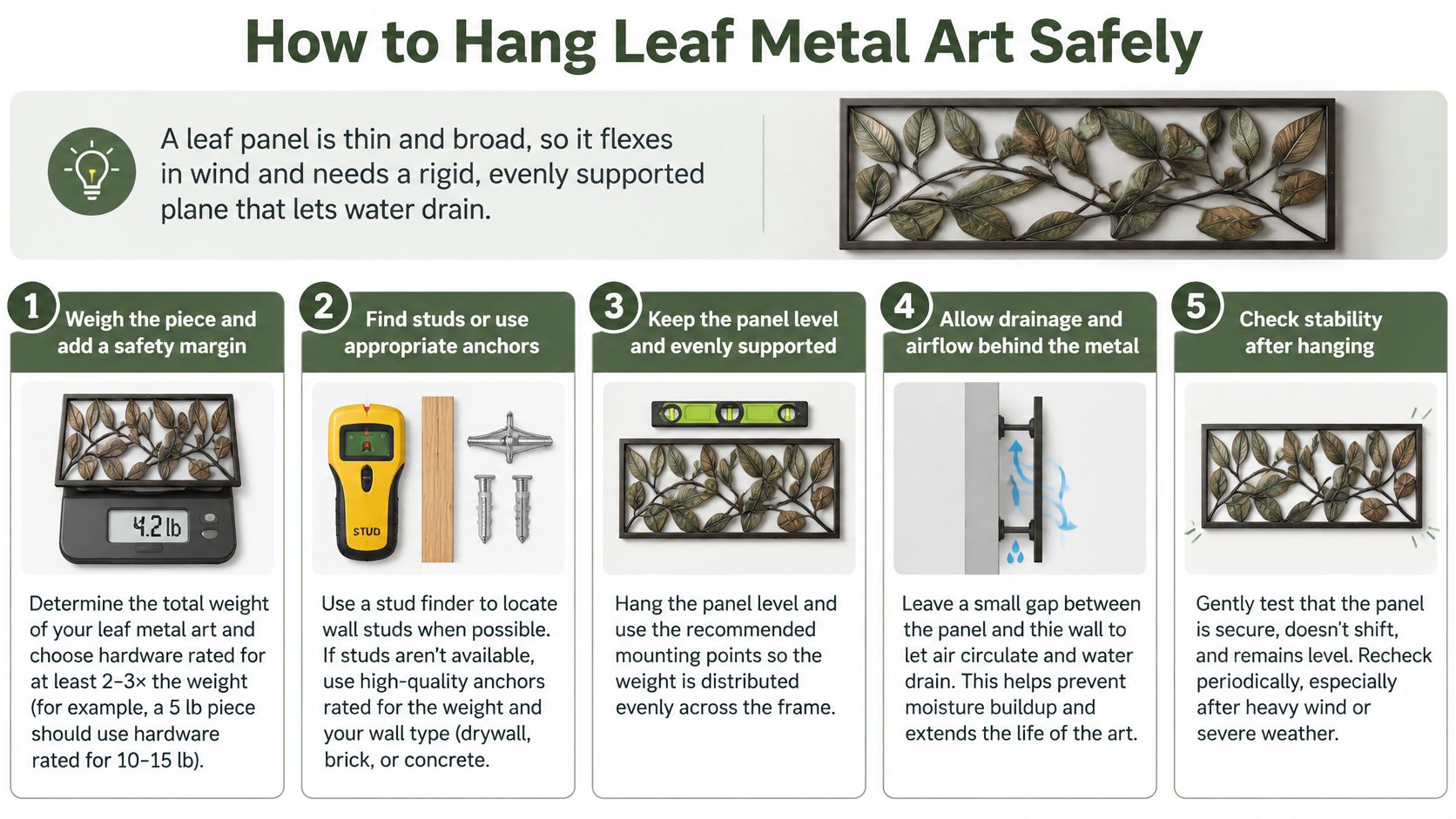
A leaf panel is thin and broad, so wind can make it flex even when it doesn't weigh much. The goal is a rigid, evenly supported installation that doesn't trap water or force the artwork out of shape.
Prepare the wall and hardware
- Weigh the complete piece. Include attached spacers, brackets, and decorative elements. Outdoors, don't treat a static picture-hook rating as proof that the installation can withstand wind.
- Identify the substrate. Find studs with a stud finder and confirm their position before drilling. For masonry, choose anchors explicitly approved for the brick or concrete you have, not a generic plug selected by appearance.
- Use the intended attachment points. Vertically separated fixings help resist twisting; larger or flexible panels may also need central support. Don't drill extra holes through a finished panel without considering coating damage and the maker's mounting instructions.
- Provide clearance without creating strain. Use rigid spacers or purpose-made offset brackets where needed for drainage and airflow. Excessively long unsupported screws can bend or let the panel wobble.
- Level and test the panel. Use a spirit level, tighten evenly, and check that the metal isn't bowing toward an uneven wall. Gently test for movement without pulling on delicate leaf tips.
- Isolate incompatible metal contacts outdoors. Suitable washers or compatible barrier coatings can separate stainless hardware from zinc-coated panels where moisture persists. Recheck the installation after severe weather and during routine maintenance.
| Wall type | Fastener | Load rule |
|---|---|---|
| Brick or concrete | Masonry anchors approved for the substrate | Capacity must exceed the installation load with allowance for outdoor movement |
| Wood framing | Structural screws into studs | Screws must engage sound framing, not just trim or wall covering |
| Drywall | Suitable hollow-wall anchors when framing isn't available | Use the rated capacity for the actual wall thickness and installation |
| Renter wall | Approved adhesive hooks or picture rail | Match the complete system to the artwork and surface; obtain permission where needed |
Avoid shortcuts that weaken the installation
A lone hanger may let an outdoor panel rotate. Bare steel screws can stain damp wood, and anchors intended for hollow walls aren't substitutes for masonry fixings.
Safety check: Don't add together individual hook ratings unless the hanging-system manufacturer explicitly permits that arrangement.
Adhesive hooks are an option only when the artwork, paint condition, surface texture, and hook instructions all agree. Avoid relying on adhesive mounting above beds or busy walkways; a suitable picture rail or mechanically fixed support is the more conservative choice.
For furniture placement around a securely mounted composition, the living room metal wall art guide offers additional room-planning context.
Outdoor Durability, Care and Seasonal Checks
Rust-resistant doesn't mean rust-proof. Outdoor life depends on the base metal, coating, exposed edges, drainage, hardware, and how much weather reaches the piece. A panel beneath a deep porch roof faces a different job from the same panel on an open garden wall.
The American Galvanizers Association's zinc coatings guide explains that atmospheric zinc corrosion is typically 10–100 times slower than corrosion of bare steel. Zinc both separates steel from moisture and provides sacrificial protection where the underlying steel becomes exposed.
That protection isn't unlimited. Continuously wet, acidic, or alkaline conditions consume zinc faster, so a decorative finish can't compensate for trapped water or unsuitable exposure.
Match protection to the location
| Exposure | Recommended material | Wall standoff | Inspection rhythm |
|---|---|---|---|
| Covered porch, dry under roof | Exterior-rated powder-coated steel or aluminum | Clear of the wall enough to avoid moisture traps | At seasonal changes and whenever dampness appears |
| Open porch or garden wall, rain exposed | Galvanized steel with protected edges | Open drainage path behind the whole panel | Regularly through wet weather and after storms |
| Coastal salt air | Stainless steel specified for coastal exposure or appropriately coated galvanized steel | Enough clearance to rinse and dry the back | Frequently during salt exposure, with fresh-water rinsing |
| Cold region with freeze-thaw | Galvanized steel with protected edges and good drainage | Prevent trapped water behind brackets and leaves | Before freezing weather and after winter storms |
Ask for the coating specification when comparing outdoor pieces. A documented zinc coating or exterior coating system is more useful than an unexplained outdoor label. Also inspect photographs of cut edges, welds, and rear mounting tabs, since those surfaces are easy to overlook.
Separate patina from deterioration
Exposed copper and raw zinc can develop changing surface colors. An even, adherent patina can be part of the intended appearance; red-brown flaking on steel, bubbling paint, or pronounced pitting needs attention.
Don't paint over active rust or a wet surface. Remove loose material using a method compatible with the metal, clean and dry the area, then apply the appropriate repair primer and topcoat.
- Inspect openings: Check drilled holes, cut edges, welds, and mounting tabs for coating failure.
- Check drainage: Clear debris behind the panel and look for damp patches on the wall.
- Test hardware: Retighten loose fixings without crushing spacers or distorting the artwork.
- Clean gently: Use mild soap, water, and a soft cloth, then rinse and allow the rear surface to dry.
- Protect the finish: Avoid abrasive pads, harsh chemicals, and pressure-washer jets directed into seams.
An outdoor finish protects best when water can leave the installation, not merely when the front looks intact.
The guide to protecting metal from rust provides further context for choosing preventive care rather than waiting for visible damage.
Styling Leaf Art With Farmhouse Décor
Farmhouse rooms reward restraint, so let the finish lead the decision. A dark leaf panel settles in when it echoes the iron of a hinge, a lantern, or a set of shelf brackets; a brighter piece works the same way against brushed hardware. Treat the artwork as one part of a wall system covering material, scale, and mounting, and judge those three before the motif. Even indoors, exposure matters: a steamy kitchen or a sunlit porch room is a mild version of an outdoor site, so choose a finish suited to that spot.
Texture does the softening. Linen curtains, a wool throw, or a woven rug near rigid metal keeps the arrangement warm, and dried stems give the botanical theme a living counterpart that changes with the season. Keep every seat and surface usable, because a bench buried under accessories stops functioning as a bench.
Build contrast without adding clutter
Contrast reads best at a distance. A matte black leaf composition above a white headboard produces a clean outline, and brass lamps can stay as a warm secondary metal while the rest of the arrangement remains restrained. The panel does not need a matching black frame, vase, and mirror gathered around it; one confident echo is enough.
The wood and metal wall decor guide shows more ways to balance timber grain against metal surfaces.
Three habits keep the contrast legible. Repeat the leaf finish selectively, in a hinge or a small accessory, instead of adding another dominant metal. Keep the background quiet, since busy botanical wallpaper hides delicate stems and blurs the outline. Leave breathing room around the silhouette too, clearing lamps, curtains, shelves, and neighboring frames away from projecting leaf tips.
Give supporting objects a smaller role
If you're already choosing complementary accents, our candle holders, rugs, and planters can support a farmhouse arrangement without adding another wall feature. A smaller sign such as Don't Grow Up Trap - Rustic Farmhouse Wall Art Decor Sign belongs in a secondary position, like a reading nook shelf, where it reads as a footnote to the leaf composition rather than a rival.
Keep a nearby sign or mirror subordinate to the leaf composition. When the wall starts to feel crowded, remove an accessory before reaching for a larger artwork; crowding is usually a count problem, not a size problem.
Choose Your Leaf Piece and Plan the Hang
The best choice isn't necessarily the most elaborate leaf pattern. It's the piece you can place securely, see comfortably, and maintain without resenting the work.
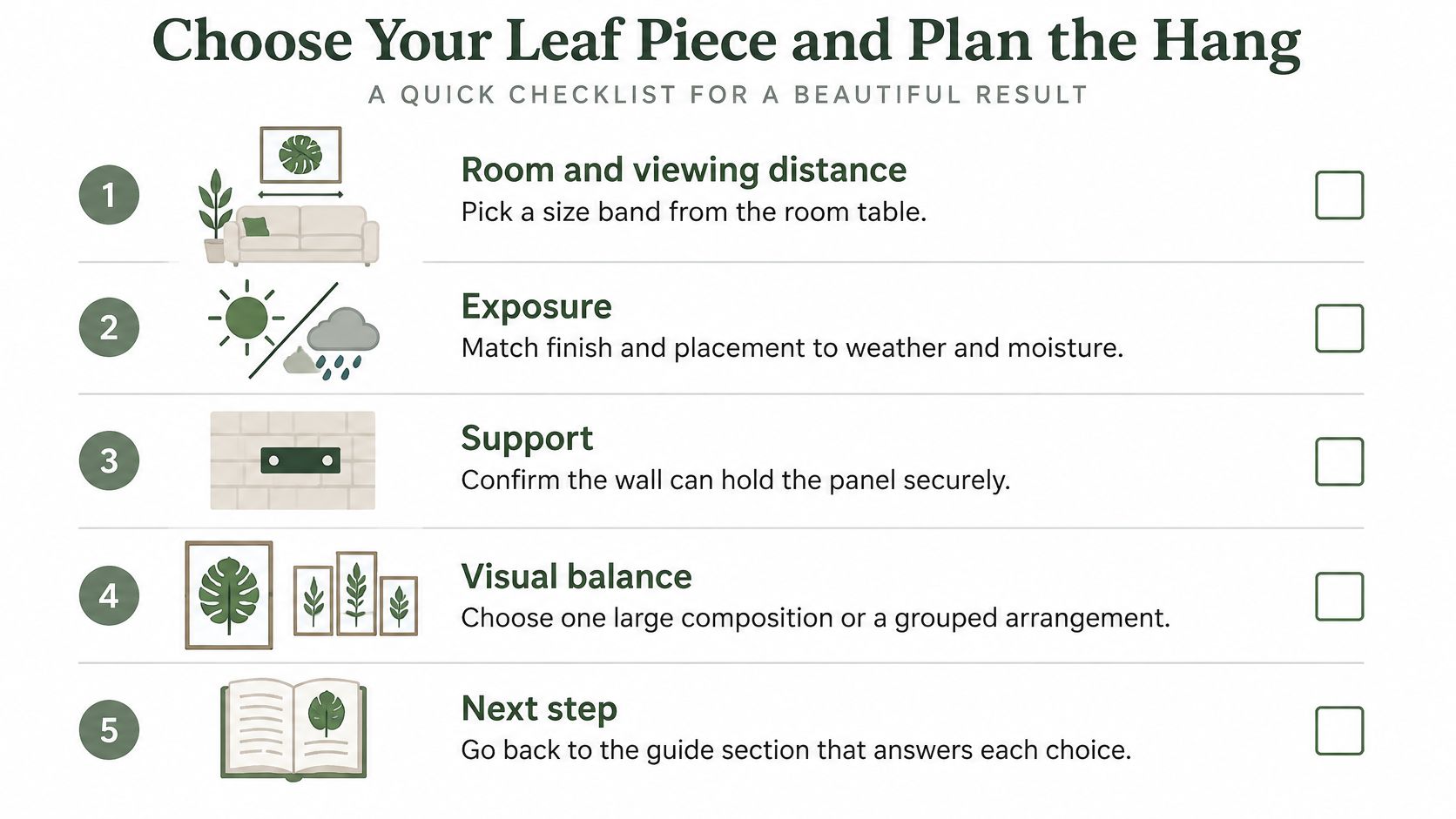
Use a short buying checklist to turn an attractive photograph into a realistic plan:
- Room and viewing distance: Check the outline from the doorway, the nearest chair, and the usual walking route. Include projecting tips, not just the central stem.
- Exposure: Decide whether the location is dry, sheltered but occasionally damp, or fully exposed. Match the product specification to that condition.
- Finish: Choose between a subdued surface and a reflective accent, then decide whether changing patina suits your expectations.
- Wall and mounting: Confirm the substrate, available attachment points, and rear access before ordering. Include mounting hardware in the project budget.
- Maintenance tolerance: Choose a location you can reach safely for cleaning and inspection. An inaccessible garden wall makes even simple care inconvenient.
Turn the checklist into a decision
Say you're renting a home with a dry hallway and pale walls. A brushed aluminum branch may suit the narrow approach better than deep layered steel, provided its weight and attachment design work with an approved picture rail. Test its outline with paper before buying, then check the installed supports during your regular household inspections.
If you're comparing botanical metal with other decorative formats, Guynn Furniture & Mattress's selection of wall art for Southwestern Virginia homes offers useful context for considering artwork alongside furniture rather than in isolation.
Hand finishing can produce differences in color and texture, so judge those details separately from defects such as loose welds, sharp unfinished edges, or damaged coatings. Natural variation isn't a substitute for sound construction.
Write down the room, exposure, and wall type now. Then shortlist alternative outlines that fit the available space and mounting method before choosing the leaf pattern you like best.
Farmhouse World offers custom metal signs, rustic wall art, personalized gifts, and complementary home accents. Visit Farmhouse World to explore pieces for your farmhouse scheme, keeping your wall measurements, exposure conditions, and hanging plan beside you as you compare.


