

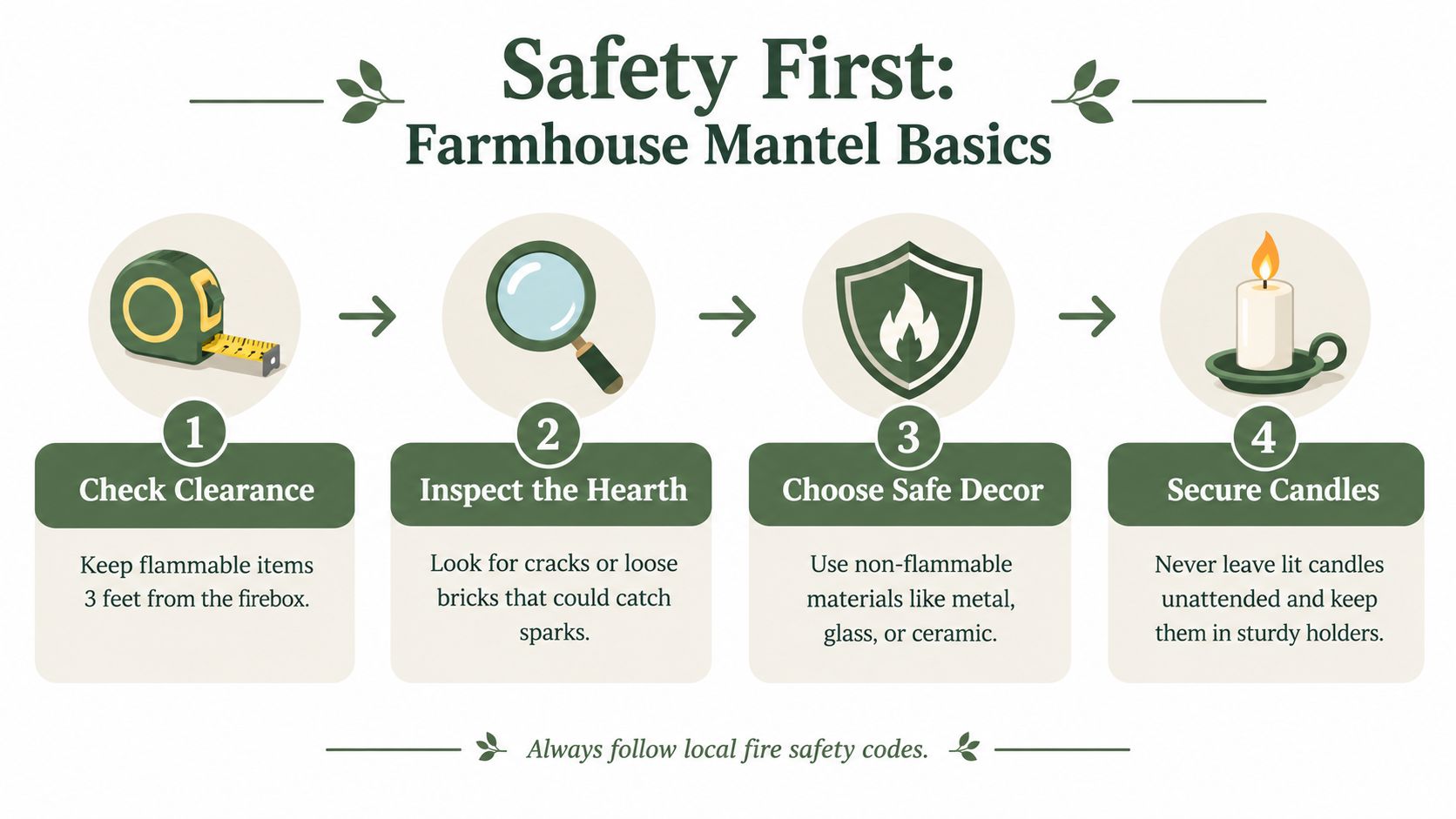
Keep all combustible décor at least 3 feet from the firebox opening, and never let stockings or ribbon hang in front of the opening while the fireplace is in use. From there, build farmhouse Christmas mantel decor around one substantial anchor, layered heights, and enough open space for the shelf to breathe.
You've probably reached the familiar stage of holiday decorating where the garland is draped, the stockings are nearby, and the mantel still looks either strangely empty or dangerously crowded. Farmhouse styling makes that tension more obvious because the look depends on natural greenery, textiles, wood, paper, and vintage finishes, all of which can become a fire concern when a working fireplace sits directly below a shallow shelf.
A successful arrangement isn't just a collection of rustic objects. It's a controlled composition that respects heat, shelf depth, scale, and the way the mantel connects to the rest of the room. The most inviting displays often combine old-fashioned materials with a slightly richer, more layered palette than the all-white farmhouse formula that dominated holiday decorating for years.
Table of Contents
- Setting the Foundation with Safety First
- Mastering Layering on Shallow Mantels
- Choosing Modern Color Palettes for 2026
- Creating a Cohesive Room Scheme
- Personalizing with Signs and Stockings
- Sourcing Decor on a Budget
- Final Touches for a Flawless Finish
Setting the Foundation with Safety First
A client once had a beautiful mantel ready for its final photo. The greenery was full, the linen stockings were neatly spaced, and a red ribbon tied the arrangement together. Then we checked the distance from the garland to the firebox. The display looked finished, but the placement had to change before anyone lit the fireplace.
That adjustment wasn't cosmetic. Garland, ribbon, stockings, paper accents, and other combustible décor must remain at least 3 feet from the firebox opening, and stockings or ribbon should never hang in front of the opening while the fireplace is operating, as outlined in this holiday mantel safety guidance. If your shelf sits close to the opening, a traditional draped garland may be the wrong choice.
Adapt the display to the fireplace
A decorative false front gives you much more freedom, but it still deserves stable placement. A working gas, wood-burning, or electric fireplace needs a different plan. Measure from the firebox opening to the lowest point of every decorative element, not just to the shelf edge. A branch that hangs lower at one end can create a clearance problem even when the center appears safe.
Use indoor-rated lights only, and inspect the insulation for cracks or worn areas before putting them into the greenery. For candles, choose sturdy holders and keep flames attended. The safest farmhouse alternatives include metal lanterns with unlit LED candles, ceramic trees, glass hurricane vessels, and nonflammable sculptural objects.
Practical rule: Style the mantel for the fireplace you actually use, not the one shown in an inspiration photograph.
If you want a candle-focused farmhouse mood, combine stable holders with a clear area around the flame, and review these farmhouse candle styling ideas. Renters and households with limited clearance can shift the focal point upward, use a wall-mounted sign, or place a lightweight seasonal arrangement on a nearby console instead of forcing décor onto the shelf.
Mastering Layering on Shallow Mantels
Most mantels are only 6 to 8 inches deep, which changes the decorating strategy completely. You can't treat the shelf like a deep console table. A row of unrelated objects pushed against the back edge will look flat, while a dense arrangement can make the room feel cramped and leave no safe or practical space for everyday use, according to this shallow mantel styling guide.
Start by measuring the mantel width, shelf depth, and firebox height. Then photograph the empty mantel from the main seating position. That view reveals whether your planned focal piece is too small, too low, or visually lost against the wall.
Build the arrangement in layers
- Place the anchor first. Choose a large sign, framed artwork, vintage window, tobacco basket, or oversized wreath. A focal piece spanning roughly 50% to 70% of the mantel width usually gives the arrangement enough presence without swallowing the shelf, as the same holiday styling guidance recommends. Set it centered for a calm, symmetrical look, or slightly offset if the surrounding objects can counterbalance it.
- Add tall support pieces. Place a lantern, narrow crock, ceramic tree, or vase with bare branches near one or both ends. The tallest pieces shouldn't form a rigid pair unless the room already has a formal character. Slight variation makes the display feel collected rather than assembled from a boxed set.
- Tuck mid-height objects in front. Use a small metal house, bottle brush tree, candleholder, or shallow bowl to overlap the base of the anchor. That overlap creates depth on a narrow shelf without requiring more furniture.
- Finish with low accents. Pinecones, small ornaments, a short strand of beads, or a folded textile can fill a visual gap. They should support the composition, not occupy every remaining inch.
Odd-number groupings generally look more relaxed than evenly matched rows. Keep roughly 2 to 3 inches of space between objects where the arrangement needs visual separation, and aim for a soft triangle or gentle wave of heights instead of a straight horizontal line.
Use shallow accessories deliberately
A metal decorative tray can corral small ornaments and candles without spreading them across the shelf. Choose a low-profile shape, then use it as one visual unit rather than treating every object inside it as a separate focal point. This guide to metal decorative trays is useful when you need rustic texture with controlled depth.
Step back after every major addition. If you can't see the anchor, the garland is covering too much of the shelf, or the objects all sit at the same height, remove something before adding more.
Choosing Modern Color Palettes for 2026
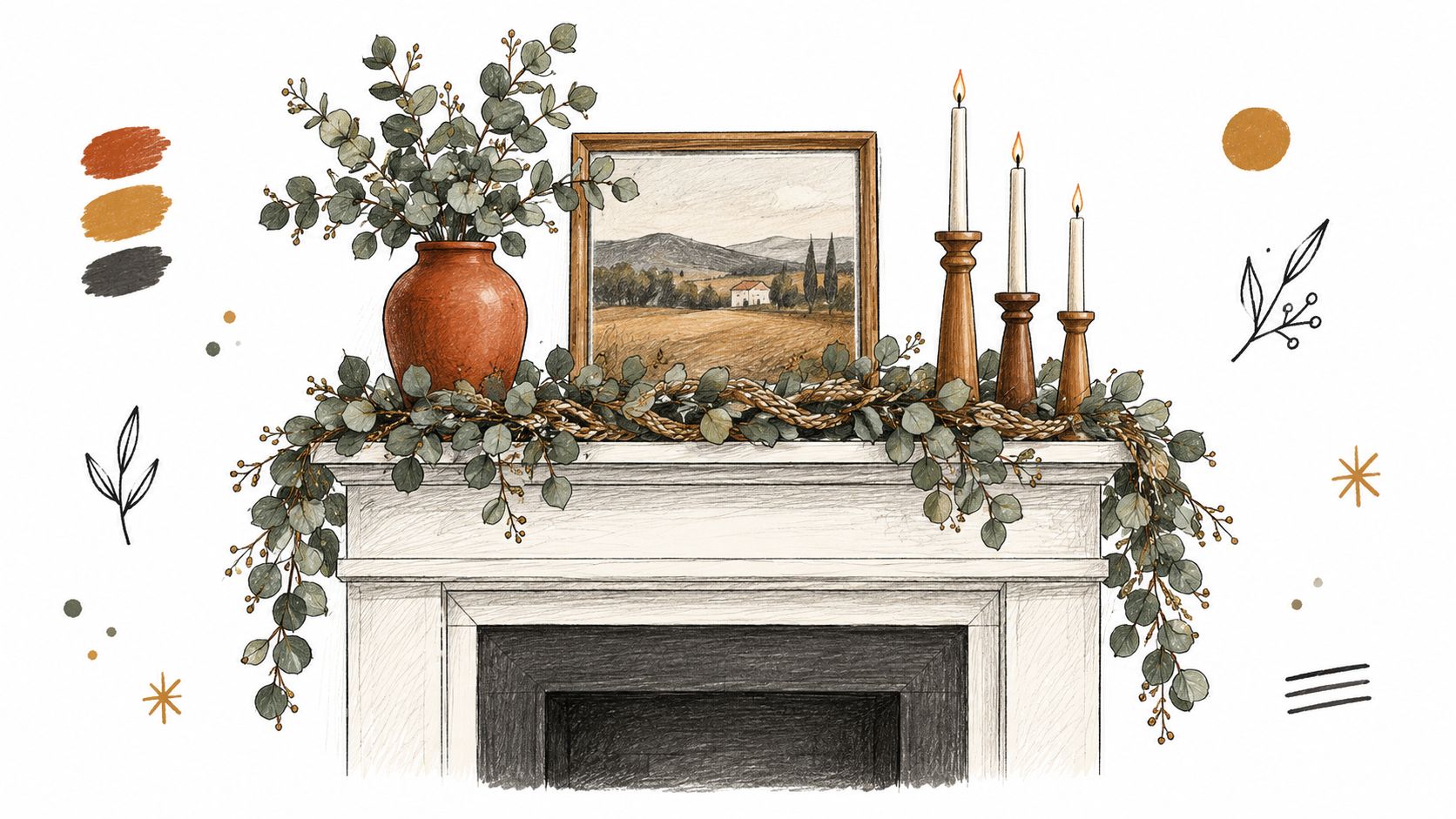
The farmhouse Christmas mantel is moving beyond a strict white, beige, and pale-green formula. 2026 holiday trend coverage points toward earthy tones, metallic accents, heritage nostalgia, bows, retro motifs, and deeper traditional colors, while still preserving tactile natural materials and an informal country sensibility. The forecast also identifies a 5,900% year-over-year rise for “Ralph Lauren Christmas” searches and a 210% rise for “Neo Deco” searches, so the direction is clearly broader than neutral rustic styling. These figures come from the 2026 holiday trends outlook.
Add richness without losing the farmhouse identity
The trick is to change the accent color, not the material language. Burgundy ribbon works with linen, aged wood, and galvanized metal. Moss green deepens fresh greenery without making the display feel formal. Brass adds warmth beside a whitewashed frame, while black iron keeps the palette grounded.
Use one dominant base, one supporting natural shade, and one metallic or saturated accent. For example:
| Base | Supporting tone | Accent |
|---|---|---|
| Warm ivory | Moss green | Aged brass |
| Weathered wood | Cream and evergreen | Burgundy |
| Soft gray | Natural linen | Black iron |
Avoid distributing every color evenly. A burgundy bow at the center, repeated in a nearby ornament or textile, often looks more intentional than burgundy objects scattered across the entire shelf. The same principle applies to brass. A pair of brass candleholders may feel collected, while brass on every frame, ornament, and tray can pull the look away from relaxed farmhouse style.
For a useful comparison between rustic foundations and more transitional combinations, consult the Willis Furniture & Mattress style guide. It can help you decide whether your room wants a weathered country palette or a cleaner farmhouse-transitional interpretation.
A richer palette also supports layered maximalism, but maximalism doesn't mean filling every surface. Let the garland, anchor piece, and one strong color carry the visual weight. The smaller elements should echo those choices rather than compete with them.
Creating a Cohesive Room Scheme
A mantel looks unfinished when it's the only decorated area in the room. It may be attractive on its own, but the eye travels from the fireplace to the sofa, rug, tree, windows, and dining area. Repeating a few materials across those zones makes the holiday scheme feel deliberate without requiring identical decorations.
Start with the room's existing foundation. If the sofa has a warm oatmeal throw, carry that softness to the mantel with linen stockings or a woven ribbon. If the coffee table has black iron legs, repeat the finish in a lantern or candleholder. A weathered wood frame can connect the fireplace to a reclaimed table, picture frame, or nearby cabinet.
Repeat details, not entire arrangements
Choose two or three elements to carry through the room:
- Wood tone: Echo a light, weathered, or dark finish in frames, trays, stools, or ornaments.
- Metal finish: Repeat black iron, brass, or galvanized metal in small accents rather than mixing every finish at once.
- Textile pattern: Use one plaid, ticking stripe, or woven texture on stockings, pillows, a runner, or wrapped gifts.
- Greenery shape: Keep the same loose, natural character in the mantel garland, tree branches, and table arrangement.
A room doesn't need matching sets. In fact, identical garlands on every surface can make a farmhouse interior feel staged. Coordinated variation works better. The mantel might use moss, brass, and linen, while the dining table repeats brass and linen with a smaller amount of greenery.
For an apartment or a room without a fireplace, create a visual mantel on a narrow console, buffet, or wall shelf. Use the same anchor-and-layer logic, but choose lightweight pieces and avoid deep objects that obstruct circulation. In a rental, removable mounting methods and freestanding signs make it easier to change the display without leaving permanent marks.
Personalizing with Signs and Stockings
Personalization works best when it has a clear place in the composition. A family name sign, address plaque, or simple seasonal message should act as the anchor or a supporting layer, not become one more small object competing with the garland.
Place a wide sign high enough to read from across the room, then keep the shelf beneath it quieter. If the sign is narrow, pair it with a tall vase or lantern on one side and a lower cluster on the other. Metal signs bring farmhouse character through their surface and lettering, while wood signs soften the display. Choose one primary sign material so the arrangement doesn't start to look like a craft market booth.

Hang stockings without damaging the wall
Stockings need both secure support and safe positioning. A stocking holder can work on a substantial shelf, but check that its base doesn't slide when the fabric is filled. For renters, removable adhesive hooks or command-strip-style hangers can reduce wall impact, provided the wall surface is clean, dry, and suitable for the product.
Keep the hooks aligned, but don't force the stockings into a perfectly rigid row. A slight variation in height can look more natural, especially when the garland already has an organic shape. If the mantel has limited width, hang stockings from a nearby ladder, stair rail, or freestanding coat rack instead of squeezing them beside candles and greenery.
Keep meaningful pieces visually calm
Family stockings often contain more pattern and color than the rest of the mantel. Let them provide that personality. Use quiet supporting pieces above them, such as a simple garland, a neutral sign, or one ceramic tree.
For additional sign inspiration, browse these farmhouse sign ideas, then edit ruthlessly. A sign with a name, date, or short phrase has more impact when it can be read clearly. Farmhouse World offers personalized metal signs and rustic wall décor that can serve as a mantel anchor or move to another room after the holidays.
Never allow stockings or ribbon to hang across the firebox opening while the fireplace is lit. If the stockings can't remain safely to the side, relocate them for fireplace use and return them when the fire is out and the area has cooled.
Sourcing Decor on a Budget
The expensive piece in a farmhouse mantel is usually the anchor, not the filler. Spend carefully on the object that controls the composition, then save on texture and small accents that can be replaced, gathered, or reused.
A simple decision framework helps:
| If you need... | Choose... | Avoid... |
|---|---|---|
| Immediate visual impact | A large framed sign, wreath, or basket | Several undersized wall pieces |
| Natural texture | Pinecones, branches, dried materials, or a reused dough bowl | Buying every accent as a matching set |
| Warm evening atmosphere | Indoor-rated light strands or LED candles | Damaged cords or unstable open flames |
| Reusable flexibility | Neutral trays, lanterns, and removable signs | Highly seasonal pieces with no second use |
Thrift stores and antique markets are particularly useful for weathered frames, crocks, brass vessels, and wooden containers. Natural branches and pinecones can provide the rustic texture that expensive artificial stems often try to imitate, though anything gathered outdoors should be clean, dry, and kept away from heat.
For practical holiday sourcing ideas and affordable decorating alternatives, use Joey'z Shopping's budget-friendly Christmas decor guide. The strongest budget displays usually mix one memorable vintage or personalized item with restrained supporting layers, rather than spreading a small budget across too many unrelated decorations.
Final Touches for a Flawless Finish
A mantel can look balanced from the front and awkward from the sofa. Before calling it finished, view it from the room's main seating position, from the doorway, and from the side. Those angles reveal low-hanging greenery, crowded corners, visible cords, and objects that disappear behind the anchor.
A client's display once needed only three edits. We raised the sign, removed one small tree that had no visual role, and shifted the lantern outward to open the center. The mantel immediately looked more intentional because the composition had room to breathe.
Run the final inspection
- Check scale: Make sure the anchor has enough presence and the small accents aren't doing the work of a major focal piece.
- Check the rhythm: Look for a soft triangle or wave of tall, medium, and low objects rather than a flat row.
- Check the depth: Pull selected objects slightly forward, but don't let the shallow shelf become a pile.
- Check the heat zone: Confirm that combustible materials remain outside the required clearance and that nothing hangs across the opening.
- Check the light: Hide cords, use indoor-rated lights, and remove or secure candles, greenery, and stockings whenever the fireplace is lit.
Overfilling is the most common finishing mistake. Remove one item, then reassess. If the arrangement still feels complete, you've improved it.
For additional guidance on using candles as seasonal accents, review these candle decorating tips for Christmas. A farmhouse Christmas mantel should feel warm and personal, but it also needs to remain functional throughout the season. The best display survives everyday life because it was designed around the fireplace, not placed on top of it as an afterthought.
Farmhouse World offers personalized metal signs, rustic wall décor, candles, holders, garlands, ornaments, and other farmhouse accents that can help you build a coordinated mantel without losing its personal character. Visit Farmhouse World to find a meaningful anchor piece or a reusable detail for your Christmas display.


