

You've found the right wreath, saved the perfect porch photo, and bought a few rustic accents. Then the wind arrives, the garland droops, the wooden sign stains, and the doorway feels too crowded for everyday use. Farmhouse Christmas porch decor works best when beauty comes after planning, not instead of it.
A successful winter porch should welcome guests, survive real weather, leave room for the door to swing freely, and give you pieces worth storing for another season. The ideas below focus on the decisions that make a display last, from layout and materials to lighting, anchoring, and sensible spending.
Table of Contents
- Why Farmhouse Christmas Porch Style Works So Well
- Planning Your Porch Layout for Any Size Space
- Choosing Weatherproof Farmhouse Materials That Last
- Creating Focal Points With Wreaths Garlands and Signs
- Lighting and Anchoring for Safe Winter Displays
- Budget Smart Tips to Reuse and Refresh Your Porch
Why Farmhouse Christmas Porch Style Works So Well
The farmhouse porch has a natural advantage at Christmas. It already provides the elements that make seasonal decorating feel warm: wood tones, simple lines, practical seating, and a clear transition between the outdoors and the home. Add greenery, lantern light, and one personal detail, and the entrance can feel festive without looking like a retail display.
The category has strong residential roots. The Christmas decorative products market was valued at USD 12.68 billion in 2025 and is projected to reach USD 19.36 billion by 2033, with a projected 5.5% CAGR from 2026 to 2033, according to Grand View Research's Christmas decorative products market report. The same source reports that residential decorating represented 67.6% of demand and North America held 37.7% of regional revenue in 2025. A porch sits directly in that residential decorating budget, but it also performs a public-facing job by shaping the first impression of the home.
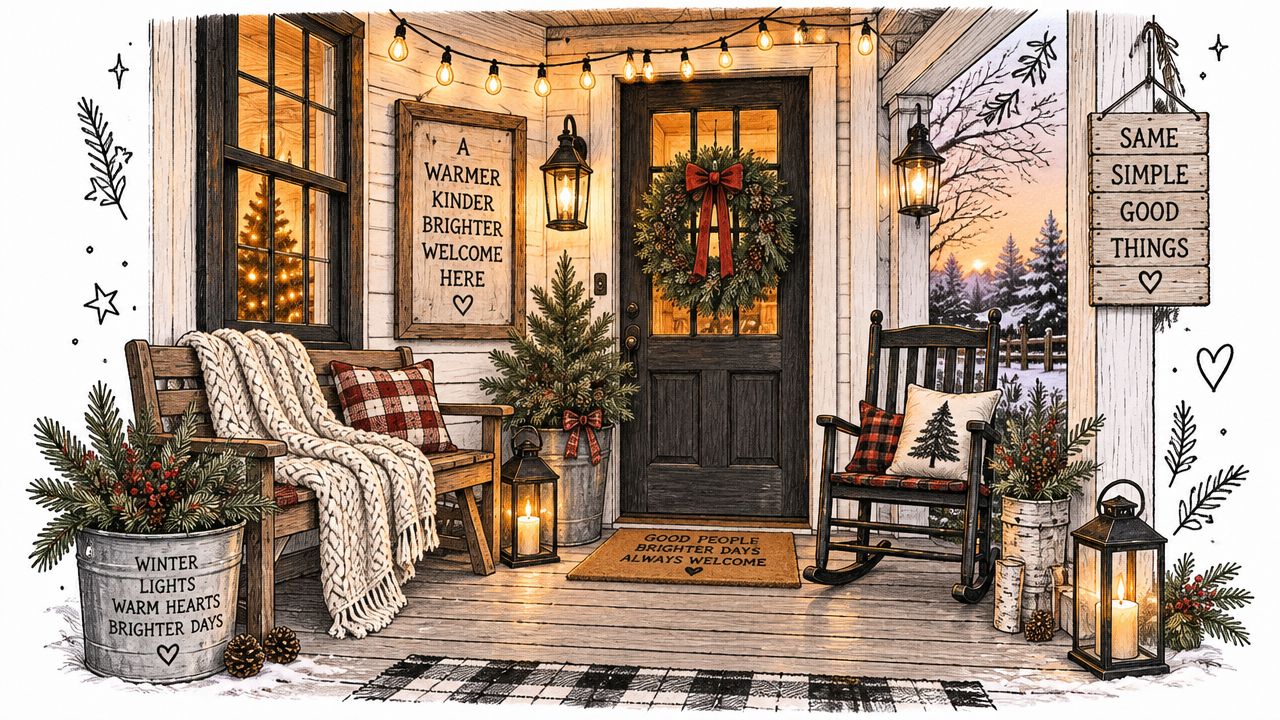
The look depends on restraint
Farmhouse style becomes muddled when every available surface receives an ornament. A better arrangement uses a few recognizable layers:
- Natural foundation: Evergreen branches, cedar tones, pinecones, and unfinished-looking textures establish the seasonal base.
- Functional structure: Rocking chairs, a bench, lanterns, or a planter make the porch feel lived in rather than staged.
- Personal anchor: A family-name sign, address plaque, or welcoming message gives the display a reason to belong to your home.
A separate industry forecast places the global Christmas decoration market at USD 6.20 billion in 2025, with a projection of USD 8.60 billion by 2035. It also reports that 78% of U.S. households decorate for the holidays and 54% buy new items annually, according to Global Growth Insights. Those figures help explain why reusable porch pieces matter. Your display shouldn't depend on buying a completely new theme each year.
Practical rule: Build the porch around durable anchors, then refresh the smaller accents. That keeps the welcome warm without making the setup disposable.
Planning Your Porch Layout for Any Size Space
Start with the porch you have, not the wraparound porch in an inspiration gallery. Measure the usable depth and width, note where the door opens, and identify anything that can't move, such as railings, steps, light fixtures, or a hose connection. Mark the walking route from the steps to the threshold before you shop.
A simple zoning method works across a small stoop, narrow balcony, or broad farmhouse porch:
- Overhead zone: Use the door header, porch ceiling, railing, or upper wall for garland, hanging baskets, and light strings. This draws the eye upward without consuming floor space.
- Eye-level zone: Reserve this area for the wreath, wall sign, window greenery, or a seasonal plaque. These pieces should be visible from the street and readable at the approach.
- Ground zone: Place planters, lanterns, baskets, a slim bench, or a low arrangement near the sides of the entry. Keep the center route open.
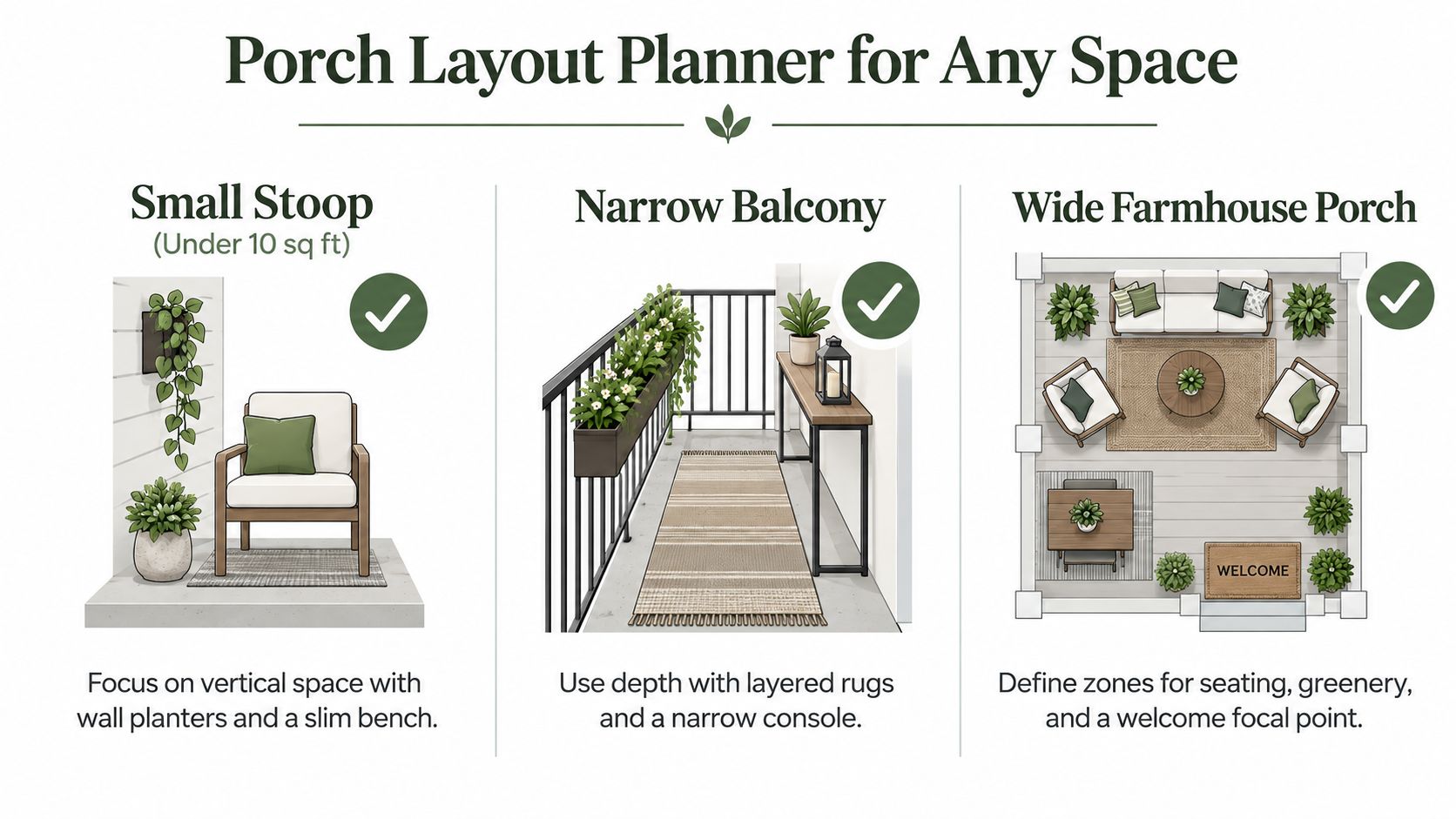
Match the arrangement to the footprint
A small stoop usually needs one vertical feature and one grounded feature. Try a wreath on the door with a narrow planter or lantern beside it. A narrow balcony benefits from a linear arrangement, such as a slim planter, railing greenery, and a compact welcome board. Don't force two large chairs into a space that only supports a clear entry and one accent.
A wide porch can hold distinct areas for seating, greenery, and a focal point. Keep the visual weight balanced, but don't assume perfect symmetry is necessary. Two matching lanterns can frame a door beautifully, while an asymmetrical grouping of a chair, tree, and sign often feels more relaxed and collected.
Before buying, sketch the arrangement and answer these questions:
- What must remain clear: Can the door, steps, and walkway operate normally?
- What will be seen first: Is the wreath, sign, or lighting the strongest feature from the street?
- What needs support: Does each tall object have a wall, railing, planter, or solid base nearby?
- What can be reused: Will the lantern, sign, rug, or greenery work beyond Christmas?
- What belongs indoors: Is the material suited to the porch's exposure, or is it only visually rustic?
For larger displays, planning the relationships between several focal points helps prevent a random collection of objects. These multi-feature holiday display tips are useful when greenery, lighting, signs, and ornaments need to share one coordinated view. You can also find broader entryway placement inspiration in these entrance decorating ideas.
Choosing Weatherproof Farmhouse Materials That Last
Rustic appearance and outdoor durability aren't the same thing. Unfinished wood, burlap, paper signs, and natural wicker may look right in a photograph, but rain, damp snow, strong sun, and repeated temperature changes can quickly alter their shape and finish. The practical choice is often a durable material designed to imitate a rustic texture, or a delicate piece used only in a protected location.
| Material | What works | What requires care |
|---|---|---|
| Cedar wood | Naturally rot-resistant and able to age to a silver patina | Seal cut edges and inspect for splitting |
| Treated pine | Cost-effective for signs, crates, and risers | Requires periodic sealing and should not sit in standing water |
| Galvanized metal | Strong choice for planters and accents | Scratches and exposed edges can develop rust |
| Resin wicker | Lightweight and more tolerant of moisture | Low-quality pieces can become brittle or fade |
| Burlap and unfinished fabric | Delivers authentic farmhouse texture | Best under cover, since moisture can leave stains and encourage deterioration |
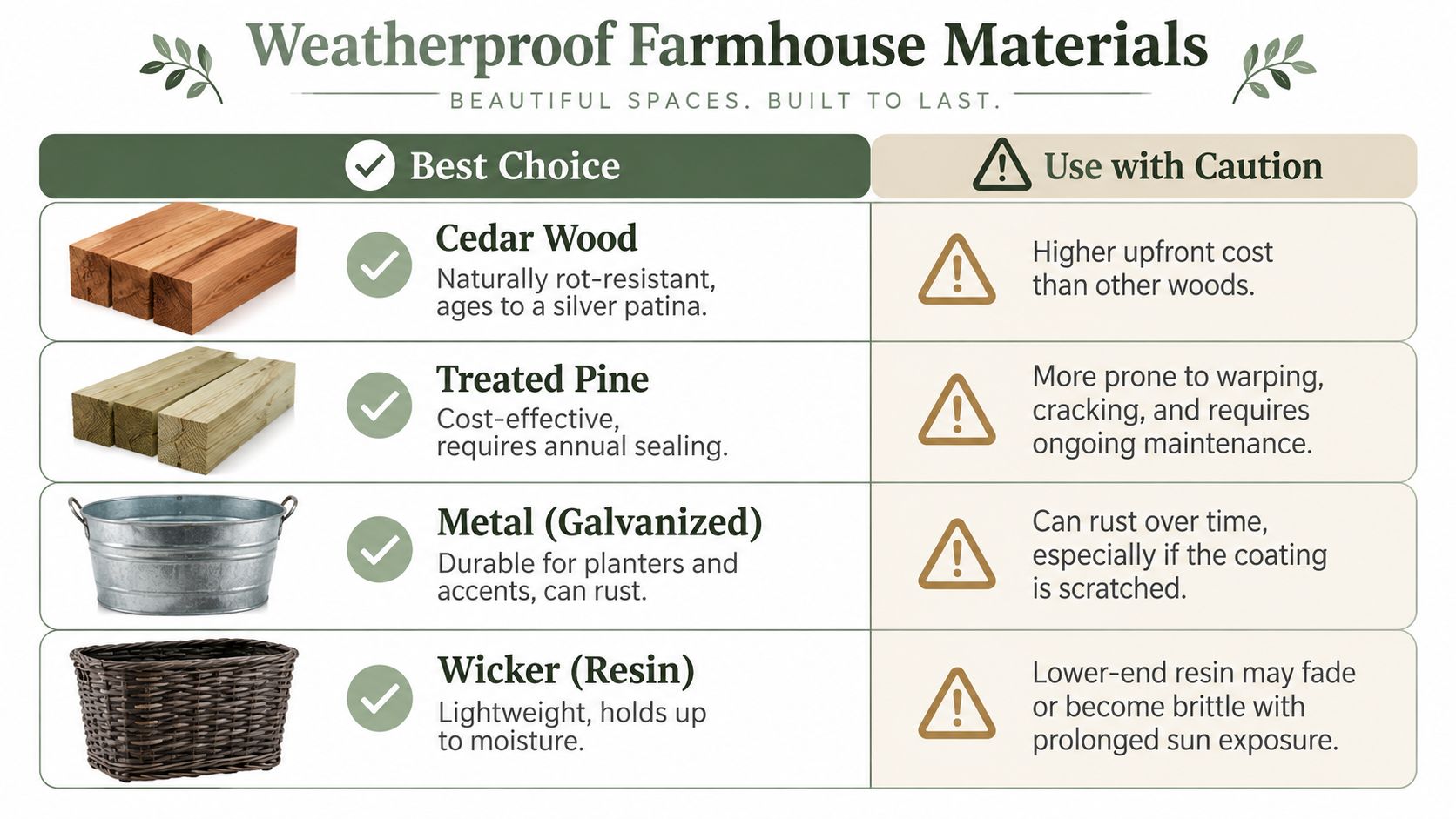
Read the label, then inspect the finish
Choose greenery labeled for outdoor use rather than assuming every faux pine branch is weather-ready. For signs and wall art, look for a sealed surface, protected edges, and hardware that won't immediately stain the siding. Powder-coated metal generally offers a more dependable finish than thin painted metal, but any coating can fail if a screw, hook, or impact exposes bare metal.
A personalized metal sign can provide the farmhouse character of a wooden board while reducing the maintenance associated with raw timber. If you choose metal, use the guidance in how to protect metal from rust before placing the piece in a wet or salt-exposed location.
Material test: If you wouldn't leave the item outside during a wet week without protection, don't treat it as permanent outdoor decor.
Fabric deserves the same scrutiny. Outdoor pillows and rugs should have weather-resistant covers, but even those pieces last longer when brought inside during prolonged rain or stored dry after the holidays. Keep baskets, burlap wraps, and unsealed wood beneath a roof overhang, and raise them from concrete so they aren't absorbing water from below.
Reversible pieces can earn more of their storage space. A two-sided porch board, neutral lantern, or plain evergreen garland can move from Christmas into other seasonal arrangements with a change of ribbon or sign. That makes the display feel refreshed without requiring a new collection every winter.
Creating Focal Points With Wreaths Garlands and Signs
Build the entry around one focal point first. On most porches, the front door is the logical starting place, and the wreath should be large enough to read from the approach without covering the hardware, peephole, or house number.
Hang the wreath securely, then add greenery only where it strengthens the door's shape. A garland over the frame can create a soft arch, while short side pieces give a narrow door more presence without pushing into the walking route.

Use height to make small groupings feel complete
A balanced cluster usually needs a tall element, a middle element, and something low. For example, place a tall lantern or narrow evergreen tree beside the door, use the wreath or sign at eye level, and finish with a low planter, basket, or wrapped log bundle.
For a compact entry, choose either a wreath plus a sign or a wreath plus a lantern. Adding all three can work, but only if each object has a separate position and the door remains visually dominant. On a broader porch, flank the doorway with low planters or lanterns and place a personalized sign on the adjacent wall or porch post.
Sign scale should follow the viewing distance and available wall space. A smaller sign can sit beside a door or beneath a window, while a larger format can anchor a blank wall or wide porch bay. Farmhouse World offers personalized metal signs in commonly used sizes from 12 to 36 inches, with color options including Black, Copper, Gold, Silver, White, Red, and Green. A personalized outdoor metal wall art piece can serve as the permanent name or welcome element while seasonal greenery changes around it.
Keep the palette controlled
Start with a neutral base of black, white, natural wood, galvanized metal, and evergreen. Add one strong seasonal accent, such as muted red, copper, or a restrained tartan ribbon. Too many competing patterns make the porch look busy, especially when the architecture already includes railings, siding, or brick.
A simple grouping might use a green wreath, black lanterns, a white or metal sign, and a red berry accent. The materials provide texture, while the limited color palette keeps the composition cohesive.
Lighting and Anchoring for Safe Winter Displays
Treat every decorated porch as a wet-location system, not as an indoor room with a few lights added. Electrical products, cords, plugs, and connections all need to match outdoor exposure, and the arrangement must prevent water from collecting around junctions.
Use the following installation sequence:
- Confirm the rating: Check the packaging for an outdoor designation. UK safety guidance commonly calls for at least IP44 for general outdoor lights and IP65 near ground-level puddling risk, as summarized in the UL holiday decorating safety guidance.
- Inspect before installation: Replace products with cracked insulation, exposed wire, damaged sockets, or loose plugs.
- Use outdoor-rated extension cords: Indoor cords aren't a substitute for weather-rated equipment.
- Connect through protection: Use GFCI or RCD protection, and test the device before seasonal use.
- Raise connections: Keep junctions off the ground and point them downward so water sheds away rather than pooling inside.
- Switch off during severe weather: Rain and storms can exceed the intended exposure conditions, even when a product is labeled for outdoor use.
Secure the display against movement
Fasten light strings to solid supports with insulated staples or hooks. Don't use metal tacks, which can damage insulation and create a conductive path. Route cables away from walkways, door thresholds, sharp metal edges, and places where a chair or planter could pinch them.
Anchoring matters just as much for non-electrical decor. Choose heavy planters with a low center of gravity, add weight inside hollow bases where appropriate, and secure tall trees, signs, and large wreaths to solid supports. Neutral safety guidance from the Texas Department of Insurance holiday lighting safety document emphasizes fastening displays to solid supports, managing cables carefully, and turning decorations off when conditions become unsafe.
For a practical installation review, South Mountain Christmas light tips can help you check placement, connections, and setup habits before the display goes live. Keep lighting on a timer or switch rather than leaving it continuously illuminated, and follow the manufacturer's limits for connected strings and bulb wattages.
Budget Smart Tips to Reuse and Refresh Your Porch
Cost-conscious decorating starts with prioritization, not with the cheapest version of every item. A 2025 KPMG consumer pulse survey found that 57% of U.S. consumers noticed higher holiday decoration prices, while Home Accents Today reported that 40% planned to buy outdoor decor such as porch boards, wind chimes, garden flags, and outdoor pillows in the next twelve months, as summarized by Decorators Warehouse's holiday decor trends coverage. That combination makes reusable outdoor pieces especially practical.
Spend first on items that carry the whole composition:
- Permanent anchor: A personalized metal sign or durable house marker gives the porch identity across multiple seasons.
- Reliable structure: Quality lanterns, a sturdy planter, or a low bench can support different themes without replacement.
- Long-use greenery: Outdoor-rated garland and a well-made wreath create volume while smaller accents change around them.
- Rotating details: Ribbon, berries, pillow covers, small ornaments, and seasonal flags can provide the yearly refresh at a lower commitment.
A reversible porch board can serve more than one holiday or season, while battery-operated lighting can simplify a small display where permanent wiring isn't practical. Choose the option based on exposure, maintenance, and storage rather than appearance alone. High visual impact with low maintenance is usually worth more than a delicate bargain piece that needs frequent replacement.
Store each category separately after the season. Dry greenery and fabric completely before packing, wrap metal so it doesn't scrape against other pieces, and keep signs away from damp garages or unheated areas where condensation can affect finishes. Labeling the box by porch zone also makes next year's setup faster and reduces accidental overbuying.
Farmhouse World is one option for sourcing personalized metal signs, rustic wall accents, ornaments, and coordinating farmhouse pieces in different sizes and colors. Visit Farmhouse World to choose a durable focal sign, pair it with reusable porch accents, and build a Christmas display that can welcome guests for many winters.


