

You know the moment. The tree is up, the pillows are swapped, maybe the garland is draped, and one wall still looks blank and unfinished. The room says “December,” but that wall says “I forgot.” That's usually the spot where Christmas tree wall art earns its keep.
When the right piece goes up, the whole room settles down. An entry console suddenly looks styled. A mantel stops feeling top-heavy. A narrow hallway gets a holiday touch without needing floor space. When the wrong piece goes up, though, it's obvious fast. It feels generic, too tiny, hung too high, or finished in a tone that argues with every other wood and metal finish already in the room.
I'm opinionated about this because shoppers often work backward. They start with a cute product photo, then try to force it onto whatever wall is available. That's why so much Christmas tree wall art ends up looking like an afterthought. The wall should decide first. The shopping comes second.
Table of Contents
- The Moment Your Wall Goes Holiday-Ready
- Styles of Christmas Tree Wall Art Worth Knowing
- Materials and Finishes Compared Side by Side
- Sizing and Hanging the Piece on the Right Wall
- Personalized Signs or a DIY Project
- Care Storage and Gifting Beyond December
- A Quick Pre-Purchase Checklist and Where to Look
The Moment Your Wall Goes Holiday-Ready
I've seen this happen over and over in real homes. A friend hangs a slim tree-shaped sign over a narrow entry bench, and the whole entrance finally feels intentional. Someone else puts a wide canvas above the mantel because the listing photo looked good, but the proportions are off and now the mantel looks squat. Same category of decor. Totally different result.
That's why I want you to think about placement before product. The wall's width, the ceiling height, the light in the room, the furniture below it, and the finishes nearby all matter more than the tree graphic itself. If the layout is wrong, even beautiful art looks misplaced.
Three mistakes I see constantly
- Wrong style for the room: A distressed rustic sign in a clean apartment usually looks forced. A spare line-drawn tree disappears in a heavily layered farmhouse room.
- Wrong size and height: This is the big one. Most holiday wall pieces are bought too small, then hung too high to compensate.
- Wrong finish: Warm oak, whitewashed wood, matte black metal, bright silver, printed canvas. These don't all belong in the same room just because they're “Christmas.”
A lot of homeowners would benefit from the same discipline designers use on feature walls. If you want a quick refresher on proportion and placement, these Colorado Art Services design tips are useful because they focus on how artwork relates to the wall, not just the artwork itself.
I'd also look at other seasonal decorating ideas if your room still needs support around the art. This roundup of country-style Christmas decorating ideas is a good example of how wall art works better when the rest of the room isn't fighting it.
Practical rule: If your wall art doesn't make the room feel calmer the second it goes up, it's probably the wrong piece or the wrong placement.
Christmas tree imagery has staying power for a reason. The first written record of a decorated Christmas tree dates to 1510 in Riga, Latvia, and the tradition spread to the United States in the 1800s with German settlers, according to the National Christmas Tree Association's history of Christmas trees. That long history is exactly why tree imagery works so well on walls. It reads instantly as Christmas, but it's flexible enough to fit farmhouse, modern, rustic, and minimalist homes.
Styles of Christmas Tree Wall Art Worth Knowing
If you can identify your room's style family, you'll stop wasting time on wall art that was never going to work in your space.
Farmhouse script signs
These are the classic pieces with a tree silhouette, seasonal wording, family name, or established date. They belong in entryways, living rooms, mudrooms, and above sideboards where you want warmth and personality.
They work because they feel lived-in. They're especially strong in homes with woven baskets, warm wood tones, old crocks, lanterns, and painted furniture. They don't work well in sleek rooms with low-profile furniture and very little visual texture. In those spaces, a script-heavy sign can look busy fast.
Minimalist tree art
This is the clean-lined option. Think simple tree outlines, neutral backgrounds, soft black or taupe linework, and very little text. If you live in an apartment, condo, or newer home with cleaner architecture, this is often the smartest route.
I especially like minimalist Christmas tree wall art for one-wall decorating. If your room only gets one holiday moment, a simple tree shape does the job without making the whole space feel overloaded.
A small space usually wants a simple shape, not a clever message.
Rustic wood pieces
These are the chunky wood-slat signs, buffalo-check accents, plaid bows, distressed finishes, and mixed-material pieces with galvanized or metal details. They can be charming in farmhouse kitchens, cabins, and lodge-style rooms.
They can also overpower a pale room in a heartbeat. If the wall is narrow, the furniture below it is delicate, or the room already has a lot of wood grain, a heavy rustic sign can make the whole area feel crowded.
Countdown and advent-style wall art
This category gets overlooked, but it's useful if you decorate for the full season and want the wall to do more than sit there. Pocket-card designs, numbered slats, or tree-shaped countdown boards work best in kitchens, breakfast nooks, and playrooms where people interact with them.
These pieces are less about elegance and more about rhythm. They bring energy to family spaces. I wouldn't put one over a formal mantel unless the room is already casual.
Novelty motifs that still work
Vintage trucks carrying trees, plaid scenes, and seasonal typography can all work, but only on the right wall. A vintage truck print feels at home in a casual den, kitchen, or back hallway. Seasonal typography fits best where people pass by quickly, like an entry or powder room wall. Plaid-heavy pieces need breathing room and a room that already has some rustic confidence.
Historically, Christmas decor has included both tree-centered decoration and wall-based ornamentation. The broader Christmas ornament history overview notes that 19th-century homes used mottoes and biblical quotations across walls alongside decorated trees, which helps explain why Christmas tree wall art feels natural rather than trendy.
My firm advice is simple. Don't mix more than two holiday wall-art styles in one room. If you already have rustic stockings, plaid ribbon, and weathered wood frames, don't add a sleek Scandinavian tree print and expect it to feel collected. It will feel confused.
Materials and Finishes Compared Side by Side
Material changes everything. Not just the look. The weight, the way it catches light, the hanging hardware you'll need, and whether it works indoors, outdoors, or both. I don't rank metal, canvas, and wood from best to worst because they solve different problems.
What each material does well
| Christmas Tree Wall Art: Material Comparison | Durability | Weight | Best Room | Watch Out For |
|---|---|---|---|---|
| Metal | Strong, seasonally reusable, better for indoor or outdoor exposure when properly finished | Light to moderate depending on base metal | Entryways, porches, modern farmhouse walls | Can read cold in soft rooms |
| Canvas | Good for sheltered indoor use | Light | Bedrooms, living rooms, apartments | Can fade in direct sun, can look flat if undersized |
| Solid wood | Sturdy and visually rich | Heavy | Mantels, dining rooms, farmhouse kitchens | Needs stronger hanging support and enough wall space around it |
Metal for crisp lines and longer reuse
Metal Christmas tree wall art has a sharper presence. It's clean, tidy, and often better than wood for outdoor or semi-exposed spaces. If you're using a porch wall, mudroom entry, or covered patio, metal is the practical choice.
For seasonal reuse, finish matters. Standardized corrosion testing is the benchmark here, and DuPont's technical guide reports that scribed Bonderite 1000 steel panels showed no undercutting, rusting, or blistering after 500 hours in 5% salt fog at 95°F and 100% RH in common salt-fog testing, which is why properly pretreated and powder-coated metal is worth prioritizing for decorative pieces intended to last (DuPont powder coating technical guide).
If you're shopping metal, ask two questions. Is the base metal steel or aluminum? And is the finish designed for exterior exposure if you plan to use it outside? Aluminum is lighter and naturally more corrosion-resistant, which makes hanging easier and rust less likely in humid climates.
Canvas for easy hanging and softer rooms
Canvas is the easiest material to live with. It's forgiving on imperfect walls, easy to move, and usually gentle enough for bedrooms, guest rooms, and softer farmhouse living spaces.
Its downside is presence. A flimsy canvas with weak framing can look temporary. That's why I only like canvas when the print is large enough and the room doesn't need the piece to provide texture all by itself. If you want more ideas in that direction, this guide to farmhouse canvas wall art is useful for seeing where canvas fits naturally.
Wood for true farmhouse rooms
Solid wood signs still win on character. Raised lettering, visible grain, hand-finished stain, and a little weight all help a piece feel permanent instead of seasonal.
But wood needs room. It looks best where it can breathe, not squeezed between shelves, sconces, and a clock. In a tight apartment, wood often feels too bulky unless the design is tall and narrow.
Match the finish to the house. Matte black belongs with matte black hardware. Warm stained wood belongs near other warm wood tones. Mixed finishes only work when they look deliberate.
If your room already has oil-rubbed bronze pulls, black iron lamps, or aged brass accents, use those as your cue. The right finish makes the art look native to the room. The wrong finish makes it look like December interrupted your decorating.
Sizing and Hanging the Piece on the Right Wall
They get it wrong. They find a nice piece first, then they negotiate with the wall. Reverse that. Measure the wall and the furniture below it before you shop. The wall gets the first vote.
Start with width, not whim
For most walls, your art should span roughly two-thirds to three-quarters of the width of the furniture or surface beneath it. That's the range that usually looks anchored instead of floaty.
A tiny tree sign over a wide mantel always looks apologetic. A giant plank sign over a skinny console looks cramped. Neither problem is about taste. It's about proportion.
Use these hanging rules
| Christmas Tree Wall Art Sizing and Hanging Guide by Wall Type | Art Width Rule | Hang Center Height |
|---|---|---|
| Open wall with no furniture below | About two-thirds to three-quarters of available wall width | 57 to 60 inches from the floor |
| Mantel wall | About two-thirds to three-quarters of mantel width | Bottom edge 4 to 6 inches above the mantel |
| Sofa wall | About two-thirds to three-quarters of sofa width | Bottom edge 6 to 10 inches above the sofa back |
| Entry console wall | About two-thirds to three-quarters of console width | Leave 8 to 12 inches between tabletop and frame |
Those numbers keep the piece connected to the furniture instead of floating in no-man's-land. If you only remember one thing from this whole article, remember that.
Narrow walls need a different strategy
Apartment dwellers and anyone working with a hall tree wall, skinny entry, or one sliver of blank drywall should stop trying to force wide horizontal signs where they don't belong. Use a vertical tree silhouette instead. It reads tall, festive, and intentional without choking the space.
In smaller homes, this matters even more because Christmas decor keeps getting more segmented by style. Trend coverage points to growing interest in minimalist, Scandinavian, natural, nostalgic, pink-pastel, and personalized holiday looks, and one market projection cited in that coverage expects the global Christmas decorative products market to grow from USD 12.68 billion in 2025 to USD 19.36 billion by 2033, with North America at 37.7% share (MerchOne trend report). More options are nice, but they also make it easier to buy something that fits your mood board and not your wall.
Don't ignore the anchor
The art itself isn't the full load. You have to count the frame, hardware, and any dimensional add-ons. According to independent drywall load guidance from Home Depot, plain screws in drywall alone are typically about 10 to 20 lb, plastic expansion anchors roughly 10 to 25 lb, threaded drywall anchors about 25 to 75 lb, molly bolts about 50 to 75 lb, and toggle anchors about 100 to 200 lb (drywall anchor load guide).
My rule is simple. Choose at least a 2x safety margin over the load. If a piece is heavy, use two hanging points to keep it from shifting all season. That matters more than people think, especially with wood signs and dimensional metal pieces.
Personalized Signs or a DIY Project
I'm firmly in favor of personalized Christmas tree wall art when the piece is going in a prominent spot. If it's over the mantel, in the entry, or on the main living room wall, generic usually looks forgettable. A family name, date, or phrase gives the piece a job beyond filling space.
Why personalized usually wins
A personalized sign comes back out every year with a little meaning attached to it. That's what makes it feel like part of the house instead of part of a shopping cycle. It also solves one of the most annoying decorating problems, which is finding a piece that's almost right but not quite the right wording, scale, or stain tone.
If you want a sign that fits your room, custom sizing and finish options help. Shops that focus on farmhouse decor, including options shown in collections like these farmhouse sign ideas, are often more useful than broad holiday marketplaces because they're built around the look people are trying to create.
DIY is only cheaper if you already own the setup
A lot of readers love to craft, and I respect that. If you already have the tools, a DIY project can be satisfying. If you don't, the supply list adds up quickly. Primer, paint, stain, brushes, transfer paper, vinyl, stencil material, sealer, hanging hardware, and the base sign itself can shrink the savings fast.
DIY makes sense when:
- You enjoy the process: The project is part of the holiday ritual.
- You need an odd size: Maybe your wall has a strange narrow span and nothing standard fits.
- You want total control: Font, phrase, paint color, distressing level, all of it.
Custom ordering makes more sense when:
- You want a cleaner finish: Especially for a main-room piece.
- You're giving it as a gift: Personalized wall art feels more substantial than a generic print.
- You don't want trial and error: A made-to-order sign removes a lot of guesswork.
I'd also say this plainly. If you want heirloom energy, don't fake it with a rushed DIY on cheap substrate. Either commit to making it well, or order a piece built to last. In the article body, one practical option in this category is Farmhouse World, which offers personalized metal signs and rustic wall-art-style decor in multiple sizes and finishes that can suit entryways, living spaces, and gift-giving.
Care Storage and Gifting Beyond December
Holiday decor earns its place when it stores well and comes back out looking just as good next year. That's especially true for Christmas tree wall art, because unlike a centerpiece or fresh greenery, a good wall piece should have real staying power.
Shoppers are also paying more attention to durability and reuse. Market research on the Christmas decoration category points to growing interest in eco-friendly, sustainable, reusable, and even tech-enhanced decor, which is one reason flat wall art often makes more sense than bulkier seasonal pieces if storage space matters (Christmas decoration market report).
Here's the simple care routine I recommend.
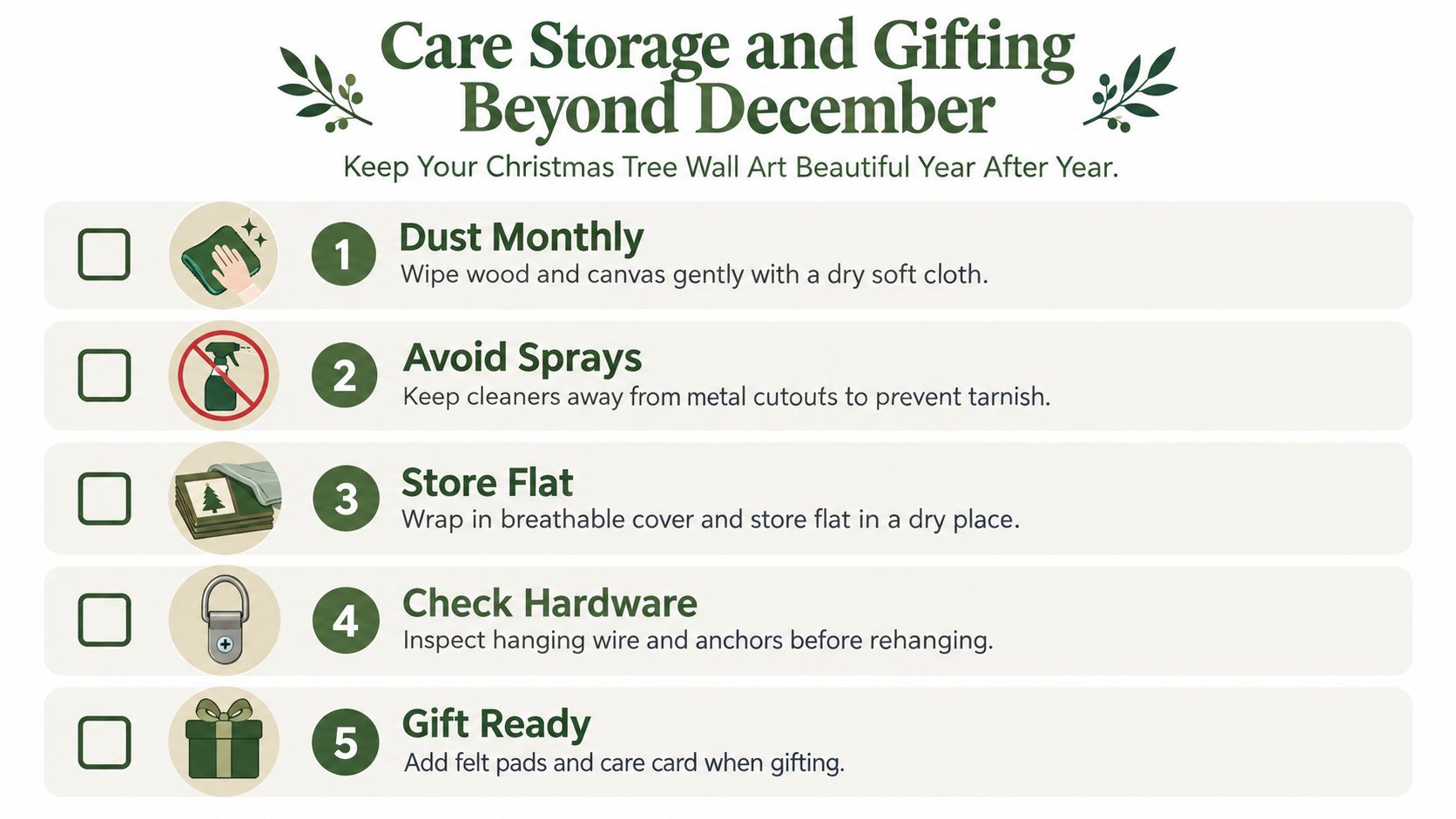
How to keep it in good shape
- Dust wood and canvas gently: Use a soft, dry cloth. Don't soak it and don't use heavy cleaners.
- Keep sprays away from metal cutouts: Cleaner residue can spot the finish, especially on detailed edges.
- Store it flat when possible: Wrap the piece in acid-free tissue or clean cotton, then keep it in a climate-controlled closet.
- Check the hanging hardware before rehanging: Seasonal decor gets handled, bumped, boxed, and unboxed. Screws loosen.
- Add felt pads before storing or gifting: They protect both the piece and the wall.
Why some pieces become year-after-year favorites
The pieces people keep aren't always the flashiest ones. They're the ones that hang easily, match the room, and still look good after repeated use. That's why I prefer designs that can bridge Christmas into winter. A neutral tree silhouette, natural wood finish, or understated metal piece doesn't scream for immediate removal the day after Christmas.
A good seasonal wall piece should work hard in December and not become a storage headache in January.
If you're gifting wall art, include care instructions in the box. That sounds fussy, but it's useful. Add a small brass hook, felt pads, or a little sprig of seasonal greenery, and it becomes a ready-to-hang gift instead of just another package.
If you're considering printable or downloadable art as a last-minute option, these instant download wall art tips are worth a look because they help you think through printing, paper choice, and framing before you hit print.
A Quick Pre-Purchase Checklist and Where to Look
Buying Christmas tree wall art gets easier when you stop asking, “Do I like this?” and start asking, “Will this work on my wall?” Those are not the same question.
Use this checklist before you add anything to cart.
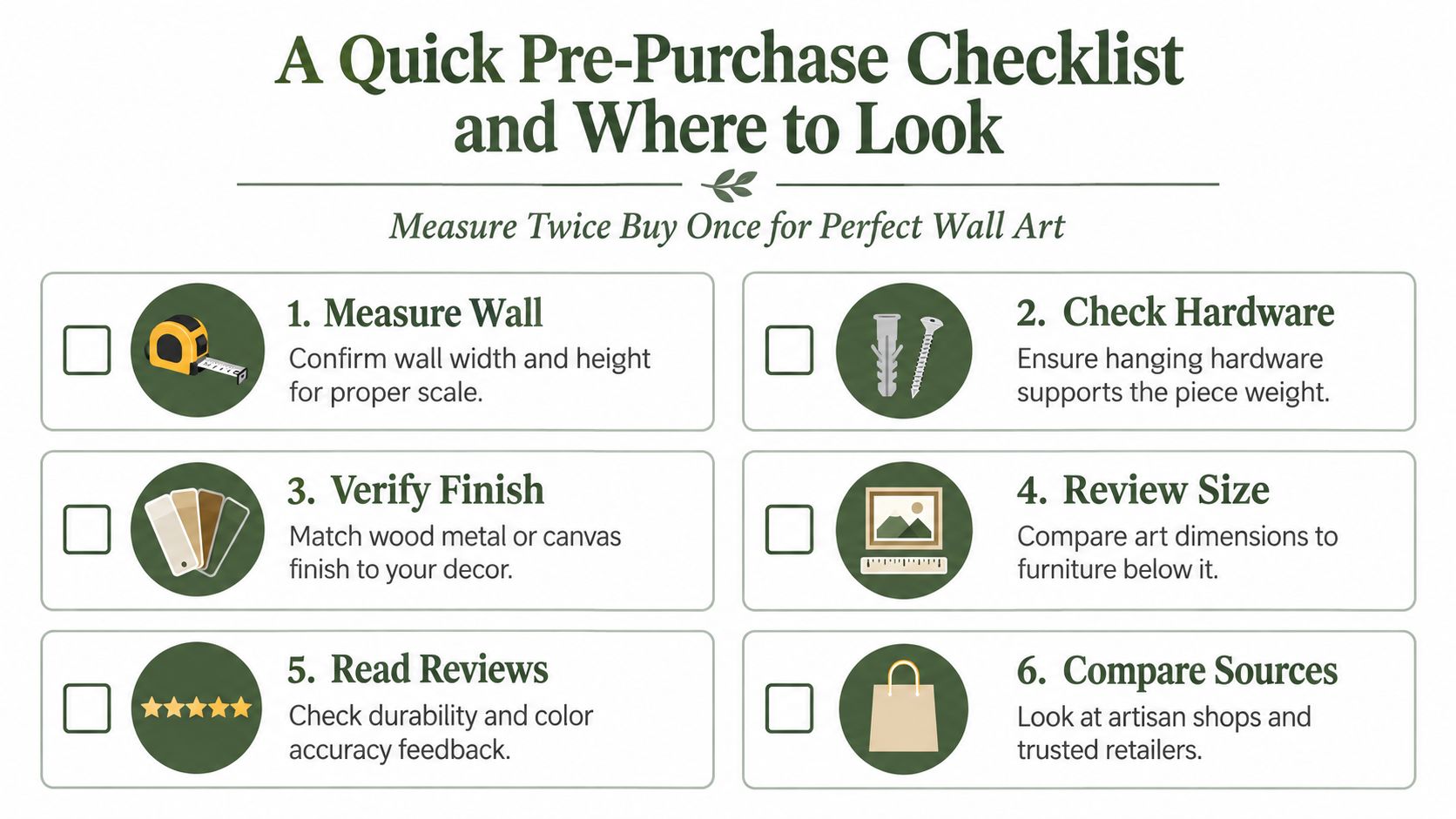
The six checks that matter
- Measure the wall first: Not after. Width and available height decide almost everything.
- Confirm the hardware can support it: Especially if you're ordering wood or metal.
- Match the finish to the room: Wood stain, black metal, whitewash, canvas tone. It all matters.
- Compare the piece to the furniture below it: Mantel, sofa, bench, console, sideboard.
- Decide whether personalization matters: If this is a main wall, I think it usually does.
- Check product photos for scale and clarity: Look for room scenes, close-ups, and clear dimensions.
Where I'd actually shop
If you want handmade variety and don't mind browsing, Etsy is a solid place to look. It's useful for personalized wood signs, painted canvases, and quirky one-off designs.
If you want budget canvas or fast seasonal turnover, big-box retailers are fine. Just be strict about dimensions and don't assume the product photo tells the truth about scale.
If you want a farmhouse look with custom direction, specialty decor shops are the smarter lane. They usually offer finishes, wording, and proportions that make more sense for real homes than generic seasonal marketplaces.
My final advice is blunt. Don't buy Christmas tree wall art because it looks cute in isolation. Buy it because it solves a wall. That one shift will save you from undersized prints, clashing finishes, and decor that feels random the minute it arrives.
If you want a personalized piece that fits your wall instead of forcing your wall to fit the piece, Farmhouse World is worth a look. They offer farmhouse-style wall decor and custom metal sign options that suit entryways, mantels, and giftable holiday decorating without sending you down a full DIY rabbit hole.


