

You're standing in front of a blank porch wall, holding a tape measure in one hand and scrolling through metal decor with the other. The designs look similar at first, but the critical questions appear quickly. Will the piece suit the wall, survive the weather, and hang securely without turning a simple decorating project into a repair job?
Sun metal wall art can answer all three needs when you choose it thoughtfully. The shape provides an immediate focal point, while the material, finish, dimensions, and mounting method determine how well it works in your home. This guide walks through those choices in plain language, from the history behind the sunburst motif to the practical details that matter outdoors.
Table of Contents
- Why Sun Imagery Endures in Metal Wall Decor
- Materials and Finishes Explained Simply
- Choosing the Right Size and Placement
- Color and Finish Options That Work
- Personalization and Custom Sizing Possibilities
- What Weather-Resistant Really Means Outdoors
- Mounting and Care Tips That Actually Work
- Bringing It All Together for Your Space
Why Sun Imagery Endures in Metal Wall Decor
A bare entryway often needs one strong shape rather than several small accessories. A sunburst can fill that role immediately. Its central disk gives the eye a place to rest, while the rays spread outward and make a narrow wall feel more intentional. On a porch, the same form can soften a plain exterior surface and create a welcoming signal before visitors reach the door.
The appeal isn't tied to one decorating trend. The Metropolitan Museum of Art records a brass tray made in the 14th century, attributed to Egypt or Syria, with a central sun symbol. Its decoration combined casting, chasing, engraving, and silver and gold inlay, showing how solar imagery and refined metalwork appeared together centuries before contemporary wall decor. The museum also notes that the sun may represent earthly power and physical strength, not only the celestial body. The Metropolitan Museum of Art's record of the brass tray provides useful context for the motif's visual authority.

A symbol that travels well
Solar imagery also crosses cultural boundaries. Stanford University's Solar Center documents personified sun worship in Babylonian, Egyptian, Greek, and Roman civilizations, along with a red circle and rays used in ceremonial settings. The Minneapolis Institute of Art records solar imagery in ancient Egyptian objects, including winged sun disks and a bronze sunburst. Stanford's overview of solar symbolism shows why the design feels familiar even when it appears in a modern farmhouse interior.
That broad history gives a sun wall piece flexible meaning. It can suggest warmth, energy, hospitality, prosperity, or strength without demanding a single interpretation. A gold design may brighten an entryway, a dark steel version may ground a rustic living room, and a simple cutout can bring visual rhythm to a patio wall.
Practical insight: A sunburst works year-round because its meaning comes from light and welcome, not from a summer-only theme.
Place it above a console, beside a covered doorway, over a mantel, or on a sheltered porch. The motif adds personality while remaining recognizable, which is why it can anchor farmhouse, rustic, Southwestern-inspired, and outdoor spaces without looking temporary.
Materials and Finishes Explained Simply
The product description tells you more than whether a piece is “metal.” It identifies how the artwork may feel, weigh, reflect light, and respond to moisture. Start by separating the base material from the finish. The base is the metal itself. The finish is the protective or decorative layer applied to its surface.
The main metals
Mild steel is the workhorse option. It's strong, easy to cut, and commonly used for detailed silhouettes and laser-cut designs. Farmhouse World's Jesus Cross Wall Art and Personalized Classic Tractor Metal Sign are examples of products described as laser-cut mild steel with a powder-coated finish. That combination can create crisp outlines and a substantial look, but the coating and installation environment still matter.
Stainless steel behaves more like a protective shield. It resists rust better than ordinary steel and has a naturally clean, reflective appearance. It suits modern farmhouse rooms, kitchens, and locations where you want a brighter metal surface, although the exact grade and finish still affect performance.
Aluminum is the lightweight choice. Think of it as easier to lift and handle than steel, which can help when a large decorative piece needs to go on siding, a fence, or a wall that requires careful load planning. Aluminum doesn't rust in the same way steel does, but its surface can still collect dirt, oxidize, or lose visual appeal if the finish isn't suited to the environment.
What the finish changes
A powder coat is a bonded coating applied for color and protection. It gives a product a consistent surface in black, copper, gold, white, or other colors. It can also make cleaning easier than an untreated surface, but powder coating isn't a guarantee of unlimited outdoor life.
Raw metal exposes more of the material's natural character. It may show cutting marks, variation, or gradual oxidation, so it's often chosen for an intentionally industrial or weathered appearance. A patina is a surface change that develops or is applied to create aged color and texture. It can look beautiful, but buyers should clarify whether the patina is sealed and whether the product is intended for sheltered or open-air use.
Light changes your perception of every finish. For a room with strong windows, Alex Trend Painters' advice on how natural light affects paint colors can help you think about how wall color and daylight will alter the appearance of metallic surfaces. For related farmhouse styling, explore iron wall art ideas alongside your chosen sun design.
Choosing the Right Size and Placement
The right size depends less on a universal measurement than on the wall's proportions. A small sun can disappear above a broad sofa, while a very large piece can crowd a narrow entryway. Before ordering, measure the usable wall area, including the space above furniture and the clearance around doors, lights, windows, and railings.
Farmhouse World's Jesus Cross Wall Art illustrates how a single design can serve different spaces because it's offered in sizes from 12 inches to 30 inches. A smaller version can act as an accent near a doorway. A larger version can hold its own over a mantel or on a feature wall. Use that same proportional thinking for sun metal wall art rather than choosing by appearance alone.
Match the piece to the viewing distance
A design viewed from across a living room needs stronger visual presence than one seen close to a porch entrance. On a garden fence, open rays may read clearly from the path, while fine details may blend into nearby foliage. On a small interior wall, a compact design with a clear silhouette often looks more polished than a crowded arrangement.
| Location | Viewing Distance | Suggested Size Range | Mounting Notes |
|---|---|---|---|
| Entryway or narrow hall | Close | Small to medium | Keep door trim, lighting, and coats clear |
| Living room above furniture | Across the room | Medium to large | Center over the furniture, not necessarily the wall |
| Covered porch | Mixed | Medium to large | Check clearance from doors, fans, and railings |
| Open patio wall | Mixed to distant | Medium to large | Confirm exposure, anchors, and wind movement |
| Garden fence | From path or yard | Medium | Use weather-suitable hardware and avoid fragile projections |
Use a paper template first
Cut paper or cardboard to the intended dimensions and tape it to the wall. Step back from the main viewing position, then check it from the side and from the doorway. This simple test reveals whether the rays feel balanced, whether the piece competes with a mirror or light fixture, and whether the center sits naturally above the furniture.
For a sofa or console, align the artwork with the furniture's center rather than automatically centering it on the wall. For an entryway, leave enough breathing room around the door so the sun looks like a focal point, not an obstacle. On a porch, account for people moving beneath it and for any seasonal decorations that may share the wall.
Color and Finish Options That Work
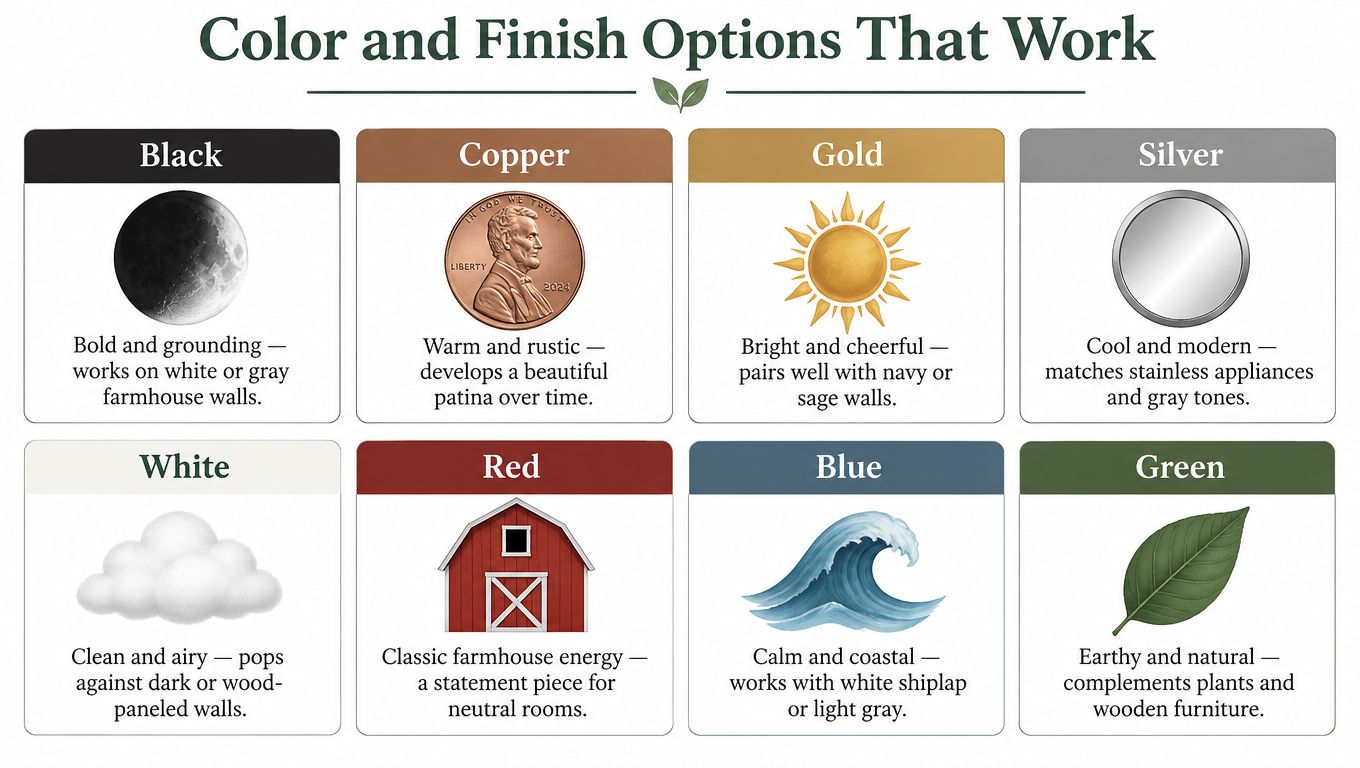
Color changes the mood of metal more dramatically than many first-time buyers expect. The same sun shape can feel traditional in black, cheerful in gold, or coastal in blue. Look at the wall, nearby wood, flooring, plants, and daylight before choosing a finish from a product thumbnail.
Warm finishes
Copper has the visual warmth of a penny or an old farmhouse kettle. It works naturally with stained wood, terracotta, tan siding, and warm neutral walls. Over time, an unsealed or specially treated copper surface may develop a patina, so confirm the intended aging before placing it outdoors.
Gold reflects light more brightly. It can glow at sunset or under warm porch lighting, especially against navy, sage, charcoal, or deep wood tones. A muted gold feels aged and rustic, while a brighter gold reads more decorative and formal.
Red carries strong farmhouse energy. It stands out against white, cream, gray, and natural wood, but it can dominate a small wall. Use it when the sun is meant to act as the room's primary accent rather than blend into a larger arrangement.
Cool and grounding choices
Black gives the rays a graphic outline and works well on white or pale gray farmhouse walls. Dust can show on very dark surfaces, particularly on covered porches where pollen settles.
Silver suits gray walls, stainless appliances, and cleaner modern interiors. It can reflect bright daylight, so check the viewing angle if glare would be distracting.
White feels airy and makes a strong contrast against dark siding, stained wood, or a brick wall. Outdoor dirt may be more visible, which makes placement and cleaning especially important.
Blue supports a calm, coastal direction with white shiplap, light gray, or weathered wood. Green connects naturally with plants, garden walls, and wooden furniture, though it may blend into dense landscaping.
Warm colors catch low evening light, while cooler colors usually look cleaner and sharper in bright daylight.
Finish texture matters too. Glossy surfaces reflect more light and may reveal fingerprints or water spots. Matte and textured finishes tend to soften reflections, but their grooves can hold dust. Choose the color for the mood, then choose the surface for the amount of cleaning you're willing to do.
Personalization and Custom Sizing Possibilities
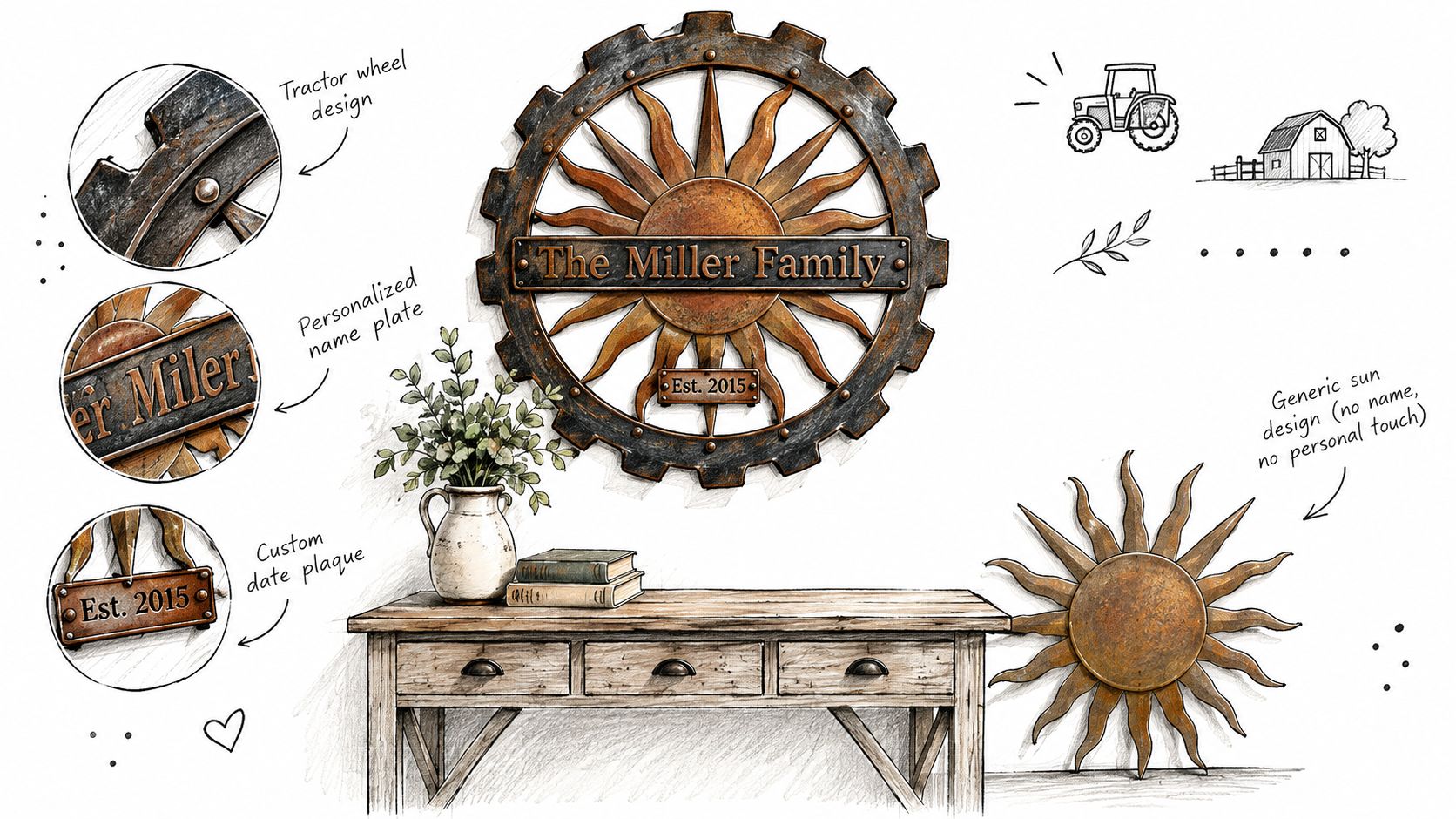
A stock sun design decorates a space. A personalized metal sign can identify it. Adding a family name, address, ranch name, monogram, or meaningful date turns a general wall accent into something connected to the people who live there.
The Personalized Classic Tractor Metal Sign from Farmhouse World shows how this approach works in a farmhouse setting. Its custom format can combine a family name with an established date, creating a sign that belongs near a home entrance, barn, workshop, or homestead. The same design principle can guide a sun piece. A central name can sit inside the disk, while rays frame the lettering around it.
Plan the wording before the artwork
Short text usually remains easier to read from a distance. Consider whether your sign should display:
- A family name: Useful above a front door, porch seating area, or entry console.
- An address: Practical for a gate, fence, or approach to the house.
- A monogram: A quieter choice for an interior wall or bedroom.
- A ranch or farm name: Appropriate for a barn, coop, workshop, or driveway-facing wall.
- A date: A meaningful detail for a wedding, move, restoration, or family milestone.
Personalization previews deserve careful attention. Product instructions may restrict emojis, and punctuation such as hyphens may be dropped during production, so enter the wording exactly as you want it processed and review any preview before approving it. If you're considering a custom design, this guide to making custom metal signs can help you think through text, layout, and placement before ordering.
Let the location determine the dimensions
A custom sign doesn't need to fill the largest wall available. Measure the doorway, fence panel, coop front, or interior niche first. Then select a size that leaves room around the lettering and preserves the sun's silhouette. Color choices also affect legibility. Dark lettering on a light finish creates one effect, while cutout lettering against the wall creates another.
Before production, confirm the spelling, date, punctuation, color, dimensions, and intended placement. A thoughtful preview can prevent a visually attractive sign from becoming difficult to read once it's mounted.
What Weather-Resistant Really Means Outdoors
“Weather-resistant” describes expected performance under conditions, not a guaranteed lifespan. Outdoor durability depends on the base metal, pretreatment, coating system, exposed edges, hardware, climate, and installation position. A powder-coated steel sun under a covered porch faces a different challenge from the same piece on an ocean-facing wall.
ISO 12944 classifies corrosive environments from C1 through CX, ranging from low-corrosivity conditions to extreme exposure. The classification helps describe the environment, but coating durability remains an estimate rather than a promise. Technical coating benchmarks can include 4,000 hours of humidity testing, 2,000 hours of cyclic corrosion testing, and 10 years of South Florida exposure, with limits for color change, chalking, gloss loss, and erosion. Axalta's anticorrosion coating guide illustrates why a vague outdoor claim needs more questions behind it.
Match the product to the placement
Sheltered porch: A roof reduces direct rain and sun, but humidity and condensation still reach the piece. Ask whether the coating covers cut edges and whether the hardware resists corrosion. A sheltered location is often more forgiving than an exposed wall, but it still needs occasional cleaning.
Fully exposed garden wall: Rain, ultraviolet light, temperature changes, and wind all matter. Look for a stated coating system, protected edges, suitable drainage, and hardware intended for exterior use. Avoid assuming that a metal label alone makes the piece suitable for open exposure.
High-humidity region: Moist air can keep surfaces damp for longer. Place the artwork where water can drain and air can circulate, and inspect seams, holes, lower edges, and fasteners for early changes.
Salt-air location: Coastal air accelerates corrosion and can weaken mounting hardware as well as the artwork. Stainless or otherwise corrosion-resistant fasteners may be important, but ask which grade is supplied and whether the coating system was selected for that environment.
Ask sellers for the base metal, pretreatment, coating type, edge protection, UV performance, hardware details, and recommended exposure before treating “weather-resistant” as a buying decision.
For a second perspective on selecting exterior plaques that hold up, consult this guide to plaque longevity for nonprofits. You can also compare design ideas in outdoor metal wall art, while keeping the specific climate and wall location in mind.
Mounting and Care Tips That Actually Work
A beautiful piece can still fail if the hanger, anchor, or wall substrate is wrong. Start by identifying what you're drilling into. Drywall, a wood stud, brick, siding, stucco, and masonry each require different fasteners, and supplied hardware may not suit every surface.
Build the installation around the wall
- Drywall: Use an anchor rated for the piece and locate a stud when possible. Don't rely on a small generic hook for a large outdoor design.
- Wood or siding: Fasten into structural wood where possible. Avoid crushing siding, and use spacers if the design needs airflow behind it.
- Brick or masonry: Choose anchors designed for masonry and avoid drilling into weak mortar unless the installation instructions specifically allow it.
- Stucco: Confirm what lies behind the stucco before selecting an anchor. A surface-only fastener may not provide the support you expect.
Wind creates movement that a quiet indoor wall never experiences. Mounting guidance recommends accounting for wind, vibration, seismic activity, and material degradation, with a safety factor of at least 3:1 for unexpected loads and aging. This installation hardware guide explains why product weight alone doesn't determine safe mounting.
A standoff can create space behind the artwork for airflow and drainage, but it can also introduce mechanical force and movement. Use corrosion-resistant screws, washers, and spacers suitable for the location, and ask whether hardware is included or sold separately. Custom metal signs commonly require a 7 to 10 business day production window, so plan installation materials before ordering if the piece is needed for a specific event.
Wipe the artwork seasonally with a soft cloth and mild water-based cleaning solution appropriate for the finish. Remove leaves, pollen, and standing moisture, and avoid abrasive pads, harsh solvents, and aggressive pressure washing unless the maker specifically approves them. Inspect fasteners and edges during cleaning, especially in humid or coastal settings.
Bringing It All Together for Your Space
The right sun metal wall art balances five decisions: material, finish, size, color, and placement. Mild steel can provide crisp shapes, stainless steel offers a cleaner reflective character, and aluminum reduces handling weight. Powder coating, patina, or raw metal changes how the piece looks and ages. Your wall dimensions, viewing distance, climate, and mounting surface determine whether the design feels settled or out of place.
Choose a sun piece that fits your home rather than chasing a generic ideal. Check the finish details, test the size with a paper template, confirm personalized wording, and select hardware for the actual wall. Then your sunburst can remain a year-round focal point in an entryway, living room, porch, patio, or garden.
Farmhouse World offers personalized metal signs, rustic wall art, and farmhouse accents in multiple designs, colors, and sizes for interior and exterior spaces. Browse the collection at Farmhouse World, compare your options, and choose a piece you can position and mount with confidence.


