

You're standing on a step stool, owl in one hand, tree wobbling under the other, and the tip bends the moment you let go. That's the most common way an owl topper fails, and it has nothing to do with how good it looks in the box. Treat the topper as a load on the tree tip first and a decoration second, and you'll choose one that stays straight, sits safely, and still gives you that farmhouse focal point.
Table of Contents
- What an Owl Christmas Tree Topper Is and How to Choose One
- Check Fit and Stability for Your Tree Type
- Electrical and Household Safety for Lit Toppers
- How to Install and Test Your Owl Topper
- Styling an Owl Topper in a Farmhouse Room
- Personalize, Make and Care for Your Owl Topper
- Choose Your Owl Topper Before the Tree Goes Up
What an Owl Christmas Tree Topper Is and How to Choose One
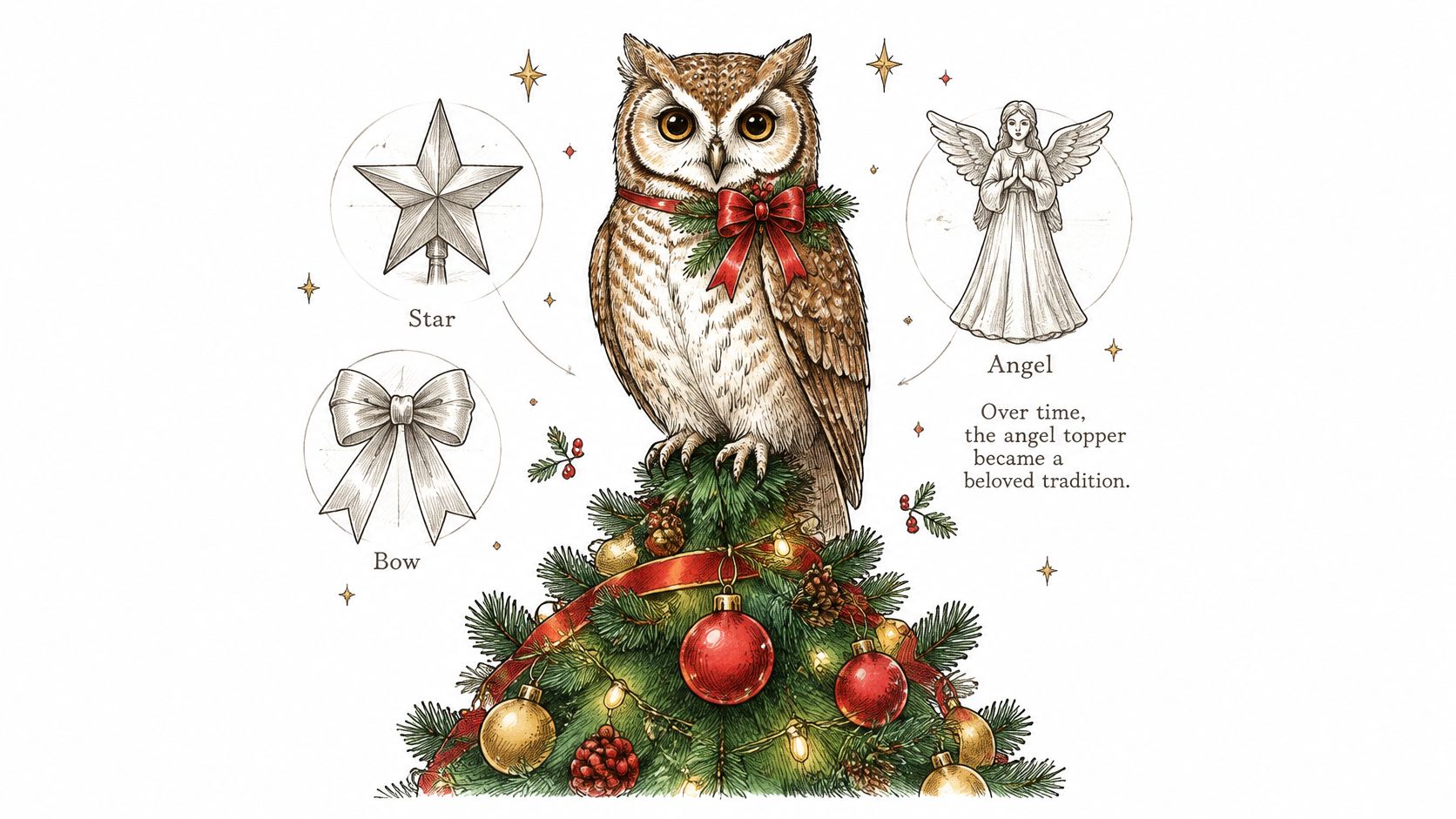
An owl Christmas tree topper is a decorative owl figure set on the crown of a Christmas tree in place of a star, angel, or bow. Say you've dressed a woodland tree in cream, pinecones, and warm white lights. A star can feel formal on that tree, while an owl perched at the top reads as part of the scene, as if it's watching over the room.
That choice isn't a gimmick. According to the Kiddle tree topper guide, the angel became prominent in the Victorian era after a widely reproduced illustration in The Illustrated London News showed Queen Victoria, Prince Albert, and their family around a tree topped with an angel, and owls are a less common but established alternative alongside stars, angels, Santa figures, bows, crosses, and sunbursts. By the 1870s, even the Union Jack had become a popular British tree top ornament, which tells you how much topper fashion has always shifted.
Why the Owl Works Symbolically
Owls carry associations with wisdom, observation, and night-time protection. On a tree, that turns into a seasonal wish for insight and good fortune, which is why the figure suits both a family tree and a gift. It also pairs naturally with smaller nature pieces, including a Christmas house ornament tucked into the lower branches.
You'll meet four main styles. Realistic feathered owls with extended wings suit cabin and woodland rooms but they're the hardest to balance. Glass-look or painted resin figures give you detail and shine for a traditional tree. Wood-look owls fit farmhouse rooms best because they repeat tones already in furniture and frames. Wool felt designs are lighter, simpler, and forgiving on small trees.
An owl topper is a nature-themed, traditional-style alternative to the star that works on almost any tree once it fits securely.
Choose the style for your room, then judge it by weight and base. Don't do it the other way around.
Check Fit and Stability for Your Tree Type
Find your tree in this table first. The attachment that works on a solid artificial tip will often fail on a hinged tip or a fresh cut leader.
| Tree type | Attachment that works | Measure before buying | Warning sign |
|---|---|---|---|
| Artificial tree with solid tip | Deep internal cone or base that seats over the tip | Tip diameter and top-branch strength | Tip splits, wobbles or slides |
| Artificial tree with hinged or compressible tip | Adjustable clip or sleeve over several upper branches | Length of branch tips and their strength | Droop within days of setup |
| Fresh real tree | Concealed floral wire or zip tie to a sturdy upper branch | Trunk diameter at the top and branch strength | Brittle tips or topper pulling the tree off-centre |
| Tabletop tree | Fixed base seated on the tip, kept low | Overall height against the ceiling and shelf depth | Tree tipping when the topper is touched |
Why Owls Tilt More Than Stars
A star is usually flat and light, with its weight close to the trunk. An owl puts mass and projected area above the tip, often with a head, oversized eyes, or wings that pull the centre of gravity forward. As the tip flexes, that forward lean grows, and the owl rotates or slides instead of just sitting a little crooked.
Recent marketplace analysis reported on the Accio Christmas tree trends page identifies base stability as a recurring product-quality concern for tree toppers, alongside durability and fit. That's exactly what you're screening for here, not colour or feather detail.
Measure Before You Buy
Run this checklist with a tape and the product listing open:
- Base opening against tip: Compare the cone or base opening with the top of the trunk or leader branch. A loose cone needs a clip or wire, not hope.
- Weight in your hand: Hold the owl on its base at arm's length. If it wants to tip forward on a flat palm, it'll tip forward on a flexible branch.
- Span and clearance: Note wing and ear span, topper height, and distance from tree tip to ceiling. Tall ears that brush the ceiling will push the owl off centre every time the tree moves.
- Branch strength: Squeeze the top branches gently. Compressible tips that fold together under light pressure can't carry a rigid base alone.
Realistic owls with extended wings, large eyes, or rustic materials often weigh more than a conventional star, so flag those first. If the topper is top-heavy, plan on a concealed floral wire, zip tie, or clip engaging several upper branches.
If the leader branch is weak, shorten it rather than forcing the topper onto it. Cutting back to sturdier wood gives the base something solid to grip. Forcing a cone onto a thin tip splits hinges on artificial trees and snaps dry leaders on real ones.
I would reject any owl whose listing doesn't state weight, base diameter, and attachment method. You're buying a mounting system with an owl on top, and those three fields tell you whether it'll work on your tree.
Electrical and Household Safety for Lit Toppers
A lit owl can add wiring and heat to the tree's upper branches, where cords are easy to pinch or overlook. Check the product's recognized independent-laboratory mark, voltage rating, indoor or outdoor designation, cord length, and maximum operating duration before buying. “LED” identifies a bulb type, not a safety certification.
The UL 588 standard listing covers temporary-use seasonal decorative-lighting products and accessories rated up to 120 V, including tree tops and illuminated ornamental figures. It defines temporary use as installation and operation for no more than 90 days. Electrical distribution or lighting equipment, along with lamps or bulbs, are among the leading causes of home Christmas-tree fires.
Lit Versus Unlit
An unlit owl avoids adding its own electrical load and wiring failure points. The light strands around it still need inspection. Before running a strand up to the crown, check wiring for electrical safety risks, especially where cords pass through branches and can become pinched.
With a lit owl, keep its wiring clear of branches and away from the tree stand. Leave the adapter accessible so you can inspect it and unplug the topper without disturbing the tree.
Practical rule: If you can't reach the adapter without moving ornaments, reroute the cord before decorating further.
Run This Inspection Before Switch-On
- Discard damaged strings: Replace strands with frayed or pinched conductors, loose sockets, or damaged insulation. Improvised tape repairs are not a safe fix.
- Switch off when away: Turn off tree lighting when the home is unoccupied or everyone is asleep.
- Clear heat sources: Keep the owl away from heat vents, candles, fireplaces, and high-temperature bulbs.
- Check small parts: Gently tug beaks, feet, faux feathers, glitter, and small eyes. In a home with young children, a part that detaches can become a hazard, especially if the topper falls.
- Watch pets: Loose feathers or fibers can attract cats, and a cat reaching for the crown can pull over a tabletop tree.
Remove a loose or damaged topper promptly. A cracked housing near wiring can expose electrical parts, while a base that no longer grips can let the owl fall. Don't leave either problem in place until later.
How to Install and Test Your Owl Topper
Treat the owl as a cantilevered load at the tree apex. The Connecticut Fire Academy Christmas tree safety guidance supports the practical specs that matter here, a secure attachment such as a deep internal cone, adjustable spring clip, or wire tie that engages several upper branches, combined with a low centre of gravity, plus flame-resistant or flame-retardant decorations on a fresh, well-watered tree.
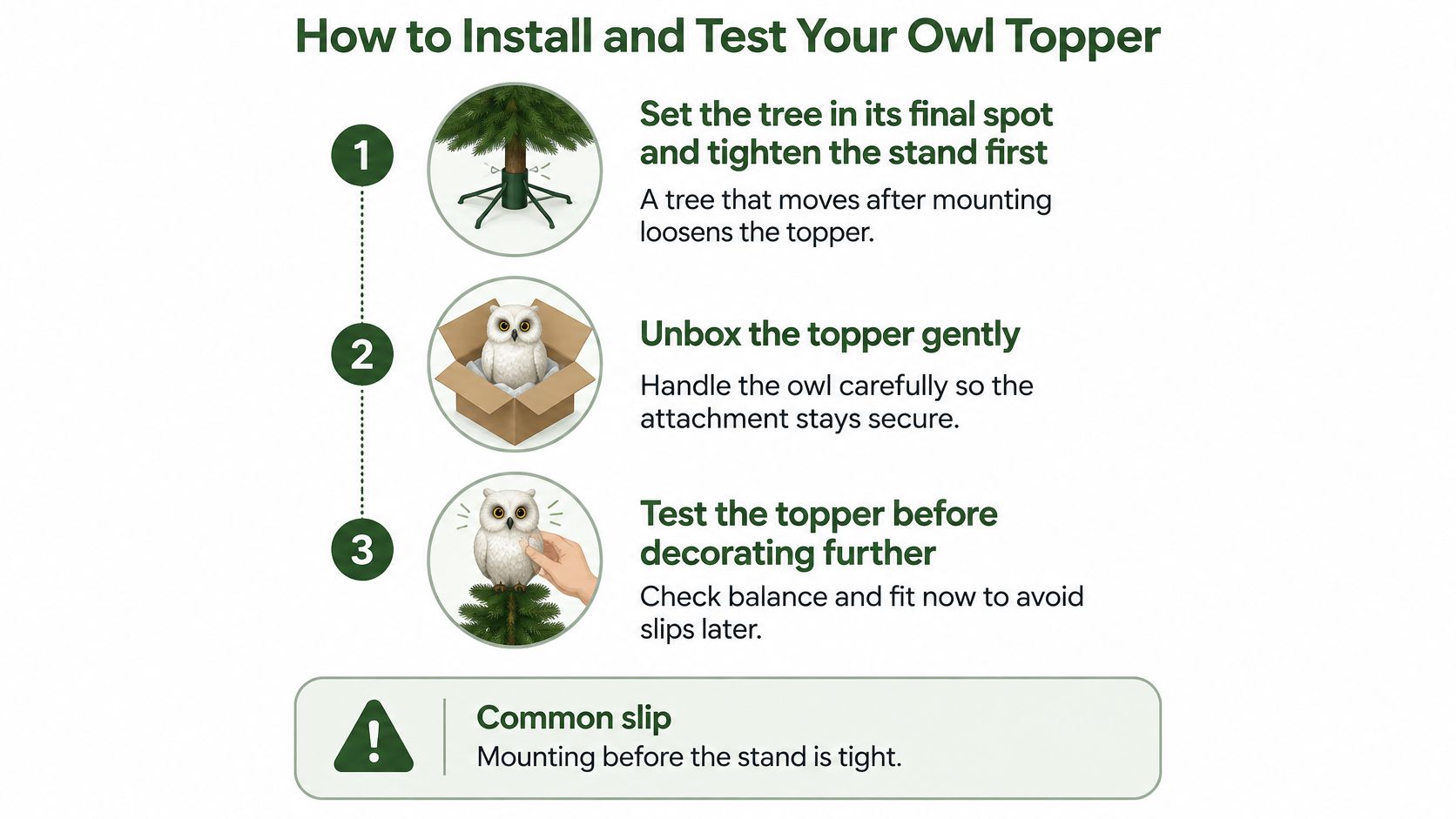
Install in This Order
- Set the tree in its final spot and tighten the stand. A tree that moves after mounting loosens the topper. The common slip is decorating in the middle of the room, then dragging the tree into a corner.
- Unbox and inspect the owl. Check that wings, ears, and feet are firm. Tighten or reglue loose parts now, not while you're balanced on a stool.
- Seat the base over the tip, aligned over the trunk. Don't balance it on one thin branch. Alignment over the trunk keeps bending forces centred.
- Attach to several upper branches. Use the clip, wire, or tie the design calls for. On a compressible artificial tip, add a sleeve so a rigid base doesn't split the hinge or droop gradually.
- Test before you decorate further. Gently move the upper trunk and watch whether the owl rotates, slides, or causes branch separation. Then gently rotate the whole tree and check that it doesn't swing, tilt, or pull off centre.
- Route any lighting cord freely. It shouldn't be pinched between branches or under the stand, and the adapter stays reachable.
- Keep heavy loads away from below the owl. Heavy garlands or clustered ornaments directly underneath stack their load onto the same flexing tip and amplify bending.
- Step back and face the owl to the room. Check it from the doorway and from seated height. Owls read differently from below, and eyes aimed at the ceiling look lost.
If it moves at all during the test, reattach it or shorten the leader branch. Never leave a loose topper overnight hoping it'll settle. It won't settle, it'll fall, usually onto the ornaments you like most.
Styling an Owl Topper in a Farmhouse Room
Start with the finish, because finish decides what the rest of the tree has to do. These pairings keep the owl connected to the room instead of floating above an unrelated tree.
| Owl finish | Best pairing | Room style |
|---|---|---|
| Wood-look owl | Cream jute garland and warm white lights | Farmhouse |
| Felt owl | Wool ribbon and neutral ornaments | Cottage |
| Copper-toned owl | Barn-style sign and matching metal stand tones | Rustic farmhouse |
| Glass-look or painted resin owl | Metallic ornaments and one ribbon type | Traditional |
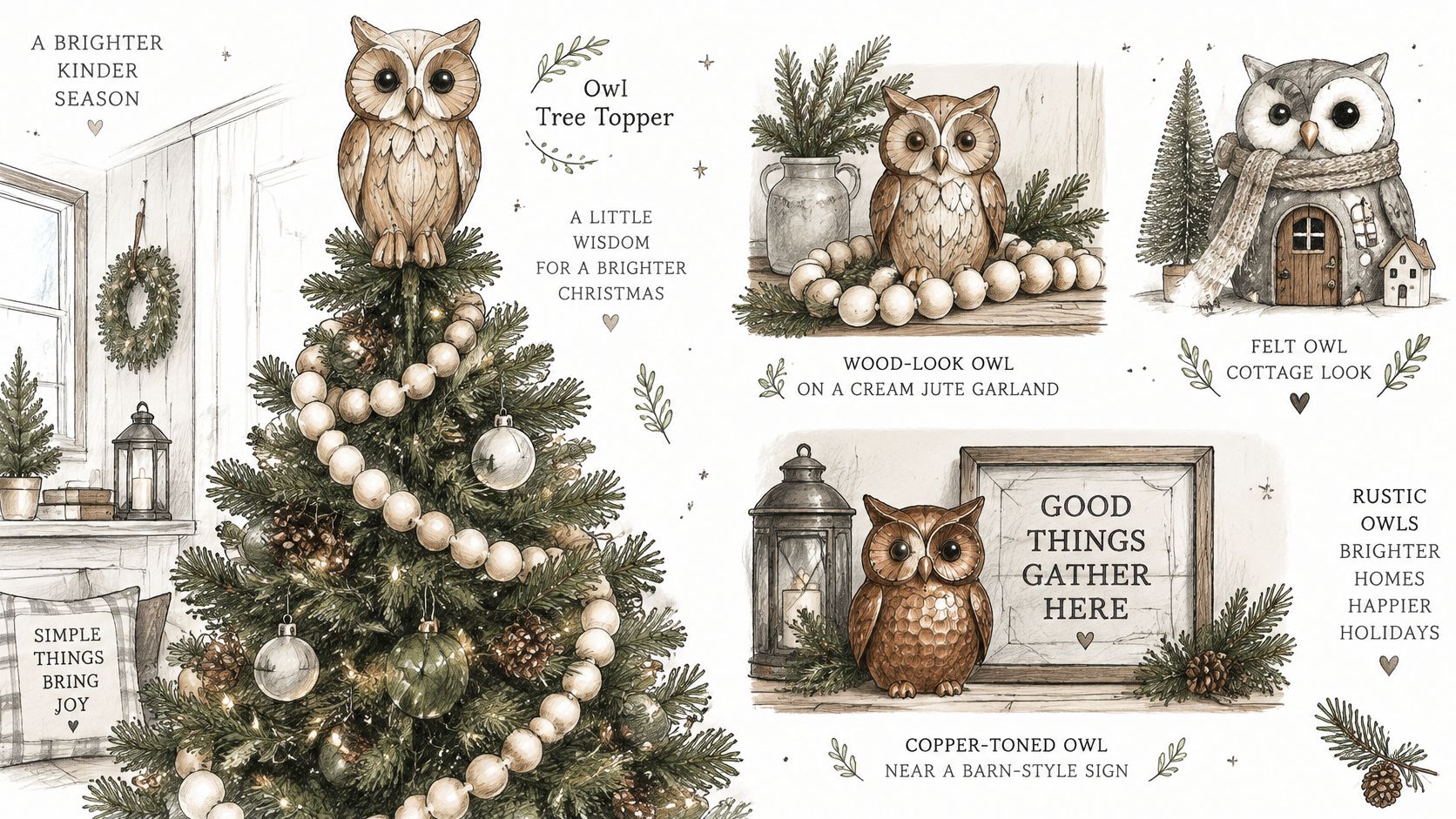
Match the owl's colour to one or two ornaments already on the tree, and repeat that colour at least twice across the branches. A single copper owl above an all-silver tree looks like a mistake. That same owl above copper bells and a copper-toned stand looks planned.
Keep the owl as the tallest focal point so the eye lands on it first. Don't flank it with tall picks or sprays at the same height, they'll compete and make the crown look crowded. Use one ribbon or garland type rather than three, and match the metal or wood tone of the tree stand to hardware already in the room.
Say you're dressing a 6-foot tree in cream and copper for a farmhouse living room. I'd put a copper-toned owl on top, run one cream ribbon, repeat copper in two ornament clusters and the stand, and keep everything else neutral. That's the same restrained logic behind country style Christmas decorations that use a few repeated materials well.
It helps that this isn't a novelty look. The Manufactum Lauscha glass owl page notes BBC coverage identifying a source suggesting that owls on Christmas ornaments date back to the 1800s, and Lauscha glassmaking itself spans approximately four centuries.
Finish with the doorway test. Stand where guests enter. Does the owl read first, and do its colours repeat at least twice below it? If not, move ornaments, don't add more.
Personalize, Make and Care for Your Owl Topper
Handmade is where owl toppers get personal, and also where weight creeps up unnoticed. The Etsy owl tree topper marketplace reports 680 reviews for the handmade wool-felt snowy owl Christmas tree topper listing in 2026, which I'd read as a single-listing signal of buyer interest rather than market data. Felt works well because it's light, soft in a cottage room, and usually sold as a one-off piece.
Make or Customize Without Making It Top-Heavy
For a DIY owl, start with a sturdy base or cone and build light. Felt, wool, fabric scraps, and a hollow form beat solid clay or thick wood at the top of a tree. Cross-check your finished weight and base against your tree type before you add detail.
Personalize low and light:
- Name tag or monogram: Stitch or tie it near the base, where added weight helps stability instead of hurting it.
- Coloured ribbon: Swap ribbon colours to match your tree each year. Keep tails short so they don't catch on branches below.
- Small painted detail: Add it to sealed resin or wood-look surfaces. Skip heavy glued embellishments on wings, they'll pull the owl sideways.
Those same colours can carry down the tree through farmhouse Christmas ornaments, so the personalization reads as a theme rather than a label.
Care by Material
| Material | Cleaning | Storage | Repair |
|---|---|---|---|
| Painted resin or ceramic-look | Dust with a soft brush; damp cloth only on sealed surfaces | Padded box, away from heat | Glue suited to the material; replace if cracked |
| Metal | Dry cloth; mild polish on tarnished areas | Dry area to prevent rust | Tighten loose hardware |
| Wool felt or fabric | Gentle brush or lint roller | Dry, sealed box with moth protection | Re-stitch loose seams with matching thread |
| Lit owl | Unplug first; wipe housing with a dry cloth | Cord coiled loosely, not kinked | Replace if the bulb or wire is damaged |
Dust before you store, not just before you display. Dust packed into felt or feather detail all year is harder to lift and can hold damp in a sealed box. Store every owl in a padded box away from heat and damp, with wings supported so they don't fold under their own weight.
Retire a cracked topper or one with damaged wiring rather than repairing it for the next season.
Reglueing a loose ear is fine. Reusing a cracked lit housing isn't.
Choose Your Owl Topper Before the Tree Goes Up
Make four decisions, in this order, and the shortlist writes itself.
First, tree type. That decides attachment, cone, clip, sleeve, or wire to several branches.
Second, lit or unlit. Lit means certification mark, voltage, and cord length confirmed before purchase, not after delivery.
Third, finish. Pick the finish that repeats a tone already in your room, wood, felt, copper, or glass-look resin.
Fourth, ready-made or handmade. Ready-made gives you stated weight and base specs. Handmade gives you a one-off felt piece, but you'll need to weigh and test it yourself.
What Those Decisions Look Like
A 6-foot artificial tree with a solid tip and an unlit wood-look owl points to a cone-fit ready-made owl. That's the simplest stable combination, and the one I'd recommend for a first owl topper.
A fresh real tree with a weak tip points the other way, a shortened leader branch and a lighter felt owl wired to a sturdy upper branch. Putting a heavy resin owl on that tip is asking for a lean by the second week.
A lit owl on any tree needs its specs confirmed first. No mark, no voltage, no purchase.
For colours to repeat below the owl, Farmhouse World sells Christmas ornaments such as the "God Made A Farmer" Ornament for $14.95, and a customer described Farmhouse World's customer service as outstanding and said the ornaments arrived exactly when promised. Check each listing's specifications, since ornaments are not owl toppers and won't tell you anything about topper fit.
Do one thing today. Measure your tree tip, shortlist one owl that matches your tree type, and run the stability test before you hang a single ornament. Ten minutes now beats rehanging a fallen owl later.
Browse Christmas ornaments and farmhouse accents at Farmhouse World to find colours and rustic finishes you can repeat below your owl, from woodland neutrals to copper tones. Measure your tree tip first, pick ornaments that echo your topper, and build the tree up from a crown that stays put.


