

You're standing back from the tree with a hook still in your hand. The red plaid is on. A few wood slices are on. The galvanized star is up top. It should look finished, and it doesn't. It looks like a pile of holiday objects that happen to share a tree. That gap between busy and settled is where Farmhouse Christmas ornaments do their real work, not as more stuff, but as the repeats and worn finishes that tie a room together.
Table of Contents
- What Makes Farmhouse Christmas Ornaments Feel Finished
- Signature Styles Behind Farmhouse Christmas Ornaments
- Materials and Finishes Worth Hanging
- How to Match Size Color and Personal Details
- Styling Trees Garlands and Mantels
- Care Storage and Safer Placement
- Gifts Worth Keeping and Your Next Step
What Makes Farmhouse Christmas Ornaments Feel Finished
You've probably seen the half finished version in your own living room. A slim tree in the front window. Glass balls from an old set mixed with new wood rounds. One plaid ribbon tied too tight at the top, nothing plaid anywhere else. Every ornament is fine on its own. Together they argue.
A finished farmhouse tree feels different because a guest can read it at a glance. Wood grain, soft matte metal, checked ribbon, and simple shapes repeat in a few colors. A cow, a barn star, a bell, a truck. Nothing shiny in a polished way. The finishes look handled, like they came from a kitchen drawer or a barn shelf rather than a display built this morning.
Calm Versus Full Is Your First Choice
A calm farmhouse tree leaves branch showing. You hang fewer pieces, mostly cream, natural wood, and black, and you let the green do the work. A fuller country tree layers more. You add softened red, sage, plaid bows, galvanized bells, and a few animal shapes low where kids can see them.
Neither is more correct. Confusion starts when you try to do both on the same tree. You buy sparse handmade pieces, then panic at the empty spots and fill them with a boxed set in different colors. Pick the density first. The ornaments get easier after that.
A room feels collected when the same two or three materials show up on the tree, the mantel, and the doorway, not when every surface gets its own theme.
The Families You Will Actually Choose From
Most of what you'll shop or make falls into a short list. Wood rounds and flat wood shapes bring grain and a handmade edge. Matte or aged metal brings weight without shine. Simple ceramic reads like kitchenware, clean and a little formal. Burlap and other fabric soften hard edges. Plaid works best as ribbon or a small accent, not as every ornament. Galvanized pieces signal barn and bucket right away.
You'll settle four practical questions as you go. Which of these can live on a porch and which belong only on the tree. How big a piece should be for a thin branch versus a wide mantel. When a name or date is worth adding. And how to store the favorites so they're worth unpacking next December.
The payoff isn't a trend roundup. It's a short list you can shop or make for one room, in materials that can survive that room.
Signature Styles Behind Farmhouse Christmas Ornaments
The personal ornament isn't a new idea, and that history explains why a pinecone or a painted cow doesn't feel like a stretch. Deutsche Welle's history of Christmas tree ornaments notes that before the 1800s, Christmas trees were commonly decorated with apples, nuts, baked goods, and sweets. Households hung what they already knew and had on hand.
In the German town of Lauscha, glassblower Hans Greiner reportedly made fruit and nut shaped glass ornaments in 1847, and a written record of large silvered glass balls dates to 1848. Production started in cottage workshops attached to homes. By the 1880s, buyers from American stores were traveling there to purchase ornaments, so a local craft had become a transatlantic market.
The point of that short history for your tree is simple. Ornaments have always carried household identity and regional memory. An edible apple said something about that kitchen. A barn star, a rooster, a family initial, or a state flower says something about yours.
What Each Style Signals in a Room
- Natural wood and slices signal handmade. They suit living rooms and entryways where you want warmth up close, and they pair well with a guide to country style Christmas decorations for the whole house.
- Matte or aged metal signals worn in. Stars, bells, and flat initials hold up in busy spots and read clearly from across a room.
- Simple ceramic signals kitchen table. A small animal or house shape works near dining areas where dishes and mugs already set the tone.
- Burlap, fabric, and plaid ribbon signal soft and homemade. They're forgiving around children, and if you're making pieces with kids at the table, the Pinwheel Crafts ornament-making guide is a useful starting place for simple shapes they can finish.
- Galvanized buckets and bells signal barn. Use them in small doses near a door or mantel, where that gray metal makes sense.
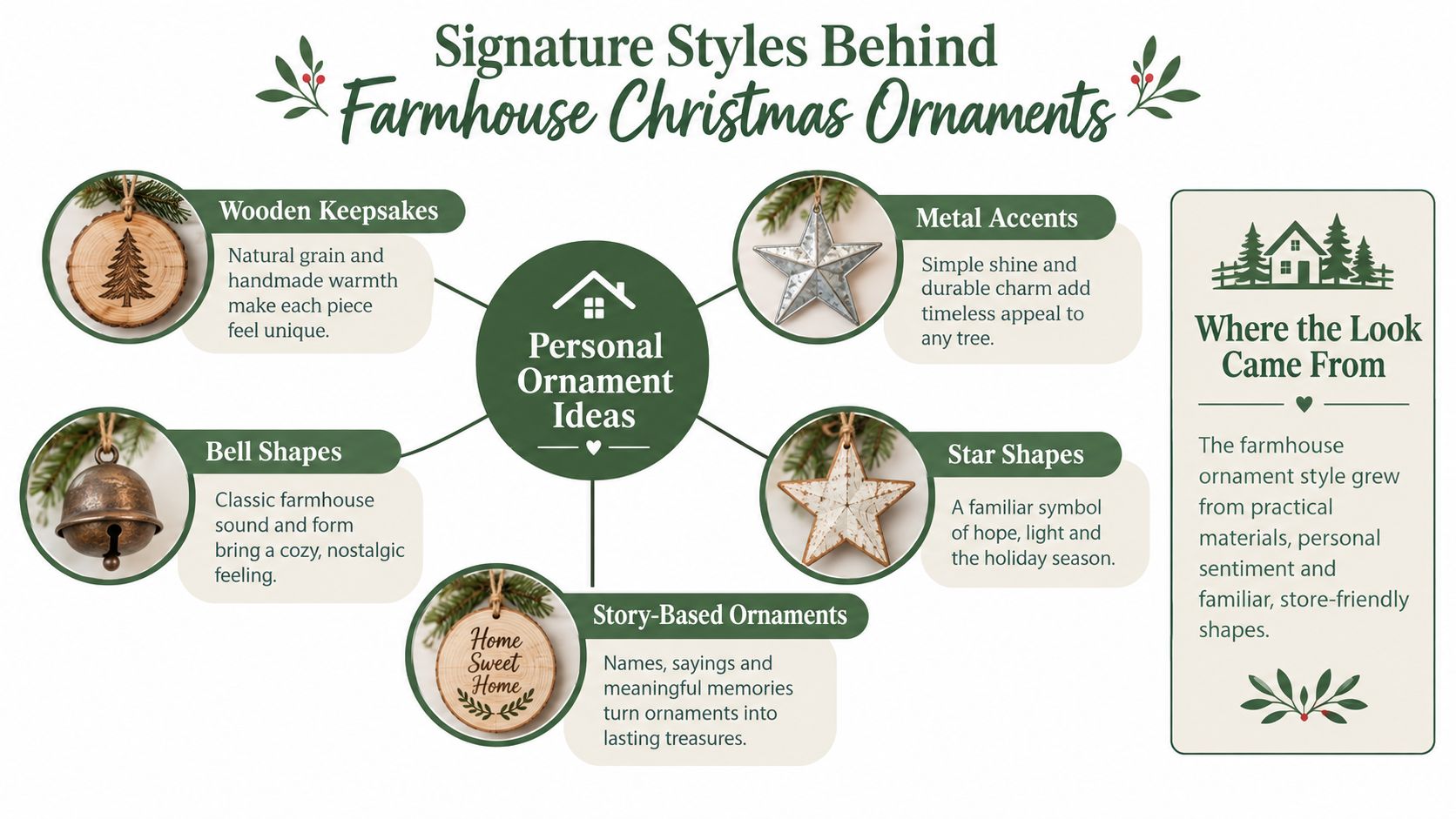
Personalization is the contemporary version of the homemade edible ornament. A name, a year, or a farm name marks this house, not a catalog theme. That's why a plain wood round with your family's name often outlasts a prettier generic ball.
Materials and Finishes Worth Hanging
Style tells you what a piece looks like. Material tells you where it can live. Those are different decisions, and mixing them up is where most breakage and warping starts.
Practical rule: The most authentic looking material isn't always the most practical one for the branch, the mantel edge, or the house you actually live in.
New York State Education Department seasonal decorating guidance recommends break-resistant ornaments because traditional glass can shatter and cause injuries, and it warns that untreated paper, plastics, and natural branches can increase fire risk. Glass can still belong in an adult room, placed high and away from traffic. For contrast, collections such as glass Judaica gifts for the home show how glass is usually displayed as a stable tabletop piece rather than hung where it can swing and fall. On low branches and in walkways, break-resistant shapes earn the spot.
Farmhouse Ornament Materials by Placement
| Material | Best placement | Main risk | Look it adds |
|---|---|---|---|
| Wood | Indoor tree, garland, mantel away from steam | Cupping or cracking as humidity swings | Grain, handmade warmth |
| Metal | Tree, doorway, mantel with a protected back | Scratching wood surfaces, sharp unfinished edges | Worn, simple, readable from a distance |
| Ceramic | Upper branches, shelves out of traffic | Chipping or breaking when dropped | Clean kitchenware feel |
| Burlap and fabric | Low branches, kids' reach, garlands | Holding dust and damp, creasing in storage | Softness against hard materials |
| Plaid ribbon | Bows and tails as an accent | Overwhelming the tree if used everywhere | Checked country pattern in small doses |
| Galvanized metal | Doorway, mantel, sturdy lower branches | Sharp edges, hardware that can rust | Barn gray, bucket and bell shapes |
Wood is light on a branch and reads warm in daylight. Thin or layered pieces are the vulnerable ones. Metal hangs straight and survives a fall, but check the back before you rest it on a painted mantel. Ceramic looks finished and can chip on a tile hearth. Fabric and burlap won't shatter, and they collect dust if they sit near a kitchen. Galvanized pieces read as farmhouse fast, so run a finger along the edge and check the hanger before a child handles one.
One caution belongs here even though the details come later. A miniature lighted ornament that looks rustic isn't automatically safe. Appearance doesn't tell you anything about its wiring.
How to Match Size Color and Personal Details
Start with the room, not the ornament bin. A piece that works on a wide living room tree can disappear on a mantel or bend a pencil tree branch in a hallway. Room first, then scale, then color, then the personal detail. That order saves returns.
Scale You Can Judge by Eye
A heavy wood round pulls a slim branch tip down and spins. Hang it lower, closer to the trunk, or on a garland where the greenery is wired. A small metal initial gets lost alone on a wide mantel. Cluster it with two other small pieces or hang it in a window where the frame gives it a border.
Weight matters more than diameter. A flat wood shape can be large and still hang well. A solid ceramic animal can be small and still be too much for an outer branch. Test one branch before you hang a matching set.
A Tight Color Story
Farmhouse rooms usually already give you the palette. Cream, black, softened red, sage, natural wood, and galvanized gray cover most houses. Repeat two or three of them on the tree. Don't add every plaid in the shop because each one looked right under store lights.
- Cream and wood with black suits a calm living room.
- Softened red and galvanized gray suits a fuller country tree.
- Sage and cream suits a kitchen or dining space where you want less contrast.
When a Name or Date Earns Its Place
Add a family name, first Christmas year, farm or ranch name, or a simple monogram when the piece is durable enough to keep. Skip personalization on a fragile experiment you'll remake next year. If you want examples before you commit, browse ideas for personalized Christmas ornaments and notice which details stay readable at ornament size.
DIY fits ribbon tails, dried slices, and simple painted wood when you can seal the edges and accept variation between pieces. Purchased fits metal and finished wood when you want consistent color and a name you can check before it's made. Farmhouse World is a farmhouse decor shop with personalized gifts and seasonal ornaments, custom metal signs in many colors, a stated free shipping threshold on orders over $49, and phone support. That's one option for the purchased side of the list, not a reason to skip the pieces you can finish well yourself.
Styling Trees Garlands and Mantels
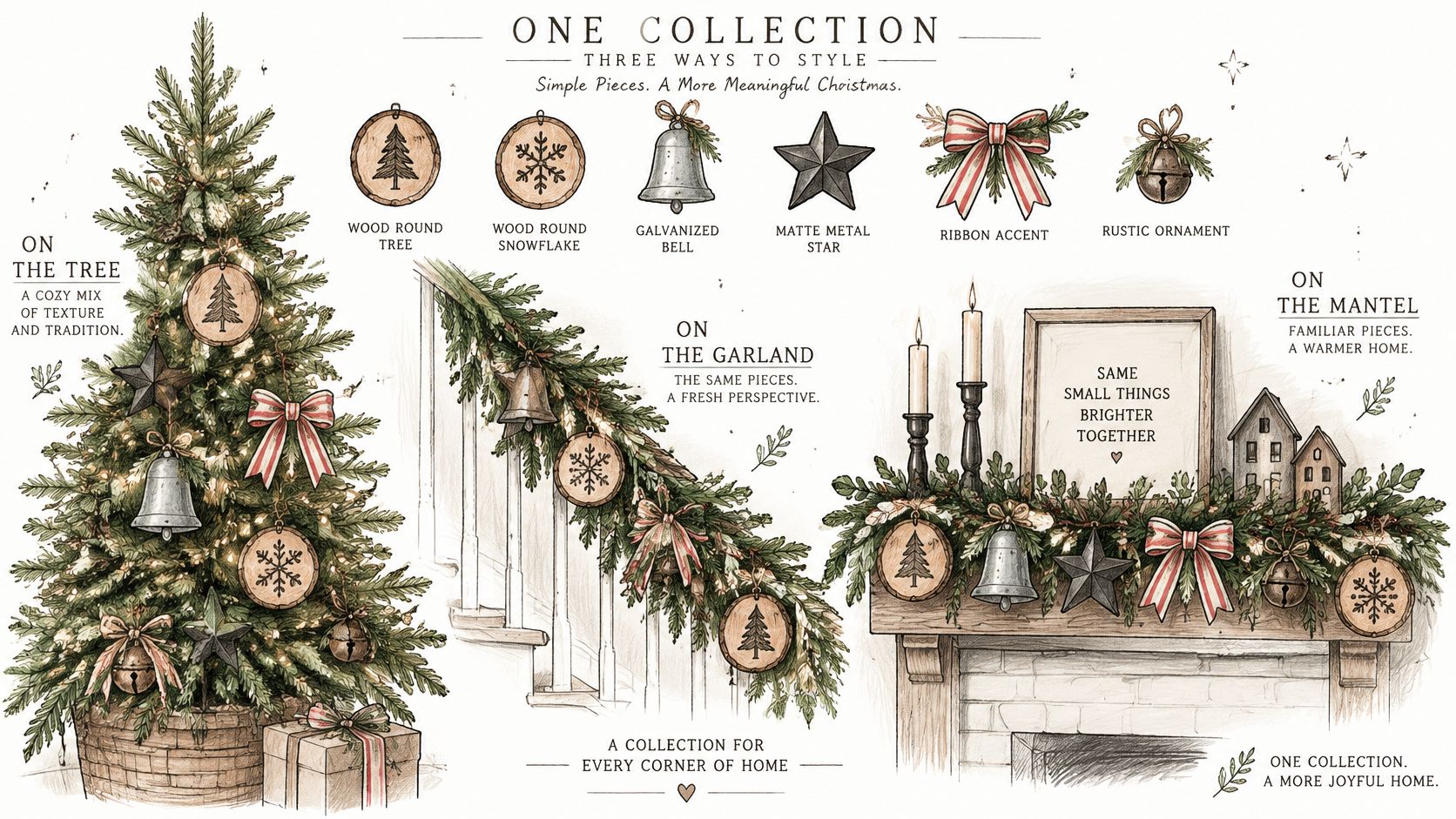
Take one small collection and move it. Two wood rounds, one galvanized bell, one matte metal star, one small ceramic animal, and a plaid ribbon tail. Six pieces. You'll use them three ways, which is how a house starts to feel coordinated without buying three sets.
This image shows the same kinds of pieces arranged across the three displays.
On the Tree
Hang the wood rounds low and inside the branch, where they won't tip. Put the ceramic animal higher, out of the path of a wagging tail. Let the metal star catch light near the top third. Tie the plaid as two or three bows, not a wrap on every hook. If you're planning the rest of the room around it, these farmhouse Christmas decorating ideas for connected spaces help you keep the tree from becoming the only decorated object.
On a Garland
Use fewer pieces and wider spacing so the greenery stays visible. The bell and one wood round are enough over a doorway. Keep anything breakable off the handrail side of a stair garland, where sleeves and hands brush past. For spacing and drape over a mantel specifically, N-TASH's Christmas garland styling advice is a helpful reference before you start wiring ornaments in.
This video walkthrough shows how small changes in spacing affect the whole display.
On the Mantel
Cluster the remaining pieces in a low bowl or along a small wood ladder only if they can't roll toward the fireplace opening. Pair them with a flat piece so the shelf isn't all hooks and hangers. The Rustic Christmas Truck Sign works as that companion. It's a 10 by 10 inch wood sign with the artwork printed on the wood rather than applied as vinyl, ready to hang beside ornaments on a gallery wall or mantel. It's not a substitute ornament.
If a display adds miniature lights, U.S. Consumer Product Safety Commission guidance on seasonal decorative lighting says to check for minimum wire size, strain relief, and overcurrent protection such as fuses, and it notes that UL 588 covers seasonal decorative lighting. Use only assemblies recognized by an independent lab such as UL or ETL, keep indoor rated sets indoors, and prefer LEDs near wood, fabric, and dried greenery because safety guidance describes them as cooler and more efficient than incandescent lights. Still check the wires. Don't pinch them under hooks.
Care Storage and Safer Placement
A display can look right on December tenth and fail in January storage. Most farmhouse ornament damage isn't dramatic. It's a thin wood round that cupped, a glued layer that lifted, or a finish that cracked at the paint line.
Wood and Humidity
Wood is hygroscopic. It gains or loses moisture until its moisture content nears equilibrium with the surrounding humidity. Composite Panel Association guidance on wood dimensional stability puts the fiber saturation point at generally about 28 percent moisture content, and it cites the Western Wood Products Association approximation of about 1 percent shrinkage across the grain for each 4 percentage point change in moisture content.
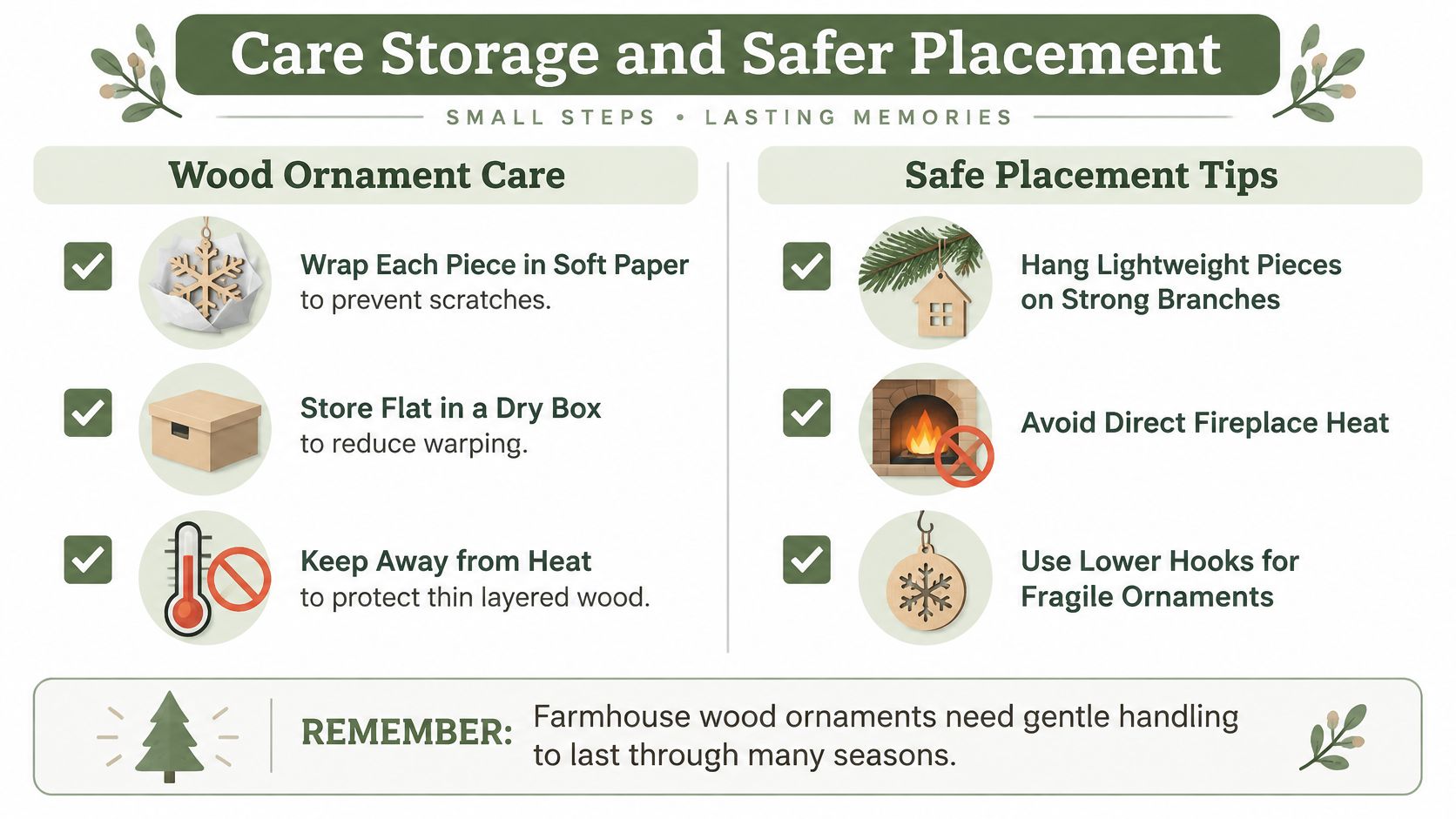
Coatings slow that movement. They don't stop it. USDA Forest Service guidance in that same bulletin says dimensional problems are minimized when wood is made and stored near its service conditions. In plain terms, store an indoor ornament near the conditions of the room where it hangs. Not in a damp basement. Not in an attic that swings from wet to baked.
Keep indoor wood pieces out of bathrooms, steamy kitchens, and unheated damp corners. A porch piece is a different object. It needs a weather resistant substrate, sealed edges, and hardware that won't corrode. Don't promote a living room ornament to the porch because it looked fine last year.
A Short Off Season Routine
- Wipe metal dry and check hooks and hangers for bending or rust.
- Wrap fabric loosely so plaid ribbon doesn't take a hard crease.
- Store wood flat in a dry box, each piece separated by soft paper.
- Inspect lighted pieces at the insulation, sockets, connectors, and battery doors.
- Retire damaged light strings instead of taping them for one more season.
Humidity cycling tells you more than one quick look on a dry afternoon. A piece that survives repeated damp and dry spells is the one worth rehanging.
End the routine with a decision for each piece. Keep, repair, or retire. A loose hanger is a repair. A cracked glued layer that catches your nail is usually a retire. Making that call in January beats finding it next December.
Gifts Worth Keeping and Your Next Step
An ornament earns a gift box when someone will still want it after the plaid trend shifts. A name, a year, a farm identity, or a plain durable shape in wood or metal usually outlasts a novelty piece tied to this season's colors.
Martha Stewart holiday trend coverage on reusing decorations reports that more than half of homeowners reuse decorations year after year, while 43 percent consider sustainability before buying new décor. It also points to reusable wood, fabric, recycled glass, and upcycled ornaments as ways to reduce waste. The practical version of that idea is simple. Fewer replacements, repairable finishes, and paper packaging beat a plastic shell around a piece that won't be kept.
Regional identity can do the same keeping work as a name. The Bluebonnet Merry Texmas Ornament - Bluebonnet Christmas Tree is a 3 inch round flat, one sided ornament with the design printed directly on one side, and it comes with a ribbon for hanging. A Texas recipient doesn't need that explained. That's the test. The meaning should be obvious to the person opening it.
Wrap It So It Arrives Intact
- Tissue around metal keeps it from scratching itself or the box lining.
- A rigid small box protects ceramic better than a gift bag.
- A note card can record who it's for, the year, and which room you pictured it in.
If the exact finish or wording is uncertain, a digital gift card is more honest than guessing. The shop states free shipping on orders over $49 and publishes a toll free support line for order questions, so check those details before you bundle gifts.
Pick the room. Pick the material that can live there. Then choose one piece worth unpacking next December.
Browse seasonal ornaments, personalized gifts, and complementary farmhouse accents at Farmhouse World, add a name or date where it makes a piece worth keeping, and start with the one room you decided on above.


