

Table of Contents
- A public-art anchor for a simple shape
- Three ways people actually use it
- The four-layer sequence
- How to set it on the wall
- What a patina actually needs
- Five installation moves
- Text the cutter will actually cut
- Timing, shipping, and who to call
- The checklist before you submit
You're standing in the driveway with a tape measure, trying to picture a peak on the porch wall before the first hard freeze. The house already has the right bones for a farmhouse look, but the wall still reads empty, and a canvas print would fade in the sun. What you want is a piece of mountain metal art that says place, not souvenir shop.
A good sign does that job with a few sharp edges. It can carry a family name, a year, or nothing but a ridgeline. The finish has to match the weather on that wall, not a generic promise that metal is outdoor-ready. Dry inland dust, salt air, and snow that sits in a letter all ask for different choices.
What Mountain Metal Art Is and Where the Style Comes From
Mountain metal art is cut or formed metal that shows peaks, a ridgeline, a pine line, or a full range. Many pieces add a name, a date, or coordinates. Sizes run from a 12-inch wall plaque up to a large porch piece you can read from the yard.
Think of it as a postcard reduced to metal. A postcard squeezes a valley into one frame. A sign squeezes that view into a few edges that still read from across a room. The pine line doesn't need shading. The peak doesn't need a sky. The silhouette does the work.
A public-art anchor for a simple shape
The same idea shows up at civic scale. Alexander Calder's Mountains and Clouds, conceived in 1976 for the Hart Senate Office Building in Washington, D.C., pairs a steel stabile with a suspended mobile, and the Architect of the Capitol describes it as his only known work to unite both formats. The stabile uses five triangular steel mountains and two curved arcs. The mobile holds four cloud forms. The mountain structure rises approximately 51 feet.
Those bold triangles are the whole lesson. Scale them down and you get a 12-inch wall sign with one clear outline. Nobody needs a 51-foot piece in a cabin. They need a shape that stays legible when the light is flat.
Three ways people actually use it
Buyers tend to land in one of three uses.
- Decorative wall art: Cabins and farmhouses use a single range as the room's graphic, often over a mantel or along a stair.
- Family or address plaques: A peak carries a name, an established year, or coordinates so the sign does a job as well as a look.
- Outdoor pieces: Gates and porches take the same motif where wind, rain, and sun will test the finish.
Peaks are simple, legible shapes that suggest permanence and place. That is why the motif works at every scale, from a niche beside a door to a public interior built around steel mountains.
Mountain Metal Art Styles, Motifs and Room Fits
| Style | Typical motifs | Visual character | Best room fit |
|---|---|---|---|
| Solid silhouette cutout | Single peak, pine line, ridge | Bold and graphic, reads from across a room | Entryway, mantel, farmhouse living room |
| Lettered mountain plaque | Peak with family name, established date or coordinates | Personal and gift-friendly | Front porch, cabin door, address display |
| Layered or dimensional ridge | Stacked peaks with offset layers | Depth and shadow lines | Rustic great room, stair wall |
| Abstract geometric range | Triangles and angular arcs | Modern and sculptural | Coastal-modern room, gallery wall |
| Mountain scene cut-out | Mountain with sun, birds or cloud shapes | Warm and narrative | Kids' room, bedroom, cabin |
Solid silhouette cutouts win entryways and mantels because the mass of metal is the picture. A single peak or pine line doesn't compete with a sofa or a mirror. Pair that wall with rustic western wall art when the room already leans ranch rather than lodge.
Lettered mountain plaques belong on porches, cabin doors, and address displays. The peak is the frame. The name is the point. Keep the lettering large enough to read from the walk, and skip tiny script that fills with dust.
Layered or dimensional ridges earn their keep on a rustic great room or a tall stair wall. Offset layers throw shadow lines that a flat cut can't. They need more depth on the wall, so don't squeeze them into a narrow hall.
Abstract geometric ranges suit coastal-modern rooms and gallery walls. Triangles and arcs read as sculpture first. Mesa, Arizona's City Hall uses that language in Strata, an abstract mountain range of steel and curved LED panels, as the Mesa Public Art Program describes it, with software tied to climate data. At home, skip the electronics and keep the angular peaks.
Mountain scene cut-outs, with a sun, birds, or clouds, feel warm and narrative. They fit a kids' room, a bedroom, or a cabin bunk wall. Fine cutouts look charming indoors and clog outdoors.
Design rule: The bolder the silhouette, the better it reads from a distance and the better it sheds weather. Thin lines are harder to keep clean and dry.
Pine and ridge lines belong in rustic rooms. Angular peaks fit modern farmhouse. Wave lines beside peaks fit coastal farmhouse, especially when the porch already has seating and you are weighing outdoor kitchen and lighting ideas so the sign isn't the only thing fighting the glare. A powder-coated Jesus Cross Wall Art piece, laser-cut from mild steel in sizes from 12 inches to 30 inches, can sit on the same mantel in Black, Copper, Gold, Silver, or White when the room needs a quiet vertical accent beside the range.
Materials and Finishes That Hold Up Outdoors
A durable steel sign is a sequence, not a color name. Corrosion resistance depends more on the full coating system and the prep than on the mountain drawing, which is the point of the guidance from Armorthane on corrosion prevention.
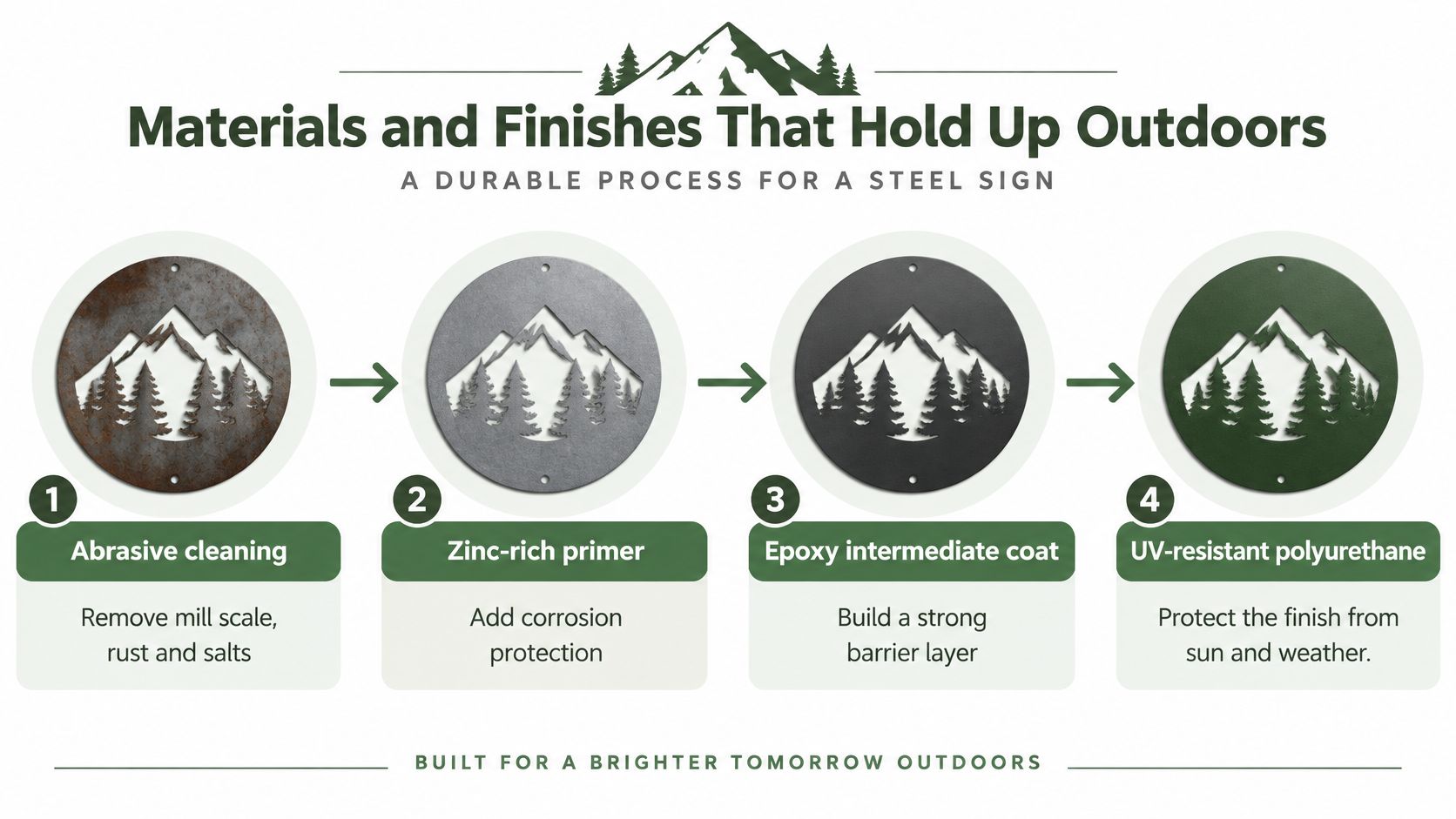
The four-layer sequence
- Abrasive cleaning removes mill scale, rust, salts, and other contaminants. Skip this and the pretty topcoat is sitting on a failure.
- A zinc-rich primer adds sacrificial protection. The zinc corrodes in preference to the steel when the film is breached.
- An epoxy intermediate coat builds barrier thickness so moisture has a longer path to the metal.
- A UV-resistant polyurethane or polyaspartic topcoat takes the sun and the weather the epoxy isn't meant to face alone.
Residual salts or a poor clean drive underfilm corrosion and coating undercreep. Zinc sacrifices itself. Epoxy blocks. The topcoat keeps ultraviolet light from chalking the film. Break any link and the chain fails at the cut edge first.
ISO 12944 durability categories describe expected time to first major maintenance as low, up to 7 years, medium, 7 to 15 years, high, 15 to 25 years, or very high, more than 25 years. Those spans move with film thickness, exposure, workmanship, and maintenance. No sign carries a universal lifespan. Specify rural, coastal, industrial, or snow-prone exposure, plus prep, layers, and touch-up, instead of a single year count.
The practical product basis for home signs is laser-cut mild steel with a powder coat, commonly in Black, Copper, Gold, Silver, and White. Powder coat is a baked film, not the liquid stack above, but the same logic applies. Clean metal, a continuous film, and prompt repair of chips.
| Finish | Look | Outdoor durability | Care |
|---|---|---|---|
| Powder-coated mild steel, Black | Matte or satin black with crisp edges | Strong while the coating stays intact; chips expose bare steel | Wipe with water and mild soap |
| Powder-coated mild steel, Copper, Gold or Silver | Metallic-tone painted finish | Same coating system; touch up any chips promptly | Same as black |
| Powder-coated mild steel, White | Bright painted look | Durability depends on the same coating; dirt and staining show more | Rinse regularly |
| Raw or weathering steel | Rust-brown patina with a rustic look | Patina needs repeated wet and dry cycles; poor in soil or standing water | Keep clear of soil and check drainage |
| Galvanized or zinc-rich finish | Silver-gray, matte | Zinc gives sacrificial protection; actual lifespan depends on exposure | Inspect cut edges and fastener holes yearly; rinse salt off in coastal sites |
Weathering steel forms a patina instead of a coating. It wants wet days and dry days in turn. Soil contact or a puddle under the sign stops that protection. A porch screen changes the exposure too. If you are choosing the right door mesh, match the mesh and the sign so salt and rain aren't trapped against the metal. More on sealed outdoor pieces sits in this guide to outdoor metal wall art.
Steel is 100% recyclable, and worldsteel's life-cycle guidance treats recycled scrap as an input whose benefit is counted across the full life. Paint, powder coat, and mixed mounting hardware should still be separated when the sign is replaced. Longevity and recyclability aren't the same job.
A short shop walk-through of how fabricated metal is cut and finished is worth a look before you pick a color.
Sizing and Placement Guide Before You Buy
| Nominal size | Typical placement |
|---|---|
| 12-inch | Mailbox, door frame, small wall niche |
| 15-inch | Entry wall, above a console table |
| 24-inch | Main living wall or covered porch |
| 30-inch | Feature wall, barn-style gable or wide porch |
A nominal size is the largest dimension of the finished piece, not a promise that every outline is a square. Verify the exact width and height before you drill. A 12-inch cross can measure about 11.5 by 8.75 inches, while a 12-inch tractor-style sign can measure about 11.5 by 11.5 inches. Same nominal size, different footprint. At 24 inches the cross runs nearer 23.5 by 17.75, and the square sign nearer 23.5 by 23.25. Tape both outlines. The narrower one can look lost on a wide porch beam.
How to set it on the wall
Scale the sign to about half the width of the furniture under it. A 60-inch console wants something near 30 inches, not a 12-inch plaque floating in the middle. Leave clear wall around the metal so the peaks aren't crowded by a frame or a sconce.
Hang at a height the room already uses. Over a mantel, the bottom edge clears the shelf by a few inches. In a stair hall, the center sits near eye level on the landing, not at the bottom step.
- Mark the footprint with painter's tape at that height.
- Step back to the doorway and check the balance against the furniture.
- Move the tape before you move the drill.
A taped rectangle on the wall is cheaper than a hole in the wrong stud.
Outdoors, put the sign under a porch overhang or on a gate that isn't in the weather's direct line. Narrow internal cutouts, sharp inside corners, and tight lettering trap water and snow. The Smithsonian's outdoor sculpture conservation work shows how long exposure breaks coatings down and lets corrosion, dirt, and pollutants build up. Rounded inside corners, open drainage, enough metal around narrow bridges, and a gap between layers keep water from sitting. Check cut edges, fastener holes, welds, and horizontal ledges on a schedule, and clean with water and a non-abrasive method.
Mounting hardware is not included. Magnetic hanging hardware is sold separately. Weigh the sign against the substrate before you order. Drywall needs a stud or a rated anchor. A cedar gate post can take screws the siding cannot.
Installing and Caring for Mountain Metal Signs
Match the climate before you match the color. A rusty look is not a maintenance plan.
| Climate | Main risk | Placement and care |
|---|---|---|
| Dry inland | Dust and low moisture | Wipe clean; covered spots work well |
| Humid | Moisture trapped at cut edges and fasteners | Check drainage; inspect edges twice a year |
| Coastal, salt air | Salt deposits that drive corrosion | Rinse with fresh water on a regular schedule |
| Snowy or freeze-thaw | Snow load and road salt | Keep off the ground; clear snow promptly |
| Heavy rainfall or standing water | Water pooling and no stable patina on weathering steel | Elevate the sign and confirm drainage |
Dry inland sites mostly fight dust. A covered eave and a wipe-down are enough for a sound powder coat. Humid sites hold moisture at every cut. If a letter has a closed counter, that bowl stays wet. Coastal salt works under a chip you can barely see, so fresh-water rinses matter more than another coat of wax. Snow and road salt belong off the ground. A sign screwed to a low fence rail will sit in a salt crust all winter. Heavy rain or standing water is the hard case for weathering steel, because the metal never gets the dry half of the cycle.
What a patina actually needs
Weathering steel needs repeated wet and dry cycles. Soil, standing water, or any pocket that stays damp blocks the protective patina. Conservation research summarized by CSIC notes that the patina may take roughly 5 to 10 years to mature, and that after 40 years of urban exposure about 20% of one weathering-steel artwork had severe corrosion that needed stabilization. A naturally rusty face does not mean low maintenance, and it does not mean the piece belongs in every climate. Sealed powder coat is the safer default on a coastal or constantly wet wall. More on stopping rust from spreading is in this guide on how to protect metal from rust.
Five installation moves
- Find a stud or a solid post, and confirm the sign's weight before you buy anchors.
- Mark the hole spacing with a level. A peak that tilts looks broken even when the metal is fine.
- Fit mounting hardware sized for that sign, not leftover picture wire.
- Leave a gap from siding, stone, or concrete so air moves behind the plate and rust stains don't run down the wall.
- Tighten fasteners enough to hold, not enough to crack the coating around the hole.
Inspect twice a year, rinse what the climate leaves behind, and repair chips before corrosion walks under paint that still looks intact.
That habit prevents most of the damage people blame on the metal itself.
Ordering With Confidence and a Final Checklist
The preview is the order. On a personalized mountain sign, the personalization preview shows the exact text that will appear on the finished piece. What you see is what you receive. If the name looks tight against a peak in the preview, it will look tight on the wall.
Text the cutter will actually cut
Skip emojis and emoticons. They won't render as metal. Hyphens and dashes do not appear on the final piece, so write dates with periods or slashes. "Est. 1998" or "Est 1998" is safer than a dashed year the machine will drop. Read the line out loud once. A missing mark is easier to catch before the file is cut than after the powder coat is baked.
Timing, shipping, and who to call
Personalized signs are made to order and ship within 7 to 10 business days. November and December need extra time, so a holiday gift ordered in the second week of December is a gamble. Free shipping applies on orders over $49. Hundreds of verified reviews sit near an aggregate 4.9 stars, and order questions can go to the toll-free line at 888-886-1005.
SaleHoo reported a typical price range for metal-art products of USD 14 to 24 in 2025. That band describes a broad product mix, not a 30-inch personalized steel plaque with a name and a powder coat. Compare size, finish, and whether the text is cut into the metal. A cheap blank and a made-to-order family sign are different purchases.
The checklist before you submit
- Decide indoor or outdoor, then match the climate row. Dry inland, humid, coastal, snowy, or standing water each change the finish and the height off the ground.
- Pick a finish. Black hides dust. White shows it. Copper, gold, and silver are the same coating system with a different face. Weathering steel only if the wall can dry out.
- Choose a nominal size and tape the actual footprint, remembering a cross outline and a square outline of the same nominal size don't cover the same wall.
- Choose a silhouette, a lettered plaque, or a scene. Bold metal for outside. Fine birds and clouds for inside.
- Check the preview character by character, including periods and slashes.
- Plan for 7 to 10 business days, longer at year end, and the free-shipping threshold if you are adding a second piece.
- Buy mounting hardware separately. If you don't know the recipient's wall or color, a gift card beats a sign they can't hang.
I would start with the climate and the taped footprint, then the preview. Those three catches stop the returns that size charts and color swatches never mention.
Farmhouse World makes personalized metal signs and rustic wall pieces for cabins, porches, and farmhouse rooms, including mountain-style silhouettes you can match to a finish and a wall. If you are ready to pick a size, a color, and a name that will cut the way you typed it, visit Farmhouse World and check the preview before you place the order.


