

You've painted the great room a warm neutral, the sectional is finally in place, and the wall above it still feels unfinished. The temptation is to grab the first longhorn print that matches the sofa. Resist it. Rustic western wall art succeeds or fails on proportion, material, and restraint, not on whether the piece contains a cowboy hat.
The right choice starts with a short checklist: wall width, sofa width, ceiling height, nearby wood tones, metal finishes, and the mood you want the room to create. From there, you'll decide among four things, motif, substrate, size and arrangement, and personalization. That order matters. A beautiful sign in the wrong material or scale will still look wrong.
Table of Contents
- Finding the Right Piece for Your Wall
- The Frontier Roots of Rustic Western Style
- Western Motifs Worth Knowing
- Wood, Canvas, or Metal
- Statement Piece or Gallery Wall
- Personalizing Custom Signs and Monograms
- Coordinating With Farmhouse Rooms
- Buying and Commissioning Checklist
Finding the Right Piece for Your Wall
Start with the wall, not the product catalog. Measure the open span above the sofa or console, then note windows, sconces, vents, and the ceiling height. A wall that looks broad from across the room may have much less usable width once trim and adjoining openings are accounted for.
Next, measure the furniture beneath it. The art should feel connected to that furniture, not stranded above it. For most sofa walls, aim for artwork spanning roughly two-thirds of the furniture below, a practical proportion also reflected in the guide graphic below. If you're working above a narrow entry console, use the console as your scale reference instead.
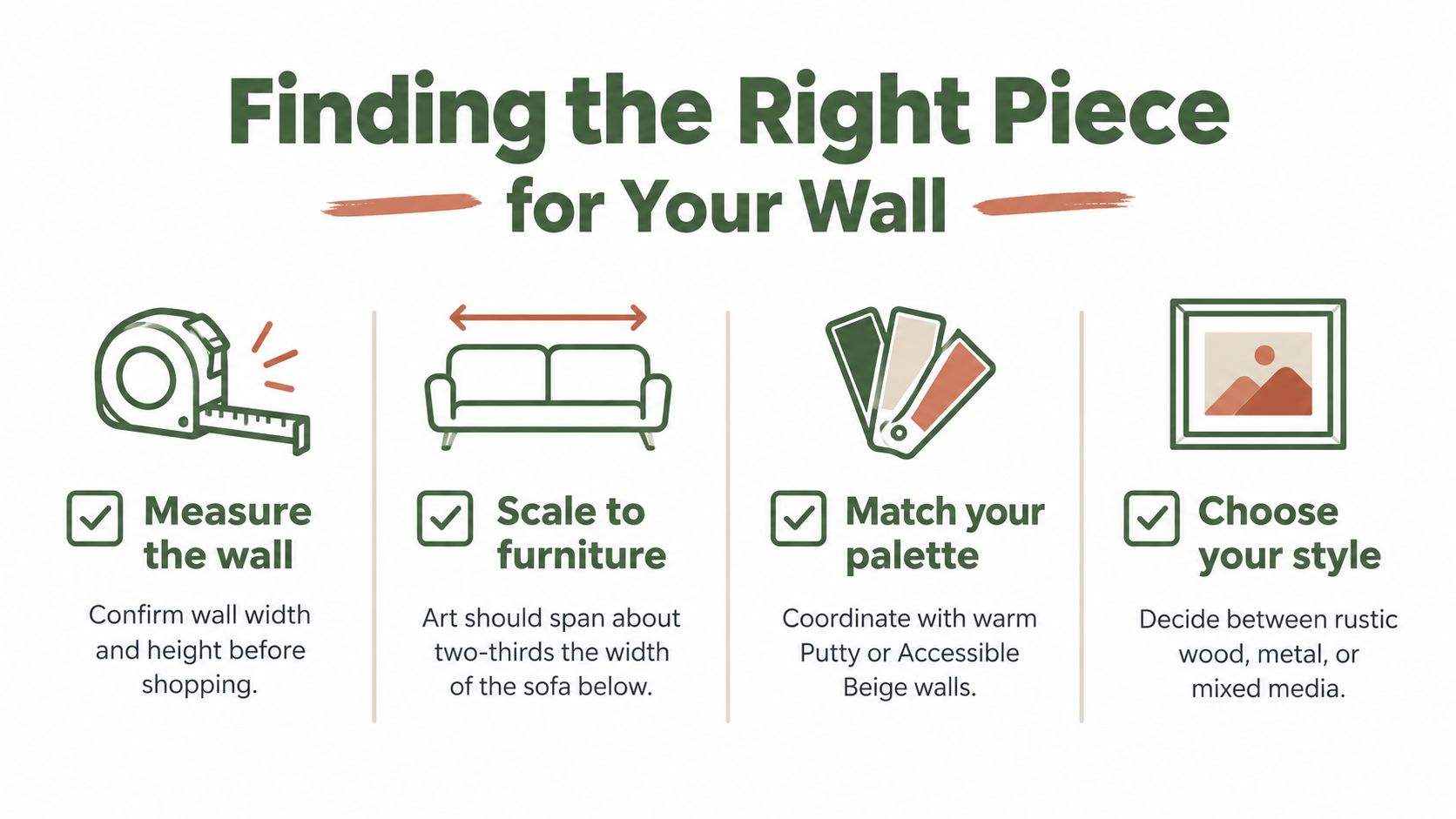
Make four decisions before shopping
- Choose the visual language. Decide whether you want a bold longhorn, an open-range vista, a working-cowboy scene, or a quieter ranch reference.
- Choose the material. Wood brings age and grain. Canvas feels lighter and more flexible. Metal gives you sharper outlines and stronger presence.
- Choose the arrangement. A single large piece usually creates a calmer room. A gallery wall adds movement, but it needs more planning.
- Choose the personal detail. A family name, ranch reference, monogram, or meaningful date can make the piece feel collected rather than generic.
Read the room's existing finishes before selecting the frame. Warm oak, leather, jute, and oil-rubbed bronze welcome weathered pine, saddle-colored canvas, and hand-finished steel. A room already full of patterns may need one quiet silhouette, while a plain linen sofa can support a denser scene or a personalized sign.
For a broader look at how material, texture, and age work together, compare your plan with these farmhouse canvas wall art ideas. The goal isn't to fill the wall. It's to give the room one deliberate point of character.
The Frontier Roots of Rustic Western Style
Rustic western wall art has a material history, and that history gives you a useful filter when shopping. In the 18th century, pioneer settlers in America lived far from cities and had limited access to manufactured goods, so they relied on locally available salvaged metal and rough-hewn wood. Homes & Gardens describes these frontier materials and the development of rustic wall decor, including the continuing importance of wood, stone, and metal.
Those early objects weren't made to look rustic. They were practical responses to scarcity. Their knots, rough edges, uneven surfaces, and signs of repair came from use and available materials. Later, people began appreciating that visual character, and the handmade look became part of the vocabulary of rustic and western interiors.
That distinction separates convincing western decor from costume decor. A piece with visible grain, a restrained patina, or a slightly irregular hand-applied finish suggests material honesty. A perfectly smooth cutout with an overly distressed printed surface often looks like a theme-park version of the same idea.
Shop for material honesty
Look for the evidence of how the piece was made:
- Wood should show grain or convincing texture. A weathered finish works best when it supports the form instead of covering every surface with artificial marks.
- Metal should have a purposeful finish. Subtle oxidation, hammered texture, or a controlled dark coating feels more settled than a bright, factory-clean surface.
- Canvas should serve the image. A soft prairie scene or monochrome horse study benefits from canvas because the substrate keeps the composition visually quiet.
- Mixed media should have a reason. Wood and metal belong together when the combination recalls a ranch sign, tool, gate, or working object.
If your room needs more than wall art, study these elements of rustic interior design for guidance on texture, natural materials, and balanced imperfection. Then return to the wall with a sharper question: does this piece look as though it belongs to the material world of the room?
Western Motifs Worth Knowing
Western motifs speak in different visual dialects. The best choice depends on how much literal cowboy language your room can handle and whether you want the artwork to dominate or support the furniture.
A longhorn skull is bold and architectural. Its sweeping horns create a strong horizontal shape, which makes it effective above a wide sofa or on a tall, quiet wall. The risk is obviousness. If the room already contains leather, cowhide, horseshoes, and tooled accessories, a highly literal skull can push the space into themed-restaurant territory.
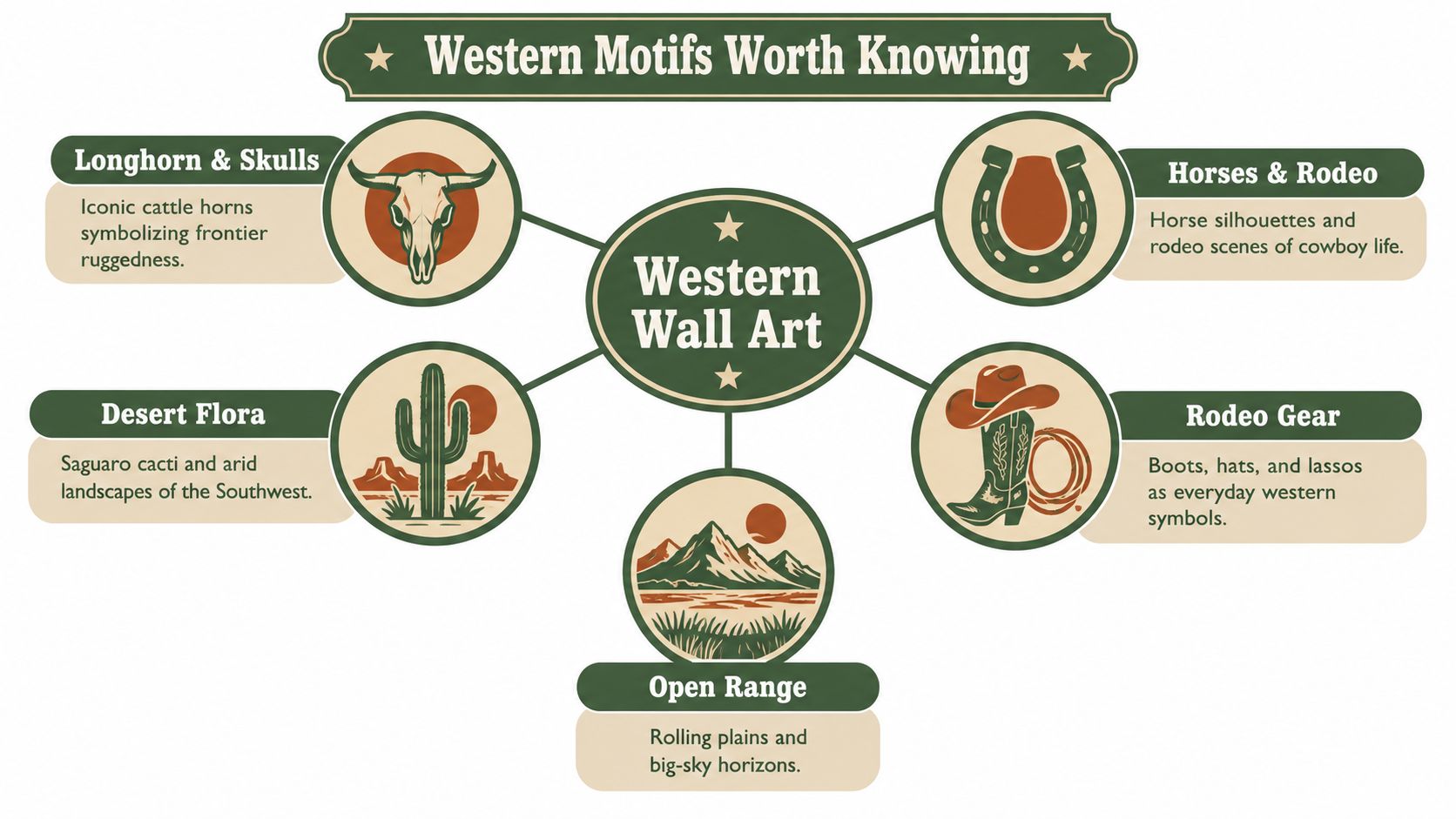
Match the motif to the room's mood
- Ranch and livestock. Horses, Hereford cattle, Brahma bulls, and longhorns feel grounded and substantial. Choose simplified outlines when the room already has heavy texture.
- Open-range vistas. Mesquite trees, saguaros, distant mesas, barns, and broad horizons add western identity without demanding a literal cowboy narrative. These are among the safest choices for a living room.
- Working-cowboy scenes. Horses being shod, branding tools, chuck wagons, and ranch work bring story and warmth. They suit libraries, dens, and rooms where guests can linger over details.
- Frontier typography. A ranch name, directional sign, or short phrase feels conversational. Bold slab serifs read as sturdy and established, while ornate western lettering makes the piece more decorative.
- Pastoral western references. Meadowlarks, sunflowers, weathered barns, and prairie grasses suggest the region without shouting it. This lane works particularly well with neutral farmhouse palettes.
A motif can be literal or abstracted. Literal imagery reads immediately but needs restraint. Abstracted silhouettes and atmospheric scenes blend more easily with farmhouse furniture, although they reward closer viewing.
Use the same test you'd apply to a large piece of furniture. Stand at the room's entrance and ask whether the art still has a recognizable shape. If it disappears, the contrast is too weak or the scale is too small. If it announces itself before anything else, simplify the surrounding accents.
This video offers another visual reference for the motif categories and the atmosphere they create.
Wood, Canvas, or Metal
The substrate changes both the visual weight and the practical behavior of rustic western wall art. Choose wood when you want warmth and visible age, canvas when you want flexibility, and metal when the location demands a tougher surface or a crisper outline.
| Substrate | Best Location | Durability | Style Fit | Typical Cost |
|---|---|---|---|---|
| Wood | Interior living rooms, entries, covered areas when sealed | Moderate, with moisture and finish depending on construction | Warm, aged, handcrafted | Varies by wood, size, and finish |
| Canvas | Interior living rooms, bedrooms, offices | Good indoors when printed and protected properly | Soft, adaptable, image-led | Varies by print quality and dimensions |
| Metal | Covered patios, porches, entries, ranch exteriors, interiors | High when properly coated | Graphic, durable, rustic-industrial | Varies by gauge, coating, size, and customization |
Wood for character
Wood has the strongest farmhouse presence because grain and unevenness give the wall tactile depth. Use sealed wood in humid or semi-outdoor locations, and inspect the back for a reliable hanging system. Thin boards can change shape with moisture and temperature, so avoid treating every “reclaimed” finish as automatically suitable for a porch.
Canvas for flexibility
Canvas works best for photography, atmospheric outdoor scenes, and artwork you may eventually move to another room. Premium longevity depends on the substrate, ink chemistry, and protective coating. 4over4's canvas guidance recommends heavy poly-cotton canvas, pigment inks, protective coating, and at least 150 PPI at finished size. Direct sunlight can still shift color, so place canvas away from strong sun or use UV control.
Metal for demanding locations
Properly powder-coated metal creates a fused barrier that helps resist corrosion, UV fading, chipping, and rust. For covered patios, screened porches, and ranch entries, Live Well Craft reports 500+ hours of salt-spray resistance under ASTM B117 for properly coated metal wall art. That benchmark doesn't make every sign suitable for every exposure, but it gives you a practical reason to ask about the finish instead of guessing.
For indoor combinations of warmth and structure, browse wood and metal wall decor and compare the finish against your existing hardware.
Statement Piece or Gallery Wall
A single statement piece is usually the safer choice above a sofa. It gives the room one anchor, leaves breathing room around the furniture, and lets a strong motif such as a longhorn silhouette or prairie horizon carry the composition.
For a standard sofa wall, look for a piece that feels substantial rather than timid. The exact width depends on the furniture and the wall, but the artwork should occupy a clear portion of the span beneath it without running into adjacent trim, windows, or sconces. Recent design coverage has favored one large western canvas, with 48-by-32-inch or larger pieces increasingly preferred over multi-print arrangements, as noted by IndexBox's farmhouse framed wall art analysis. That source also points to a market split, large-format and multi-panel sets are both gaining attention, so fit should decide the format, not fashion alone.
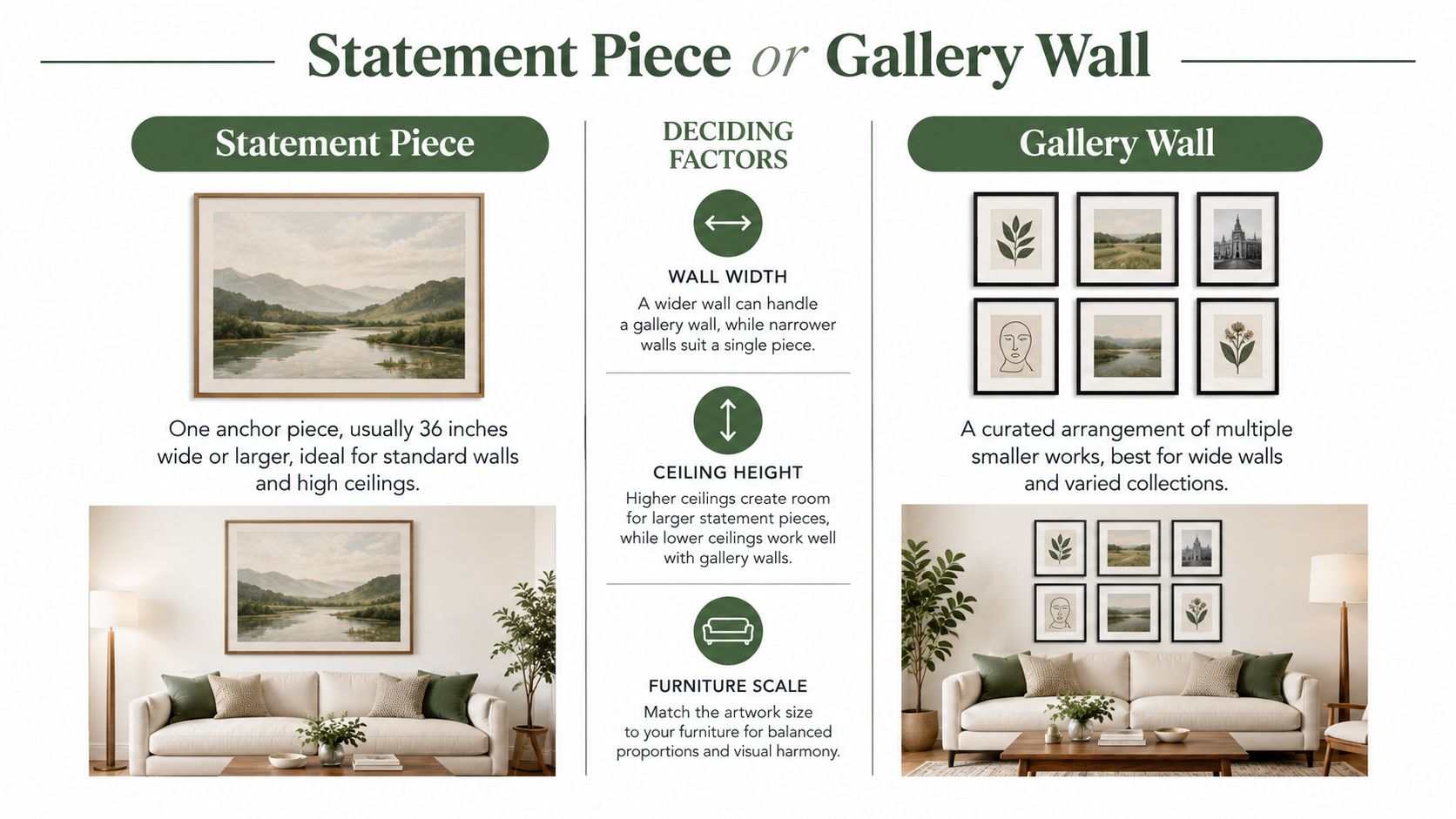
Use the wall as your deciding factor
Choose a statement piece when:
- The sofa wall is visually contained. One centered artwork can finish the wall without competing with openings.
- The room already has texture. Wood floors, a patterned rug, leather seating, and woven baskets don't need another busy layer.
- The ceiling is tall. A vertically oriented canvas or tall metal sign can give the room needed lift.
Choose a gallery wall when the wall is broad, the staircase needs rhythm, or you have several pieces that share a palette. Combine a small ranch plate, a weathered sign, a framed print, and one metal accent rather than assembling a random collection of unrelated souvenirs.
Hang the arrangement's centerline around 57 to 60 inches from the floor, keep roughly 2 to 3 inches between frames, and keep the overall grouping within about two-thirds of the furniture width. Lay everything on the floor first, then photograph the arrangement before putting holes in the wall.
Practical rule: If the wall is the quietest surface in the room, a gallery can add needed rhythm. If the room already has plenty of texture, one confident piece will look more expensive.
Personalizing Custom Signs and Monograms
Custom signs reward precision. Start with the wording, not the font. A family name, ranch name, address, established date, or short phrase such as “Home on the Range” gives the sign a clear job, while too much copy turns a wall accent into a difficult-to-read plaque.
Keep the text to three lines or fewer when the sign will be viewed across a room. Bold western scripts and slab serifs hold their shape at a distance. Thin script may look attractive in a product preview but lose clarity once it's mounted above a sofa.
Approve the details before production
Check every character in writing:
- Spelling and punctuation. Verify names, apostrophes, commas, and abbreviations.
- Casing and date format. Decide between “1923” and “Established 1923,” then confirm the exact treatment.
- Font and layout. Request a digital proof at the actual sign dimensions, not just a small screen mockup.
- Finish and color. View a finish sample under the room's lighting if possible.
- Mounting. Ask whether the sign uses keyhole slots, a French cleat, or standoff bolts.
Mounting deserves special attention above a sofa. A heavy metal sign needs a secure connection to suitable wall structure, not a casual anchor chosen from a kitchen drawer. Confirm the product's weight, bracket position, and installation requirements before approving the order.
For hospitality spaces, a bar, or a game room, these unique pub sign ideas can help you think beyond a family-name plaque while keeping the wording concise. For a home-focused treatment, compare the layout options in this guide to custom monogram signs.
The strongest personalized sign doesn't explain the room. It adds one specific piece of family or place, then lets the rest of the decor stay relaxed.
Coordinating With Farmhouse Rooms
Western wall art should share the room's material language. If you already have warm oak floors, a jute runner, black wrought-iron hardware, and a leather chair, choose weathered pine, raw-looking steel, or saddle-toned canvas. Don't introduce a completely unrelated finish just because the product photo looks attractive.
Metal undertones matter more than many shoppers expect. Oil-rubbed bronze hardware pairs naturally with darkened, rust-toned, or hand-hammered signs. Brushed nickel can look cold beside those finishes, so use it deliberately or select artwork with a cleaner black or charcoal treatment.
| Room Element | Recommended Art Material | Metal Tone | Motif Density |
|---|---|---|---|
| Warm oak floors | Weathered wood or canvas | Bronze, dark brown, black | Moderate, with open negative space |
| Patterned woven rug | Quiet canvas or simple metal outline | Matte black or aged bronze | Low |
| Solid linen sofa | Detailed canvas or mixed media | Black, copper, or muted steel | Moderate to high |
| Black iron hardware | Powder-coated metal or dark wood | Black or oil-rubbed bronze | Graphic and restrained |
| Leather seating | Reclaimed wood or saddle-toned canvas | Aged iron or bronze | Moderate, with ranch references |
Let textiles set the volume
A heavily patterned Navajo-inspired rug calls for quieter art. A single-line longhorn sketch, open-range silhouette, or restrained barn image gives the floor pattern room to breathe. A solid linen sofa can absorb a denser scene with multiple horses, a ranch-name banner, or a layered vista.
Use the 60-30-10 rule loosely, not as a rigid formula. Let the walls and major furniture establish the dominant palette, let the floor and textiles provide supporting texture, and let the western artwork act as the accent moment rather than turning the entire room into a costume set.
Echo one motif somewhere else. A leather pull, wool throw, vintage horseshoe, or saddle-colored cushion is enough. Repeating every western symbol around the room makes the art feel pasted on instead of rooted.
The U.S. home decor category provides a broad commercial backdrop for this style. It's projected to rise from USD 215.21 billion in 2025 to USD 227.43 billion in 2026, then reach USD 292.71 billion by 2031, with a projected 5.18% CAGR from 2026 to 2031, according to Multi Home Decor's market overview. That scale explains the variety available, but it doesn't change the buyer's basic task: choose one piece that belongs to the room you already own.
Buying and Commissioning Checklist
Before you click “add to cart” or send a deposit, test the piece against the wall, the furniture, and the installation conditions. Rustic western wall art should arrive as a planned finish, not as a storage problem that happens to be decorative.
Confirm the fit
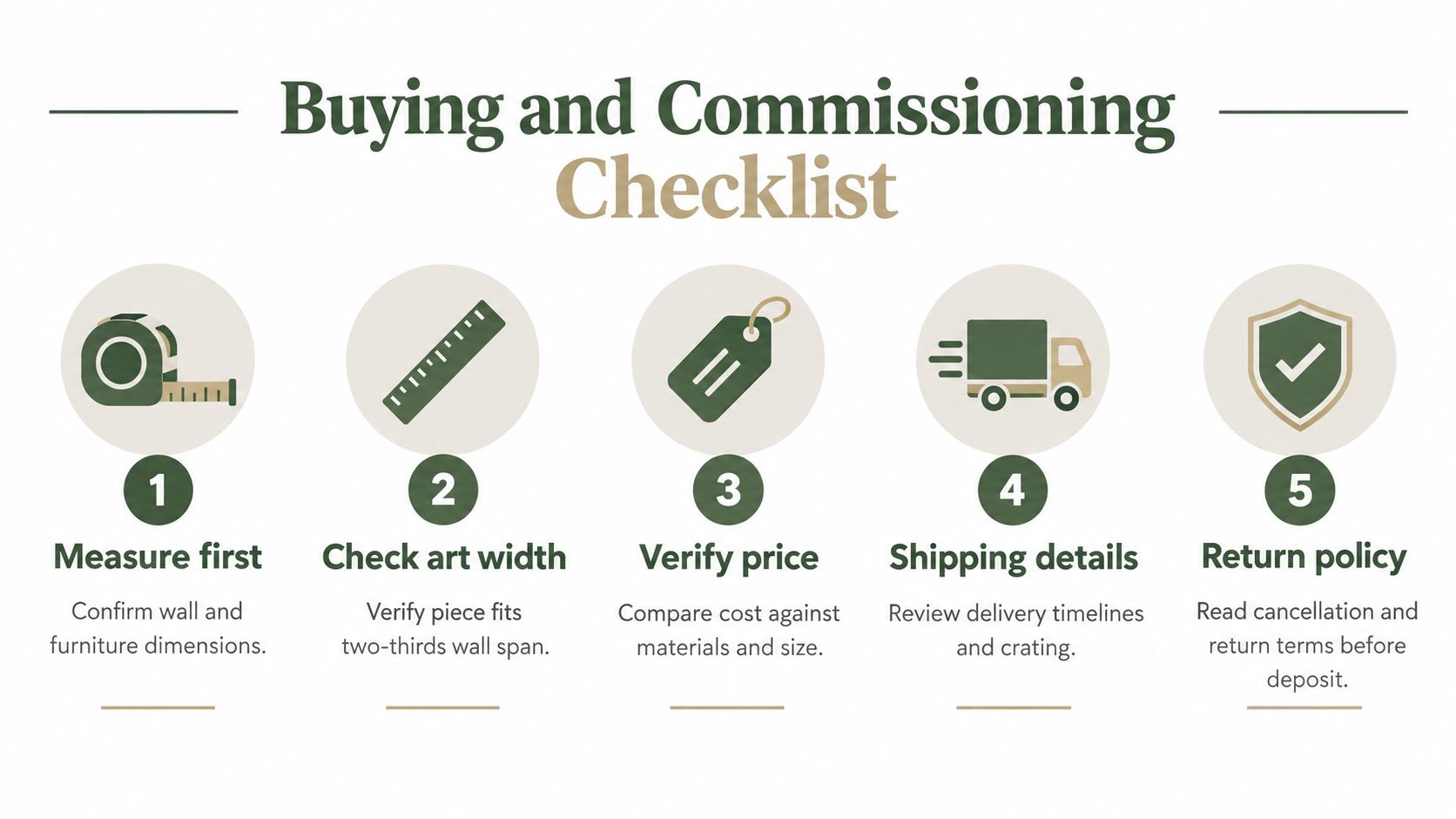
- Measure first. Record the wall width, usable height, sofa or console width, window positions, and ceiling height.
- Check the art width. Aim for roughly two-thirds to three-quarters of the furniture length beneath it, while leaving enough side clearance for trim and adjacent objects.
- Set the hanging height. Place the arrangement's centerline near eye level, generally around 60 inches from the floor, while adjusting for unusually tall furniture or ceilings.
- Inspect the substrate. Look for continuous wood grain, substantial metal without sharp burrs, and canvas with a secure backing. If direct sun reaches the wall, ask about protective coating and UV exposure.
- Approve custom wording. Lock the spelling, punctuation, date format, font, layout, color, and finish in writing.
- Request a full-size proof. A digital proof at the actual dimensions exposes crowded lettering and weak contrast before production.
- Verify mounting hardware. Ask about keyhole slots, French cleats, standoff bolts, bracket placement, and the wall structure required.
- Review delivery terms. Confirm production timing, crating, damage procedures, and return or cancellation rules, especially for oversized pieces.
- Save the paperwork. Keep the order confirmation and approved proof together so installation matches what you authorized.
Farmhouse World offers rustic wall art, personalized metal signs, canvas pieces, wood signs, and farmhouse accents, including a customizable horse wall sign for indoor or outdoor decor. Visit Farmhouse World to compare materials, sizes, and personalized options, then choose the piece that fits your wall before you choose the one that merely matches your theme.


