

You're standing in the hallway with a red tin Santa in one hand and a tape measure in the other. The corners are scuffed, the red is a little dull, and the person at the sale said it came from an old hardware store. You still can't tell whether it belongs on a nail by the door or in a frame, away from the damp.
That confusion is normal. Antique Christmas signs, later vintage prints, and new pieces made to look worn all share holly, bells, and greeting script. Age is not a feeling you get from the picture. It sits in the metal, the paper, the wood, and the way the surface has worn.
Sort the family first. Then you can read the age, pick a size that fits the wall, and store the piece so it survives another season.
Table of Contents
- Antique Christmas Sign Styles at a Glance
- Materials and Finishes Compared
- How to Date and Authenticate an Antique Sign
- Sizing and Placement by Room and Outdoor Space
- Personalizing Signs Without Faking Age
- Caring for, Storing and Displaying Signs Safely
- Choose the Right Antique-Style Sign for Your Home or Gift
Antique Christmas Sign Styles at a Glance
Five families cover most holiday signs: lithographed tinplate, porcelain enamel, paper or card trade displays, farmhouse-style wood, and personalized metal. Each family gives you a starting point for reading a sign's age and deciding how to handle it. A familiar Santa or holly design can appear on a genuine old sign, a vintage-era print, or a modern reproduction.
| Style | Typical Era | Common Subjects | Best Placement |
|---|---|---|---|
| Lithographed tinplate advertising sign | Late 1800s to early 1900s | Santa, toys, trees, shop greetings | Indoor wall, glazed or sheltered |
| Porcelain-enamel holiday sign | Early 1900s through mid-century | Holly, bells, greetings, trade names | Indoor or covered outdoor wall |
| Paper or card trade card display | 19th century | Children, gifts, Santa | Indoor frame only |
| Farmhouse-style painted or printed wood | Contemporary reproduction | Red trucks, trees, Merry Christmas script | Indoor wall, mantel or door |
| Personalized powder-coated metal sign | Contemporary | Family name, year, custom message | Indoor or outdoor, depending on finish |
The era column is a guide, not proof of age. A wood sign with an old-fashioned greeting may still be a contemporary reproduction. Likewise, a seasonal subject alone cannot establish when a sign was made. Look at the construction and surface before treating a sign as an antique.
Placement also depends on how the sign will meet its surroundings. Paper and card belong in an indoor frame, away from exposure. Signs intended for a covered outdoor wall or porch still need a suitable finish; a style label by itself does not guarantee weather resistance. Keep this distinction in mind when comparing an old sign with a newer piece designed for seasonal display.
Holiday signs also sit among the other decorations in a room. In a 2023 U.S. survey, 70% of respondents said they planned to buy ornaments, and 56% planned to buy string lights, according to Statista. Walls, windows, tabletops, and porches can work together, so consider the sign's placement as part of the whole display.
Use the table to identify a likely family, then check the sign itself before cleaning or hanging it. “Old-looking” describes a style; the sign's construction and condition help you judge what it is and how gently to handle it.
Materials and Finishes Compared
A sign's material works like its chassis: it sets the limits for weather, cleaning, and handling. The image is the finish on top, and its condition can reveal how the sign has been used.
Offset lithography, patented in 1877, let printers apply multicolored images to shaped tin. That made detailed holiday advertising practical to produce in quantity. The Victoria and Albert Museum's advertising collection also includes nineteenth-century Christmas trade cards, showing that seasonal graphics appeared in commercial print well before the modern farmhouse look.
| Material | Construction | Typical Finish | Durability | Main Risk |
|---|---|---|---|---|
| Lithographed tinplate | Thin steel coated with tin, printed in colour | Printed ink under lacquer | Good indoors, vulnerable when lacquer fails | Rust after coating breaks |
| Porcelain enamel | Powdered glass fused to steel above about 1,400°F | Glassy, glossy colour layer | Very resistant to UV and weathering | Chips expose dark steel edges |
| Printed paper or card | Paper or card, often mounted to board | Printed surface, sometimes varnished | Fragile; sensitive to light and humidity | Acid damage and moisture |
| Painted or printed wood | Wood base with printed or painted art, usually sealed | Matte or satin, grain visible through print | Good indoors; swells in damp air | Warping and cracked finish |
| Powder-coated metal (modern) | Steel or aluminum with baked-on coating | Uniform, even colour | Strong indoors and outdoors | Coating chips can start rust near salt air |
What Each Finish Does
Lithographed tinplate has a thin tin coat, coloured inks, and a lacquer layer over steel. If the lacquer breaks, the steel can rust. Fading, scratches on raised areas, bends, and small rust blooms can all mark years of use.
Porcelain enamel forms when powdered glass is fused to steel above about 1,400°F. Its glassy surface resists sunlight and weather better than printed tin, but a chip can expose a dark steel edge. Water left at that exposed spot can lead to rust.
Paper and card trade cards are the most delicate option. Light fades their printed surfaces, while humidity can make the paper buckle. A frame helps protect them, so keep them indoors rather than hanging them on a porch.
Painted or printed wood brings visible grain and a warm look indoors. Moisture can swell the board and crack its sealer. For a new wood sign, The Knotty Lumber Co.’s finishing guide explains how a protective finish can preserve the grain without hiding it.
Powder-coated metal is a modern choice for signs that may be displayed outdoors. Its baked coating creates a tough, even surface, though a chip can allow rust to begin, especially near salt air. For examples of this contemporary style, see these farmhouse metal signs.
Practical rule: Identify the material before cleaning. Strong polish can lift original lacquer or printed ink, and can remove oxidation that helps show a sign's age.
How to Date and Authenticate an Antique Sign
A weathered Santa sign may be an old shop display, a vintage-era print, or a modern panel made to look worn. Treat nostalgic look as a style, not a date. Start with its construction, then compare the evidence across the surface, edges, and back.
Holiday signs developed alongside commercial Christmas traditions. By the nineteenth century, trees commonly carried candles, while German makers produced glass ornaments shaped like spheres, fruit, and nuts. The Week's history of holiday décor recounts that F. W. Woolworth bought a box of German ornaments in 1880, after initially hesitating. In 1903, General Electric sold a mass-market string of Christmas lights for $12, more than $400 in modern value, as a safer alternative to candles. Signs from the late nineteenth and early twentieth centuries reflect the period when Santa, holly, bells, trees, and gift promotions became familiar shop graphics.
A routine you can run at the table
The National Museum of American History's Christmas holdings include nineteenth-century advertising cards and materials dated 1899 to 1917. This offers a reference point for promotional graphics, not proof that a similar-looking sign comes from that period. Examine the sign in order:
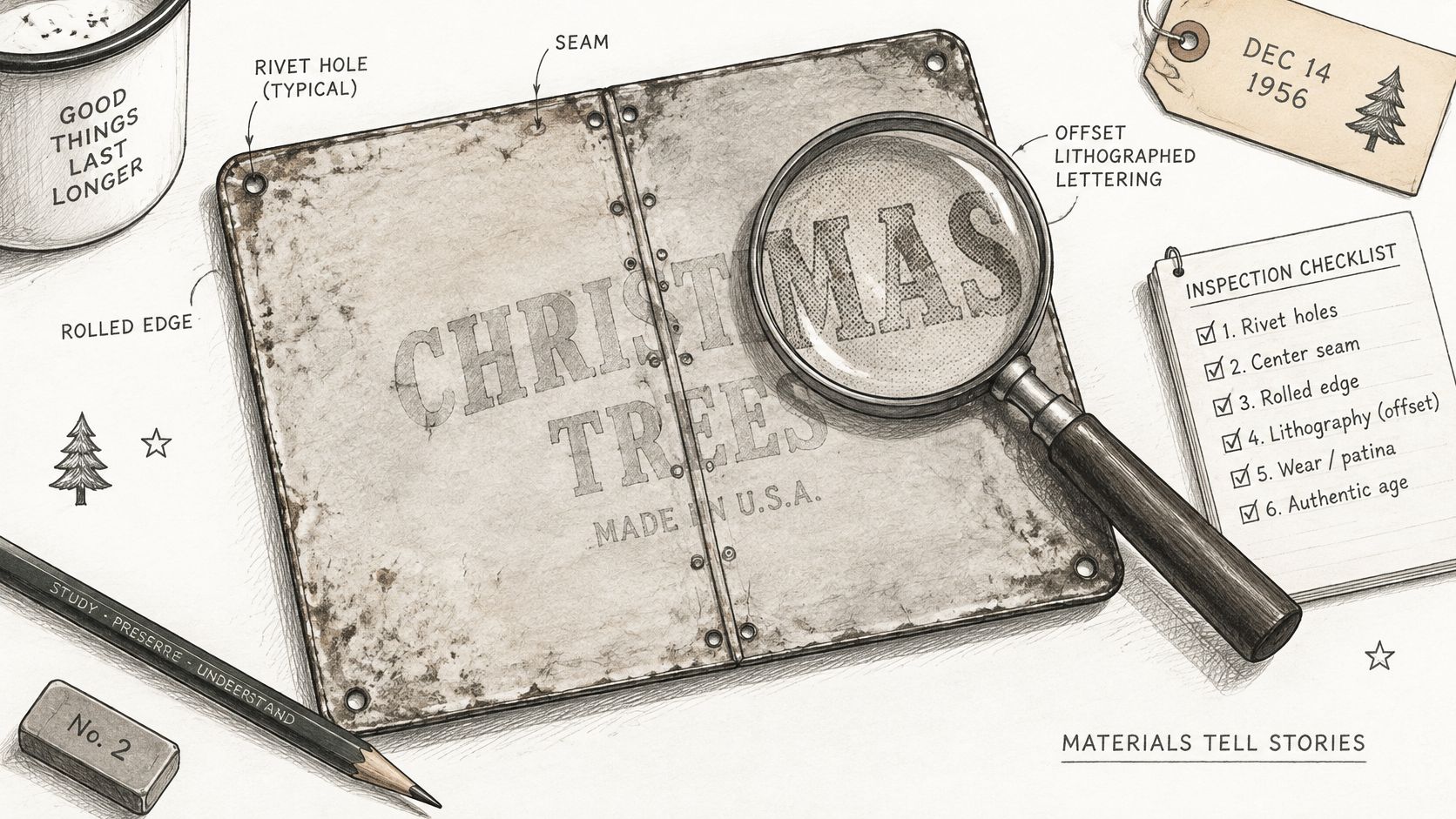
- Identify the substrate. The substrate is the material beneath the image. Tin with offset-lithographed graphics suggests factory production. Hand-painted lettering, paper mounted on board, and later screen printing point to different methods and may indicate a different age.
- Read the edges, holes, and fasteners. Evenly spaced factory holes should suit the metal's thickness. A rough drilled hole or a modern screw fitted into an old flange may show that the sign was altered. Treat either clue as part of the evidence, not a verdict.
- Check the printing. Look at registration, or how well the color layers line up. A crisp, perfectly even field of tiny dots can point to a modern press rather than an early tin run.
- Compare wear across the sign. Genuine use often leaves marks on raised areas, corners, and places people handled. Rust in neat patches on a flat face, without corresponding wear on raised spots, may have been added.
- Consider the subject and wording. A Santa image paired with a toy-shop name fits the commercial graphics represented in historic collections. A plain religious line without a shop name could be later or homemade, so the subject alone cannot establish a date.
- Look for marks and repairs. Check for a maker's name, printer's line, old repairs, or fresh paint covering original ink. These details can help distinguish an untouched sign from one that has been restored.
- Record what you find. Note the size, material, printing method, inscriptions, maker marks, and restoration. Photograph the edges and back clearly. Those details give you a useful record before you describe the sign as antique.
Fading, dents, and stable surface oxidation can preserve clues about a sign's use. Repainting, hard scrubbing, and fabricated rust can hide or remove them. If cleaning is needed, first identify the material and finish. A printed surface and painted lettering may not tolerate the same treatment as bare metal.
The same careful approach applies to other old household objects. This guide to how to identify authentic antique chairs explains how construction and wear patterns can matter more than a darkened finish. On a sign, too, the surface color is only one part of the evidence.
What the Sales Words Mean
- Antique: Commonly used for an item about a century old or older. Faded color alone does not establish age.
- Vintage: A looser term for an older item that may be less than a century old.
- Retro: A later design that revives an earlier look. The sign itself may be new.
- Vintage-style or reproduction: A newly made sign designed to imitate an older one. It can suit a nostalgic display when described accurately.
If a seller cannot identify the material or show the back, treat “antique” as a style claim until the construction and wear support a date.
Sizing and Placement by Room and Outdoor Space
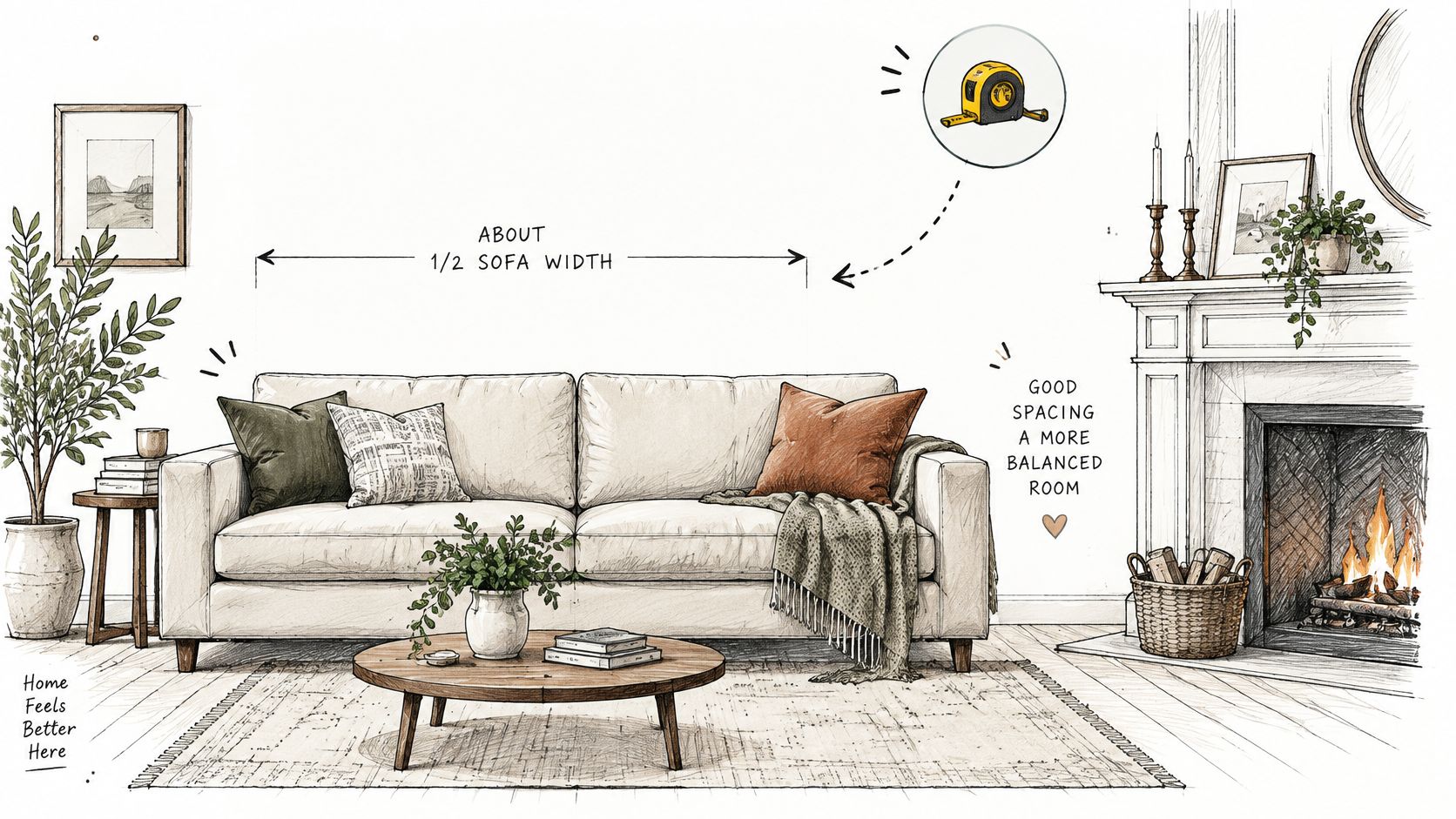
A sign that fits a shop wall may disappear above a sofa or crowd a mantel. Let the available surface guide the size, then choose a spot where the sign can be seen without competing with nearby furniture.
For wall art viewed while standing, place the center about 57 to 60 inches from the floor. Check the furniture below it, too. The sign should feel connected to the room, with enough space to avoid looking crowded.
| Placement | Mounting Guidance | Example |
|---|---|---|
| Mantel or shelf | Stand the sign or lean it against the wall. Keep it under about one-third of the mantel width. | 10-inch red truck sign |
| Entryway or front door | Hang the center near 57 to 60 inches, or center it on the door if the door is the whole canvas. | Name or address metal sign, often 12 to 36 inches |
| Over a sofa or console | Set the center near 57 to 60 inches, leaving several inches of wall between the furniture and sign. | Large statement sign |
| Kitchen wall | Place it near eye level, beside a window or open shelving. | Vintage-style tin sign |
| Gallery wall cluster | Leave 2 to 3 inches between frames. Align their tops or centers, not both. | Mixed signs and frames |
| Covered porch or coop | Hang under the eaves, out of direct rain, at eye level. | Weather-rated metal sign |
A small wood sign on a mantel
A Rustic Christmas Truck Sign 10" is identified as a 10-inch sign. On a 36-inch mantel, that width stays under about one-third of the shelf, so it can serve as an accent beside greenery rather than dominate the display. For any wood sign, choose a mounting method suited to its size and the surface it will hang from.
Above a sofa, a larger sign or a group of smaller frames is usually easier to see. Leave a clear gap above the sofa back, so the artwork does not feel pressed against the furniture. In a kitchen, a modest tin sign beside a window can sit within your line of sight while you work. A very large panel may overwhelm that smaller wall space.
Groups and the outdoors
For a cluster, choose one alignment. Line up the tops or the centers, then keep 2 to 3 inches between frames so their edges have room. Aligning both tops and centers can make a mixed group look uneven, especially when the frames differ in size.
Outdoor placement calls for more care. Put signs under eaves and out of direct rain, and choose a finish suited to the location. Keep the sign near eye level if it carries a name or address meant to be read from the path. A guide to farmhouse Christmas decor outside offers ideas for coordinating greenery and lighting around the display. Fragile tin and other delicate older materials are better kept indoors or protected from weather.
Personalizing Signs Without Faking Age
A new sign with your name on it is not a failed antique. It's an honest object. Personalization is the clean alternative to fake age: a contemporary panel can carry a family name, a year, a monogram, or a short message and still sit comfortably in a farmhouse room.
Nostalgia is doing a lot of the shopping right now. 60% of Gen Z consumers planned to purchase nostalgic-themed décor in 2025, and 55% of ornament shoppers wanted pieces reflecting individual interests, as Home Textiles Today reported. That demand is partly met by new goods built to feel like a memory. Buying one on purpose is fine. Selling one as a hundred-year-old shop sign is not.
Choices that stay readable
Farmhouse World offers metal signs with a name, date, monogram, and design variations, in colors that include Black, Copper, Gold, Silver, White, Red, Blue, and Green.
- Keep the words short. A porch sign has to read from the walk, not from six inches away. A last name and a year usually beat a full sentence.
- Echo a classic holiday palette. Red, cream, or green lettering on a darker ground recalls old shop graphics without copying rust and fake chips.
- Match the finish to the spot. Use an outdoor-rated coated metal sign for a porch or a coop. Save paper, early tin, and unsealed wood for indoor walls.
On select items, the business validates the personalized design before production. That's your proof step. Check the spelling, the year, and the line breaks on that proof before you approve it. A swapped letter is cheap to catch on screen and annoying once the coat is baked.
When you give the sign, say what it is. Call it a new piece made for this house, not an heirloom from a hardware store. The recipient can love the look and still know the truth, which is the whole point of an honest reproduction.
Caring for, Storing and Displaying Signs Safely
Holiday rooms can fill quickly with signs and decorations. Give each sign enough space to hang securely, and clean it according to its surface. A fragile print needs a different touch from sound enamel, and a modern reproduction may tolerate a damp cloth while an older finish may not.
John Lewis reported that sales of retro-nostalgic décor rose 180% in 2025, while retailers described fresh demand for colorful, densely layered arrangements, according to the BBC. When a room has more decorations, take extra care that a sign's edges and hanging hardware are not caught by garlands or crowded against other objects.
Cleaning without erasing the date
Start with the gentlest method. Dust fragile ink and paper with a soft brush. This lifts loose dust without rubbing the printed surface. Avoid wet cleaning paper or card.
For sound enamel, use a soft cloth with mild soapy water, then rinse and dry it. Water left sitting in a chip can contribute to problems at the damaged edge. Skip abrasive polish: it can cut through lacquer, lift ink, or remove wear that helps show a sign's history. A reproduction's finish may be more tolerant, but check its care instructions rather than assuming every coating can take the same treatment.
Before hanging a sign, photograph its front, edges, and back. These pictures record its condition before seasonal decorations go up, so you can compare them later if it is bumped or scratched.
Storage and the hazards age adds
Keep sign faces from touching during storage. Place acid-free tissue between metal pieces, then lay them flat or stand them upright in a space that does not swing from damp to dry. Store paper in an acid-free folder inside a box, away from sun. Keep wood off a concrete basement floor, where moisture can wick into the grain.
If a sign must travel or stay in a crate for months, use padding at the edges and keep bare faces from pressing together. The same care used to protect antiques from humidity and shock helps reduce the chance of damage while it is packed or moved.
Check these hazards before hanging a piece near kids, pets, or a tree:
- Old wiring on an illuminated sign may be brittle. Have someone who works with old electrical parts inspect it before plugging it in.
- Flaking coatings can shed bits onto a table or within a pet's reach. Avoid placing the sign where loose flakes can be disturbed.
- Sharp metal edges can cut, and loose hanging hardware can fail if a garland catches it. Check both before hanging, then make sure decorations are not pulling on the sign.
Good care depends on the object's condition, not just its age label. Handle an older sign gently, especially around chips, worn ink, and loose edges. A modern reproduction may have a more durable finish, but inspect its coating and hanging hardware before display. Keep the original surface intact, and store each piece so its face and edges remain protected.
Choose the Right Antique-Style Sign for Your Home or Gift
Three buyers walk into the same stall, and they should leave with different things.
The collector wants an original. Buy from a seller who states age, restoration, and condition in plain words. Photograph the edges and the back before you pay. Price follows condition, rarity, and a story you can check. An old-looking sign is not automatically valuable, and a pretty fake isn't a bargain just because the rust looks even.
The decorator wants the look at a price that won't jump next December. Use the placement table, then pick a modern wood or coated metal sign in that size. A reproduction labeled as new is a stable choice. You're paying for the picture and the finish, not for a date you can't prove.
The gift buyer should match the object to the person, not to a trend photo. A name or address panel suits a porch. A small red-truck wood sign suits a housewarming for someone who already likes farmhouse rooms. A coop or ranch panel suits a backyard flock keeper. Candles or a textile can sit under the sign so the gift isn't only a rectangle on the wall.
Mixing a true older piece with a clearly new one is easier when you treat them as partners, not rivals. This look at mixing vintage and modern decor is about balance in a room, which is the same decision you're making on one wall.

A short list before you pay or wrap
- Decide the job. Collection, room décor, or gift. One sign rarely does all three well.
- Measure the wall or mantel. Keep a mantel piece under about one-third of the shelf width, and aim a wall piece's center near 57 to 60 inches.
- Confirm the material fits the room. Tin and paper stay indoors. Enamel can take a covered wall. Coated metal can go outside.
- Read the proof on any personalized order, including spelling and the year.
- Keep the care notes with the sign so the next person doesn't polish the lacquer off.
A good buy is the one whose material, date claim, and hanging spot all agree with each other.
Farmhouse World makes personalized metal signs and rustic holiday wall pieces, including wood signs with classic red-truck artwork, for entryways, porches, and indoor walls. If you're choosing a new piece on purpose, rather than guessing at a flea-market date, start with a size and finish that match the room. Visit Farmhouse World to compare signs you can hang this season and label them clearly.


