

You're at the mantel with a gold candle holder in one hand and a candle that may not fit in the other. The wood is rough, the linen is already down, and lamplight makes the metal look richer than the piece may be. Color is the easy decision. Fit, stability, and the actual finish decide whether it lasts past the first dinner.
Table of Contents
- Start With the Mantel and Three Questions
- Match Candle Size to Each Holder
- Gold Finish Types and How Each Wears
- Safe Placement and Stability Checks
- Styling Centerpieces and Mantels Step by Step
- Mixing Gold With Wood, Iron and Textures
- Clean and Refresh Gold Holders Before Your Next Gathering
Start With the Mantel and Three Questions
That glow against rough wood and linen is why a gold candle holder gets bought before anyone checks the socket. Most gold-look holders are plated, painted, or coated over another metal. The color doesn't show what will wear, or whether the cup suits the candle you already own.
Candlesticks earned that warm metal look over centuries of real use. The MAK Museum Vienna notes they were among the most important household utensils because they supported the most refined artificial light available for hundreds of years. The museum estimates that only about 2 to 4% of earlier goldsmiths' work has survived, which is why a surviving gold piece still reads as prestige, not just a lamp.
On a farmhouse mantel, run three checks in this order.
Does the candle fit? The socket or cup has to match the candle, and the base can't rock.
Which finish will last? Solid brass, gold plating, painted gold, and gold-tone resin each wear on a different clock.
Is the setup safe? The candle needs a level, noncombustible surface and a clear zone from curtains, dried greenery, and paper before anyone lights it.
Fit comes first, then finish, then placement. Styling, mixing metals, and cleaning only pay off after those three hold.
Match Candle Size to Each Holder
Choose the candle by the holder's opening, not by how the pair looks in a product photo. A close but loose fit lets a candle rock; a candle wider than its plate can drip beyond the base or sit at an angle. Check the candle you intend to use before buying or lighting it.
| Candle type | Fit check | Holder style that suits |
|---|---|---|
| Taper | The shaft sits snugly, without rocking | Taper cup or spike holder |
| Votive | The cup is only slightly wider than the candle | Glass or metal votive cup |
| Pillar | The base or socket is at least as wide as the candle | Pillar holder |
| LED taper | Check the packaging for its diameter | Battery taper with a matching cup |
Check the fit
Slide the candle into its socket or set it on the plate. It should sit securely, with no sideways play. A taper needs a cup or spike that holds its shaft upright. A votive needs enough room to sit in the cup without wandering as the wax pools. For a pillar, compare the candle's base with the holder's supporting surface.
The Farmhouse Candle Holders listing is a place to check product details before choosing a candle. Confirm the stated pillar dimensions on the product page rather than assuming a fit from the photographs. Holder style alone does not confirm candle size.
Practical rule: If you can tilt the candle with two fingers while the holder stays put, the fit has already failed.
Check stability before buying
ASTM F2601 addresses tip-over resistance as a candle-accessory hazard and uses an incline check as an acceptance test. A gold or metal body does not guarantee that the full assembly will stay upright. The standard also covers nonmetallic parts. Adhesive, glue, or solder that can melt or burn remains subject to flammability requirements.
- Set the empty holder on a flat counter and check for rocking.
- Test it with the candle you plan to burn, not a narrower substitute.
- Place the assembly on a board tilted to about 10 degrees, then check it in several orientations. Reject a holder that tips, rocks, or has a soft joint.
Ask the supplier which candle size and assembly were tested, and which finish and standard version the test covered. A photo cannot confirm those details. Use the same fit check for any farmhouse candle you plan to pair with the holder.
Gold Finish Types and How Each Wears
"Gold" on a tag is a color, not a material. The base metal and the coating decide whether the piece darkens, chips, or softens near a flame.
| Finish | What it usually is | Wear pattern | Best use |
|---|---|---|---|
| Solid brass | Solid brass body | Darkens and tarnishes over months; patina can look intentional | Long-term centerpieces and heirloom-style pieces |
| Gold plating | Thin gold layer over steel or brass | Edges and handled spots wear through to the base metal | Low-touch display on mantels and shelves |
| Painted or spray gold | Paint over metal, wood, or resin | Chips and scratches reveal the material underneath | Decorative pieces that rarely get handled |
| Gold-tone resin or composite | Molded resin or plastic with a coated surface | Scratches and fades in strong sun; can soften near heat | Lightweight decor away from flame and sun |
A magnet and a written finish
- Touch a magnet to an inconspicuous spot. If it sticks, the body is steel under plate or paint.
- If it doesn't stick, you're likely looking at brass, another nonmagnetic metal, or a nonmetal. Weight and a cool touch help separate metal from resin.
- Ask the supplier for the finish in writing. "Gold" alone doesn't name the base.
Solid brass darkens over months, and many people keep that patina. Plating is a thin layer, so rims and places you grip go first. Paint shows whatever sits under the chip. Resin can look convincing in a photo and still fade in a sunny window or soften near heat.
A holder that survives the candle is the useful sustainability test. Reuse it with an LED taper, a seasonal stem, or a small object. A natural wax still has an impact, so don't treat the candle as automatically low impact. Judge the holder on durability, and pick refillable or unscented candles only when they fit your burning habits.
Safe Placement and Stability Checks
Fit doesn't remove fire risk. NFPA figures for 2020 to 2024 estimate an annual U.S. average of 5,894 home structure fires caused by candles, with 63 civilian deaths, 532 injuries, and $286 million in direct property damage. More than half began when combustible décor or household materials were too close to the flame. 21% involved unattended, discarded, or otherwise misused candles, and 36% began in bedrooms.
A placement routine that holds
- Set a hard surface. Put the holder on a level, heat-resistant, noncombustible top, not a bare wood shelf or a stack of books.
- Clear the fuel. Keep a gap from curtains, bedding, paper, dried greenery, garlands, wood signs, and table runners.
- Stay with the flame. Don't burn a candle while you sleep, and don't leave the room with it lit.
- Retire damaged pieces. Stop using any holder that deforms, cracks, or wobbles.
- Skip flammable trim. Don't add loose rings, ribbon, or dried stems on the holder itself.
A gold finish is not a thermal barrier. The color does nothing to stop heat from reaching nearby fuel.
On a farmhouse mantel or entry, décor sits close. Look above the flame and beside it before you light, including garlands and paper signs. Households with children, pets, or a rental rule against open flame can keep the silhouette with a flameless taper. If you're building a seasonal row, you can find candle holders for advent and still apply the same clearance rules to every real flame in that row.
Finish color doesn't cancel flame, heat transfer, or the textiles around it.
Styling Centerpieces and Mantels Step by Step
Measure the surface before you fall in love with a grouping. A tall gold candle holder planted in the middle of a short mantel looks stiff, and the same piece on a dining table can block the person across from you.
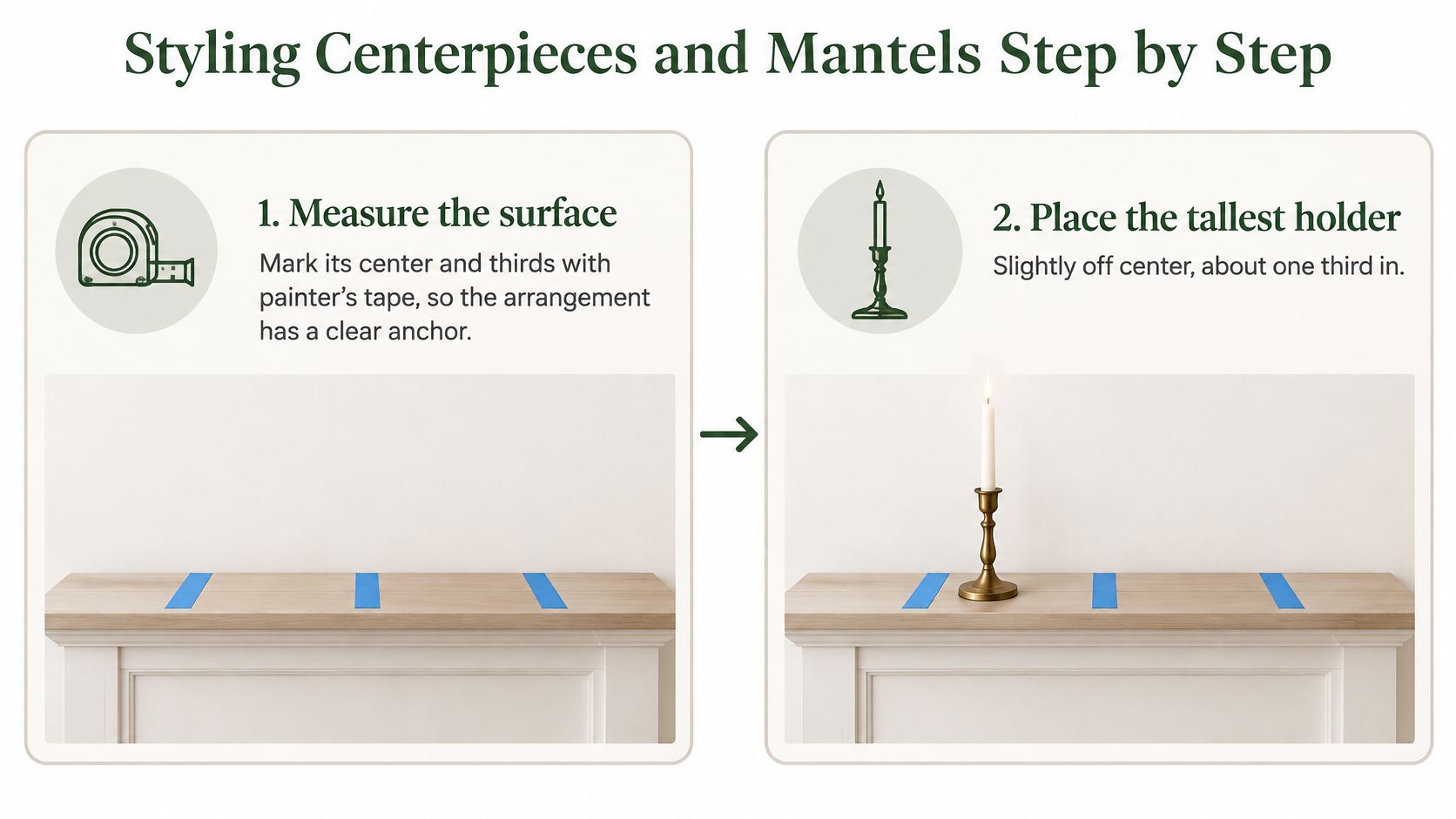
- Mark the surface. Use painter's tape for the center and the thirds so the group has an anchor instead of a guess.
- Set the tallest holder off center. About one third in from one end keeps the line from looking pasted on.
- Cascade the shorter pieces. Drop heights so the tallest top stays at a comfortable eye line across the room. A three-piece set of different heights makes that drop obvious.
- Fill low, and keep fuel back. One or two low pieces, such as greenery in a bowl or objects on a metal decorative tray, can sit between the holders. Keep them, for example, about 6 inches (15 cm) from any flame.
- Check overhead clearance. Keep candles, for example, at least 12 inches (30 cm) below a shelf, sign, or garland.
- Light one and walk the room. Move any holder that throws glare into someone's eyes.
- Trim and recheck. Cut wicks to about a quarter inch, then look again after 30 minutes of burning. Wax pools and holders shift.
On a dining table, keep taller holders below the sightline of seated guests. A reception table follows the same logic at a larger scale. Pairing simple holders with linen and wood is the same instinct behind budget-friendly reception decor inspiration, where the surface plan matters more than adding another shiny object.
What doesn't work is a matched pair glued to the exact center, dried stems tucked against the cup, and a mirror behind the flame. You get glare, a tip risk, and a centerpiece nobody can talk across.
Mixing Gold With Wood, Iron and Textures
A gold candle holder should fit the room's materials before it becomes the focal point. Choose one dominant metal, one supporting finish, and gold as an accent. Matte black iron, aged wood, and galvanized metal give gold a grounded setting. Several polished finishes competing nearby can make the holder look out of place.
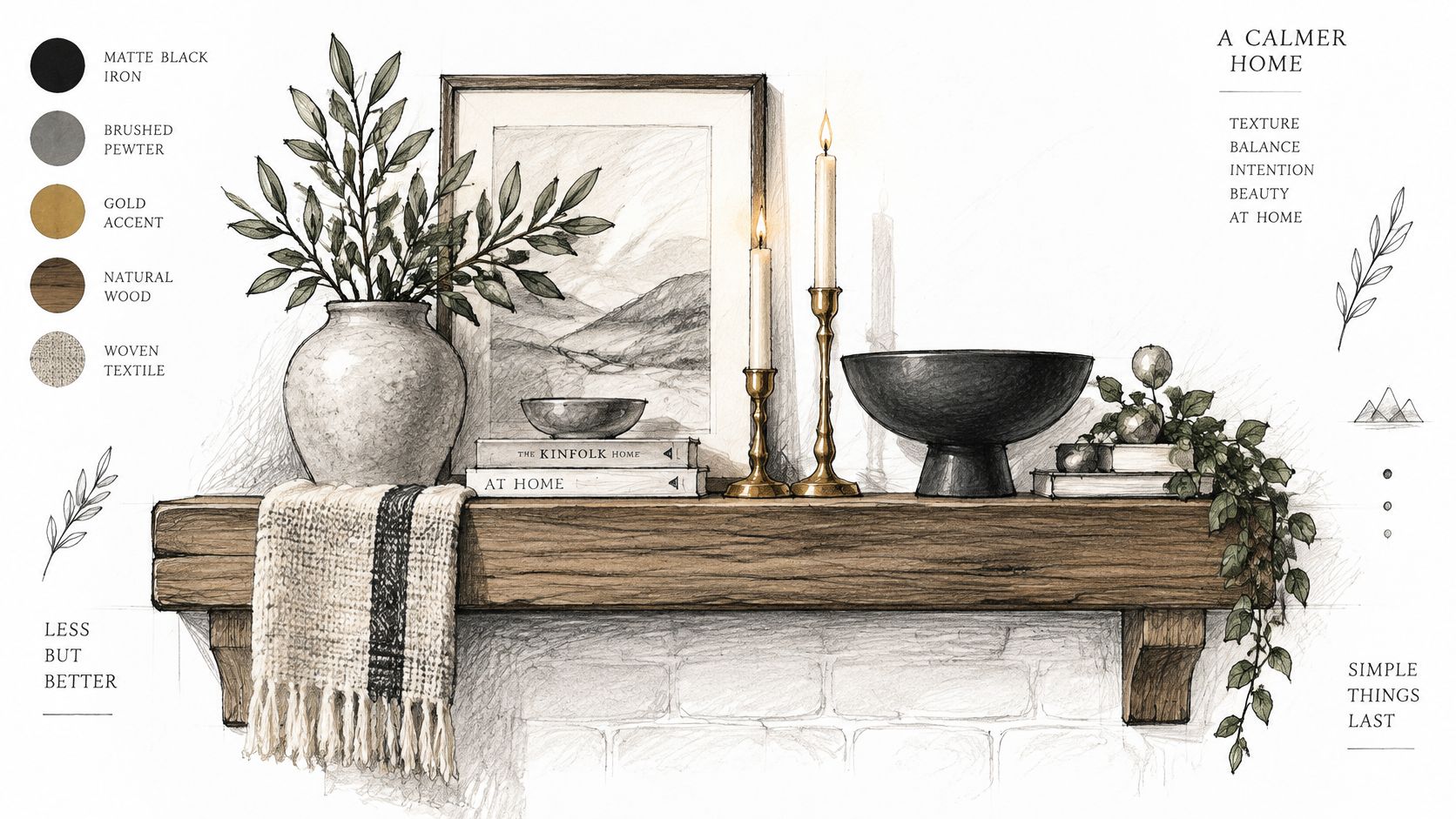
On a whitewashed mantel, two gold holders can sit comfortably with a black iron clock and a wooden sign. A chrome vase adds another bright reflection and can make the arrangement feel less settled. Wood softens the shine. A mango-wood pillar stand, for example, pairs well with brass or gold because the visible grain breaks up the metal's reflection.
Textures that do the same job
Linen, burlap, jute, cotton, and rough-sawn wood add warmth without introducing another metal. A Rustic Flag Braided Oval Table Runner in natural jute can ground a centerpiece and soften the transition between a gold holder and the tabletop. For a cooler stone contrast, shop natural selenite candle holders. Let the gold remain the warm note in a mix of materials.
Repeat the gold finish in another room detail so it looks intentional. Pair warm brass with gold; keep cool silver out of the group. A dark element, such as black iron or a charcoal frame, gives the gold a defined backdrop.
A short clip on mantel scale can help you judge the balance before settling on the metal mix.
Then step back and count the finishes:
- One: The metal you want people to notice first.
- Two: The supporting material or finish, often iron, wood hardware, or galvanized metal.
- Three: The accent, often gold.
- More than three: Remove the finish that feels least connected to the rest.
When the materials relate in tone and texture, the gold reads as a deliberate detail rather than an isolated shiny object.
Clean and Refresh Gold Holders Before Your Next Gathering
| Symptom | Likely cause | Fix |
|---|---|---|
| Dull film on the finish | Tarnish, oil, or candle soot | Wipe with a soft cloth and mild soap, then dry at once |
| Wax drips on the holder | Hot wax running down the body | Let the wax harden, lift it with a plastic scraper or ice, then wipe |
| Water rings on the base | Damp candle or wet surface | Dry the base and use a coaster or felt pad |
| Green staining on brass | Copper reacting with moisture | Clean with mild soap, then polish solid brass lightly |
| Chipped gold paint | Wear, heat, or knocks | Sand lightly, prime, and apply two thin coats of gold spray paint |
Work in that order. Pull the candle and let wax cool. Dust with a soft brush or dry microfiber. Wipe with a cloth dampened in mild soap and water, and don't soak the piece. Dry it immediately. Use a non-abrasive polish only on solid brass, and test an underside first. Skip steel wool, scouring pads, and harsh cleaners on plate or paint.
For chipped paint, sand lightly, prime bare spots, and spray two thin coats in a ventilated space. Wait a full day before use. Small worn spots on plating can take a dab of gilding wax. Sort each holder as keep, clean, or replace. Anything cracked, wobbly, or heat-damaged leaves the rotation.
Farmhouse World carries rustic candle holders, jute runners, and mantel accents sized for real farmhouse tables and shelves, not just a styled photo. If you're matching a gold finish to wood, iron, and a stable pillar plate, start with the holders and textiles already built for that mix. Visit Farmhouse World and check the pieces against the candle you burn.


