

The most repeated advice about how to decorate with crosses is to build a gallery wall out of them. Gather nine crosses in nine finishes, stagger the sizes, fill the shape of the wall, and call the result a collection. It photographs well and it fails in a real room, because a wall covered in crosses changes what the symbol does. Nine crosses read as pattern. One cross reads as a statement, and a statement needs empty wall around it to be heard.
Flip the order of the usual advice. Style, quantity, and hardware are the last three decisions, not the first. The first decision is what the cross is doing in that room: holding a devotional place, carrying a family story, or working as a vertical design anchor. Everything else follows from that answer, including whether the wall gets one cross or five.
Start here: a cross earns its wall by being seen, not by being repeated.
What follows is the height and scale table by room, a step-by-step hanging sequence, the load limits that decide between a hook and a stud, and three room setups that pair a cross with rustic companions instead of competing with them.
Table of Contents
- Decide What the Cross Means in Your Home
- Cross Heights and Scales by Room
- Arrange and Hang One Cross Step by Step
- Hang Heavy Crosses Without Damaging Walls
- Style Crosses with Rustic Companions
- Start with One Focal Cross
Decide What the Cross Means in Your Home
Crosses are not interchangeable wall filler. A 30-inch steel cross over a mantel, a carved wood cross that came out of a grandmother's kitchen, and a 12-inch monogram beside the front door do three different jobs, and each job sets its own size, spacing, and fastener. Sort that out before you measure anything.
Faith-minded decorators make a similar point from a different direction: choose crosses deliberately, leave visual breathing room, and avoid arrangements dense enough to turn the symbol into filler. That same guidance notes households tend to draw their own lines around rooms such as bathrooms, which makes placement a family decision rather than a style rule (About Wall Art). Respect that, especially in a shared home where one person's devotional object is another person's decor.
A devotional cross
One piece, one wall, one job. The living room, the bedroom, or the entry wall you pass every morning. The empty wall around it is the point, not wasted space. A large metal cross with a figure on it belongs here, and it should be the only symbol on that stretch of paint.
A heritage cross
A family or regional piece, often carved wood, sometimes painted, occasionally repaired by someone who loved it. Pair it with one photograph or a small shelf holding a candle or a bowl. Not a matching set of six. And no new holes in the object itself.
A decorative cross
Simple geometry, black metal, distressed wood, or a clean silhouette used as a vertical accent. One is usually enough, particularly if anyone in the house is uneasy about the symbol being treated as a motif. Use it to give a console or a stair wall a vertical stop, then let botanical or typographic art do the rest.
None of this is niche styling. Pew Research Center's demographic study estimated approximately 2.18 billion Christians in 2010, or 31.7% of the world's population across more than 200 countries and territories (Pew Research Center). A symbol with that reach sits easily in a farmhouse entry, a coastal hallway, or a contemporary stairwell, and it also means the piece you buy may be a devotional object to someone who visits.
Material and scale carry the intent faster than anything you say about the wall. A large metal Jesus cross over a mantel reads devotional. A small monogram on a console reads personal and decorative. Match the message to the room before you buy the hardware.
Write this before you measure: "This cross is ______, and it lives ______." Fill both blanks. The sentence decides how many pieces you hang and how much wall stays empty.
Cross Heights and Scales by Room
Crosses end up near the ceiling because people hang by eye and measure to the top edge. Pick your row from the table first, then read the reasoning underneath it.
| Room or view | Visual center | Gap above furniture | Useful size |
|---|---|---|---|
| Open wall, standing view | 57–60 in (145–153 cm) | Not used | 18–30 in |
| Living room, seated view | About 55 in | 6–8 in above the sofa back if hung over it | 24–30 in |
| Above a console or entry table | Set by the gap, not the floor | 6–8 in | 12–18 in |
| Above a mantel or headboard | Set by the gap | 6–8 in | 18–30 in |
| Gallery of several crosses | Center of the whole group at eye level | 2–3 in between pieces | Mix of 12 in and 18 in |
| Shelf, desk, or lean | No wall center | Object rests on the surface | 12 in or smaller |
The standing-view baseline
Use the first row for a hallway, stair wall, or any wall you read on your feet. Museum-style display practice puts the visual center of a piece 57 to 60 inches above the finished floor, a figure drawn from average standing eye height, including median heights of 64.57 inches for men and 59.72 inches for women in a U.S. adult summary (Colorado Art Services). Treat it as an averaging convention, not a rule with legal force. If everyone in the house is tall, nudge up two inches and nobody will complain.
For a room where you sit, drop the center toward 55 inches. A cross hung at standing height above a sofa looks like it's floating away from the furniture.
Furniture changes the measurement
Above a console, mantel, or headboard, stop measuring from the floor. Set the gap instead: 6 to 8 inches between the top of the furniture and the bottom of the cross. That gap keeps the piece visually attached to what's below it and leaves room for a lamp, a bowl, or a garland without collision.
The mistake to avoid: measuring to the top edge of the cross instead of its midpoint. On an 18-inch cross that error lifts the piece about nine inches, and it's the single most common reason a hung cross looks wrong.
Scale is a wall decision
Size the cross to the wall, not to the shelf it sat on in the store. A 12-inch cross suits a narrow entry or a bookshelf. 18 inches works beside a mirror or on a compact wall. 24 to 30 inches anchors a mantel, a dining wall, or a two-story entry.
Check both dimensions before you commit. Metal Jesus crosses are frequently wider than they are tall, and a wide piece centered over a narrow console overhangs it.
Groups count as one piece
If the role you chose allows companions, treat the whole arrangement as a single composition and center the group at eye level, not the largest cross. Check the group's width against the furniture below it, and keep 2 to 3 inches between pieces so each shape still reads.
If you plan to build out the rest of the wall, farmhouse wall decor ideas shows how signs, frames, and crosses share a wall without turning into clutter.
Mark the midpoint with a strip of painter's tape, step back to the doorway you'll enter through, and only then pick up the drill.
Arrange and Hang One Cross Step by Step
One afternoon, one cross, seven moves. The sequence matters more than the tools, because each step removes a decision you'd otherwise make with a drill in your hand.
The visual below is the short version of what follows, useful when you're deciding where the eye should land before any hardware goes up.
- Name the viewing spot. Stand where you'll look at the cross most often: the doorway for an entry, the sofa for a living room, the foot of the bed for a bedroom. The wall you see from the hallway is usually not the wall that matters.
- Choose one focal cross. Add up to two smaller companions only if the role you settled on allows a group. Three pieces is a composition; nine is wallpaper.
- Tape the centerline and the midpoint. Run a vertical tape line, then mark the height from the table for that room. Tape the four outer corners of the cross so you see its footprint, including the width.
- Lay out a group on the floor first. Space the pieces 2 to 3 inches apart, then look at the arrangement from above. If a window or doorway pulls the eye sideways, shift the largest piece slightly off center so the group doesn't fight the room.
- Add one horizontal element nearby. A narrow shelf, a framed print, or a console top stops the cross from floating. The cross stays the vertical anchor, and the horizontal piece gives it a base.
- Find a stud with a finder. If there's one behind the piece, screw into it. If not, use two attachment points on wide or uneven metal so the cross can't rotate, and choose the fastener from the wall and weight guidance below rather than whatever is in the drawer.
- Hang it, then look from the seat you use. Check the height from the sofa or the doorway, not from the ladder. Nudge the piece before you tighten anything.
If your tape lines keep drifting and the second pair of hands keeps guessing, this how to hang wall art straight walkthrough covers the measuring and marking half of the job in more detail. Getting the mark right is cheaper than filling a wrong hole.
https://www.youtube.com/embed/xTMAOvoRhtQ
Watch the sequence once before you start, because seeing the tape go up first makes the marking steps obvious.
A second, quieter layer under the cross should add texture rather than another symbol. Small decorative wooden wall art at shelf scale does that job without competing for the same focal point.
Done looks like this: one readable shape, a clear band of empty wall around it, and nothing touching a light switch, a mirror frame, or the top of a lamp. If a guest's eye lands on three different things at once, take one down.
Hang Heavy Crosses Without Damaging Walls
"Damage-free" is a claim about the strip, not about your wall. Adhesive hooks earn their rating on smooth, sound, fully cured paint and lose it on textured finishes, fresh paint, humid rooms, and old plaster with a chalky surface. A renter-focused report on reversible upgrades puts it plainly: adhesives react differently to paint, texture, humidity, and wall age, and leaning a piece on a console, mantel, or shelf is the lower-risk option (Detroit News). Test any hook on a hidden patch for a day before it holds something you love.
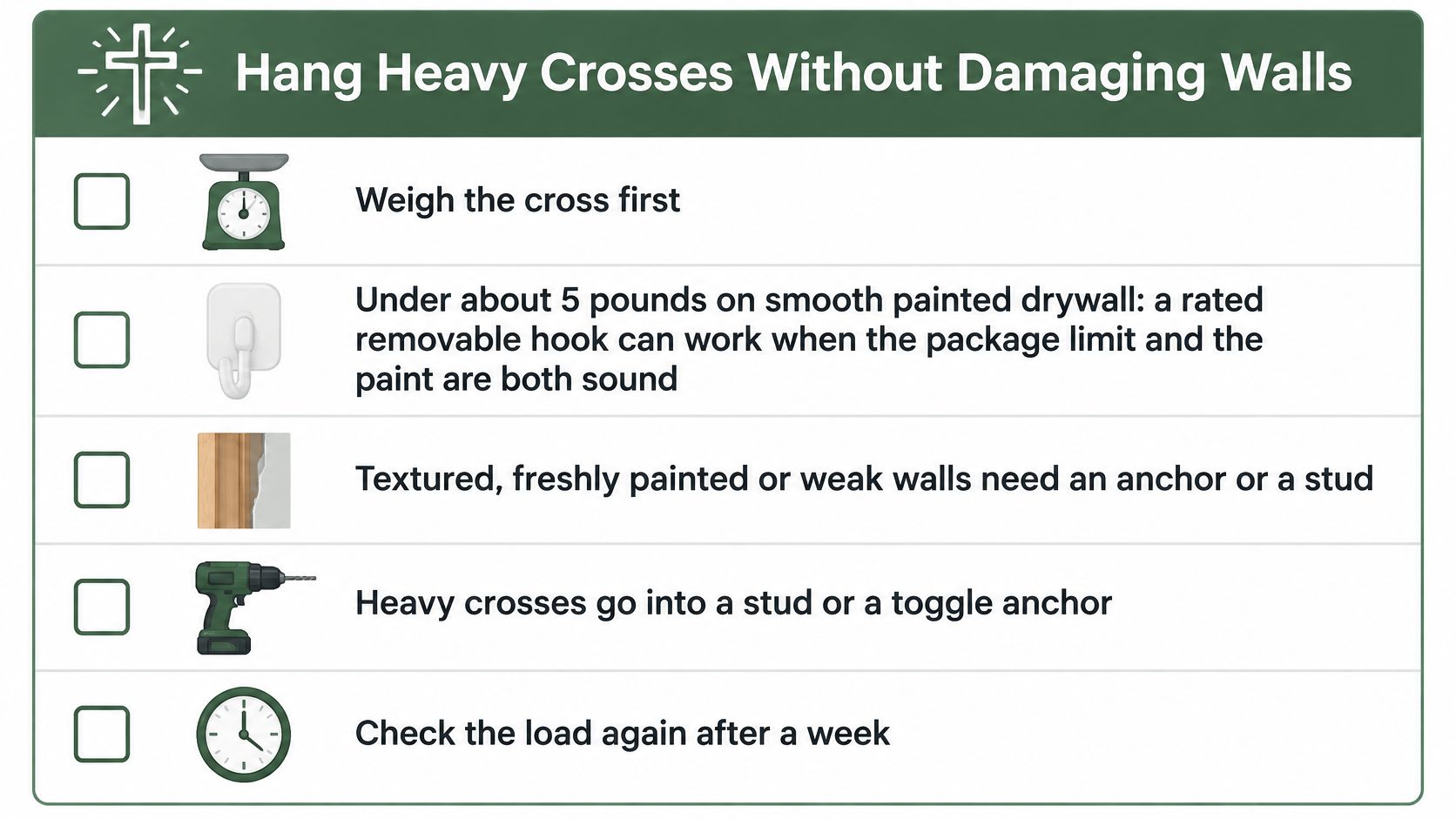
The checklist above keeps the four decisions in order: weigh, match the fastener to the wall, use two points, recheck the load.
Weigh the cross on a kitchen scale rather than guessing from the box. Under about 5 pounds on smooth painted drywall, a rated removable hook can work when the package limit and the paint are both sound. Above that, and for any steel cross in the 18- to 30-inch range, skip the strips and go into structure.
Treat the cross as a load
Conservation guidance is blunt about hung objects. The Journal of the American Institute for Conservation recommends mounts that support the entire object, hardware such as D-rings and braided metal wire for framed pieces, and a wall fastener anchored firmly enough to carry the weight (American Institute for Conservation). It also warns against concentrating stress in one area, which is the technical argument against a single nail on a wide cross.
That guidance adds a rule for older pieces: add a non-reactive barrier or padded contact surface where the object touches a shelf or bracket, and avoid drilling, taping, or gluing the cross itself. A painted family cross that has survived four decades should not be modified to fit your wall.
Match the fastener to the wall
| Situation | Weight cue | Use | Avoid |
|---|---|---|---|
| Smooth drywall, renter | Under the hook rating, often under 5 lb | Rated removable hook after a spot test | Strips on texture or new paint |
| Drywall, no stud | Medium wood or metal | Two anchors rated above the weight | One nail or one adhesive strip |
| Stud available | Any weight, including 30 in steel | Screws into the stud, two points if wide | Guessing stud location |
| Plaster or masonry | Any substantial cross | Anchor made for that wall | Drywall plugs |
| Lease forbids holes | Any weight | Lean on a console, ledge, or ladder | Hidden nails |
| Antique or painted wood | Any | Padded lean or shelf, no new holes in the object | Glue, tape, or drilling the cross |
Plasterboard behaves differently from drywall, and the rating printed on the packet assumes the wall it was designed for. If your walls are plasterboard, choosing fixings for plasterboard walls explains which anchors spread the load and which pull straight through.
Failure modes worth naming
- A strong hook in weak drywall. The hardware was fine. The wall wasn't, and the cross came down anyway.
- One nail on a wide cross. The piece rotates on the nail, drifts out of level, and eventually works the hole wider.
- Adhesive on a finish. Strips and tapes can stain paint, lift a topcoat, or mark the back of a wooden cross.
- Drilling an antique. A new hole in a painted or carved heirloom removes value and can split old timber.
Before you let go, tug the hardware downward with steady pressure and watch the anchor, not the cross. Then check the floor zone: the bottom of a heavy cross should clear door swings, chair backs, and the reach of small children.
Style Crosses with Rustic Companions
A cross with nothing around it looks stranded. A cross surrounded by five rustic objects looks like a display. The difference is one companion in the right place, which is why three rooms are enough to learn the pattern.
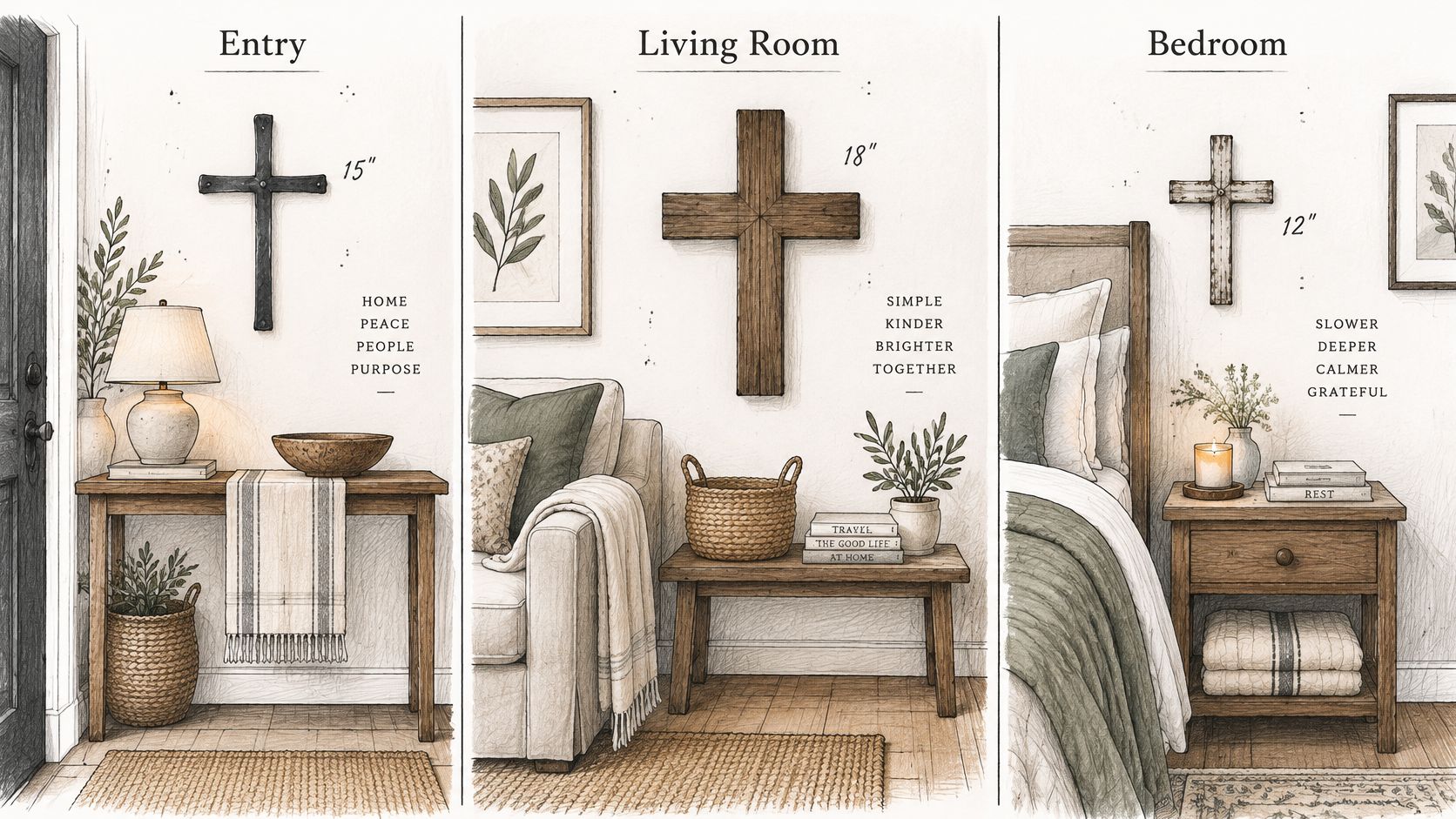
The same rule, three ways: vertical cross, one horizontal line, one natural texture.
The entry
Center a 15- or 18-inch metal or wood cross over a narrow console. On the console, one ceramic lamp, one shallow bowl for keys, and a linen runner. The runner gives the vertical shape a horizontal base, and the lamp adds warmth without adding a second focal point. Leave out the second cross. An entry with two crosses has no greeting, only a queue.
The living room
Take a 24-inch cross above the mantel and let it be the tallest thing on that wall. Keep a garland or two candle holders lower than the cross arms so nothing competes at the top. Add a neutral throw on the sofa so texture isn't concentrated in one spot. Leave out the third metal object. Copper candle holders, a black cross, and a steel frame read as a collection rather than a room.
The bedroom
Hang a smaller cross over the headboard with 6 to 8 inches of clearance, then flank the bed with matching lamps rather than more crosses. Symmetry belongs to the lamps here, and the cross stays singular. Leave out the gallery of small crosses. A bedroom is the one room where quiet placement carries the most meaning and the least maintenance.
Pair materials on purpose
Black or copper metal sits well against whitewashed wood and stone-colored ceramics. A pale wood cross needs a darker frame or a matte black shelf behind or beneath it, or it disappears into a cream wall. Limit the wall to one symbol type: if the cross is the faith piece, keep nearby art botanical, typographic, or photographic.
Material choices can also carry region and tradition without copying one church interior. Pew Research Center's analysis of global Christianity found that by 2020, sub-Saharan Africa was home to the largest share of the world's Christians at 30.7%, compared with 22.3% in Europe (Pew Research Center), which is exactly why distressed wood and black metal sit as comfortably beside carved and painted finishes as beside anything else. There is no single correct cross wall.
The rule that holds all three rooms together: one cross, one horizontal line, one natural texture.
If you want to build the rustic layer yourself, rustic home decor DIY has projects that add texture at shelf height, well below the cross. Then walk the room and remove any third object that repeats the cross's shape, including a mirror with a strongly arched top.
Start with One Focal Cross
Commit to one wall this week, not a whole-house theme. The first cross sets the standard for every piece after it, and a single well-placed cross teaches you more about your own taste than a cart full of options.
Choose by role. If the cross is devotional, use a single metal piece in black, copper, gold, silver, or white, sized from about 12 inches on a bedroom wall to about 30 inches over a mantel. If it's personal or decorative, a monogram or simple geometric cross in the same size range marks an entry without turning the wall into a gallery.
Then take three actions.
- Tape the midpoint at the height for that room from the table earlier, plus the centerline and the outer corners.
- Choose one cross sized to the wall and confirm its width as well as its height before you buy. A wide metal piece over a narrow console is the most common sizing miss.
- Add one horizontal piece beneath it, such as a narrow shelf, a bowl, or a lamp. Remove any third object that repeats the cross shape.
Hardware comes after the stud check, not before it. The wall is finished when the cross is secure under a firm tug and the room reads as one clear vertical shape from the doorway.
For a personal piece, the Initial Cross Monogram Steel Sign comes in sizes from 12 to 30 inches, laser cut from mild steel and powder coated for durability, with mounting hardware sold separately.
Farmhouse World carries personalized metal crosses, rustic wall signs, and the small accents that finish a console, a shelf, or an entry, so you can pick one focal piece instead of a wall of maybes. Measure your midpoint, choose the size that fits the wall, and give the cross a single job. Visit Farmhouse World to browse the crosses and farmhouse wall decor in current sizes and finishes.


