

You pulled a Santa Claus candle holder out of the box, set it between the garland and a wooden sign, and reached for a match. It looks like a cheerful figurine. It is also a small fire appliance, and that second job is the one to settle before you light anything.
A painted beard and a little cup for wax can hide a wobbly base, a finish that softens near heat, or a candle that never belonged in that socket. This guide treats the figure as a safety object first. You'll decide whether a real flame or a flameless LED belongs in it, inspect the piece, then place and style it so the display stays calm.
Table of Contents
- Where Santa Candle Holders Came From and Why It Matters
- Choosing a Santa Holder by Format and Material
- Real Candles or Flameless LEDs for Your Santa Holder
- How to Inspect a Santa Holder Before Lighting It
- Placement Rules That Keep a Santa Holder Safe
- Styling a Santa Holder in a Farmhouse Display
- Decide Whether Your Santa Holder Is Ready for Use
Where Santa Candle Holders Came From and Why It Matters
Say the Santa on your mantel is doing more than posing. The cup in his hands, or the slot at his feet, is a working part. Think of a vintage kitchen tool in a display set. It's pretty, and it was still built for a job.
That job has a long craft history. In Johanngeorgenstadt, Germany, the first documented arched Christmas candle holder was reportedly made in 1740 by blacksmith Johann Teller, as a thank-you to local miners, according to a Deutsche Welle account of Erzgebirge candle arches. Those dates come from a local tradition, so treat them as approximate rather than a lab record. The form later settled into the Erzgebirge Christmas craft. Holders stayed metal for centuries, then production began shifting toward wood in the 1940s, when makers added figurative scenes, including Santa Claus.
A modern Santa Claus candle holder sits in that folk-art line, not in the disposable-novelty aisle. Age doesn't make it safe, and a fresh ceramic coat doesn't either. What matters is how the candle sits, what the body is made of, and whether you can watch it. Three questions sort the rest: which holder and flame type to choose, how to inspect and place it, and how to style it without crowding the flame.
Choosing a Santa Holder by Format and Material
Start with the job the socket was cut to do. A taper, a tealight, an enclosed candle, and a display figure are not interchangeable, even when the Santa looks similar.
| Format | Reference listing | Candle it takes | Key check before buying |
|---|---|---|---|
| Taper holder | Department 56 mercury-glass Santa, $22.00 | Taper candles | Socket fits taper diameter without wobble |
| Tealight holder | Black-metal Santa with 5 slots, $24.99 (was $35.00) | Tealights | Each slot sized for one tealight, no open flame above the slot |
| Ceramic lantern | C&F Home Santa, 4.72 in tall, 4.13 in wide, 5.43 in deep | Enclosed or recessed candle | Maker names compatible candle height |
| Display figure | Mount Vernon Shops Santa, $38.00, about 7.5 in x 3 in x 2.6 in | Candle type not listed; confirm with maker before lighting | Do not light until the maker names a compatible candle |
Those 2026 listings are reference points, not a shopping list. Read them for format, size, and stated candle, then apply the same checks to whatever is in your hand.
How to match the candle to the socket
Measure the candle's diameter and height against the socket before you buy a refill. A holder made for one format is not safe for another just because the wax fits loosely. Check whether the maker names compatible types, including whether tealights or votives are allowed. Set the base width against the hat height. A tall hat on a narrow foot tips when a sleeve brushes it.
Prefer a noncombustible body such as ceramic, glass, or metal, with the candle fully recessed rather than standing beside the hat, beard, or coat trim. If you like the look of wood near a flame, keep real fire in a noncombustible socket and use wood as surrounding décor, the way a guide to wood candle holders treats timber as a styled accent rather than a fuel source next to the wick.
What the accessory specification is asking for
The voluntary U.S. specification ASTM F2601-18 addresses accessory stability and flammability of components used in candle holders, candle rings, burners, and potpourri burners, as described in the CPSC voluntary standards page for candles and candle accessories. In practical terms, you want a low center of gravity, a base broad enough to resist tipping, and a socket that stops the candle from sliding sideways.
Painted, glued, fabric, paper, resin, or plastic parts sitting above or beside the flame change the risk. Incident categories that show up in that same guidance include flare-ups, excessive flame height, wax transfer, holder ignition, shattering, and candle tipping. Vintage mercury glass and painted ceramics need the inspection in the next part of this guide before any match comes out.
Gift card rule: Write the candle type, the diameter, and a one-line placement note on the card so the recipient isn't guessing at the socket.
A display figure whose listing never names a candle stays unlit. Confirm compatibility with the maker first. Charm is not a specification.
Real Candles or Flameless LEDs for Your Santa Holder
This is a decision, not a verdict against real flame. A real candle gives the flicker, warm glow, and scent that make the nostalgic look. It also asks for continuous supervision and a clear zone you can keep. A flameless LED removes open-flame exposure around children, pets, fabric, wrapping paper, and a crowded farmhouse shelf. That trade suits renters and anyone styling a small room.
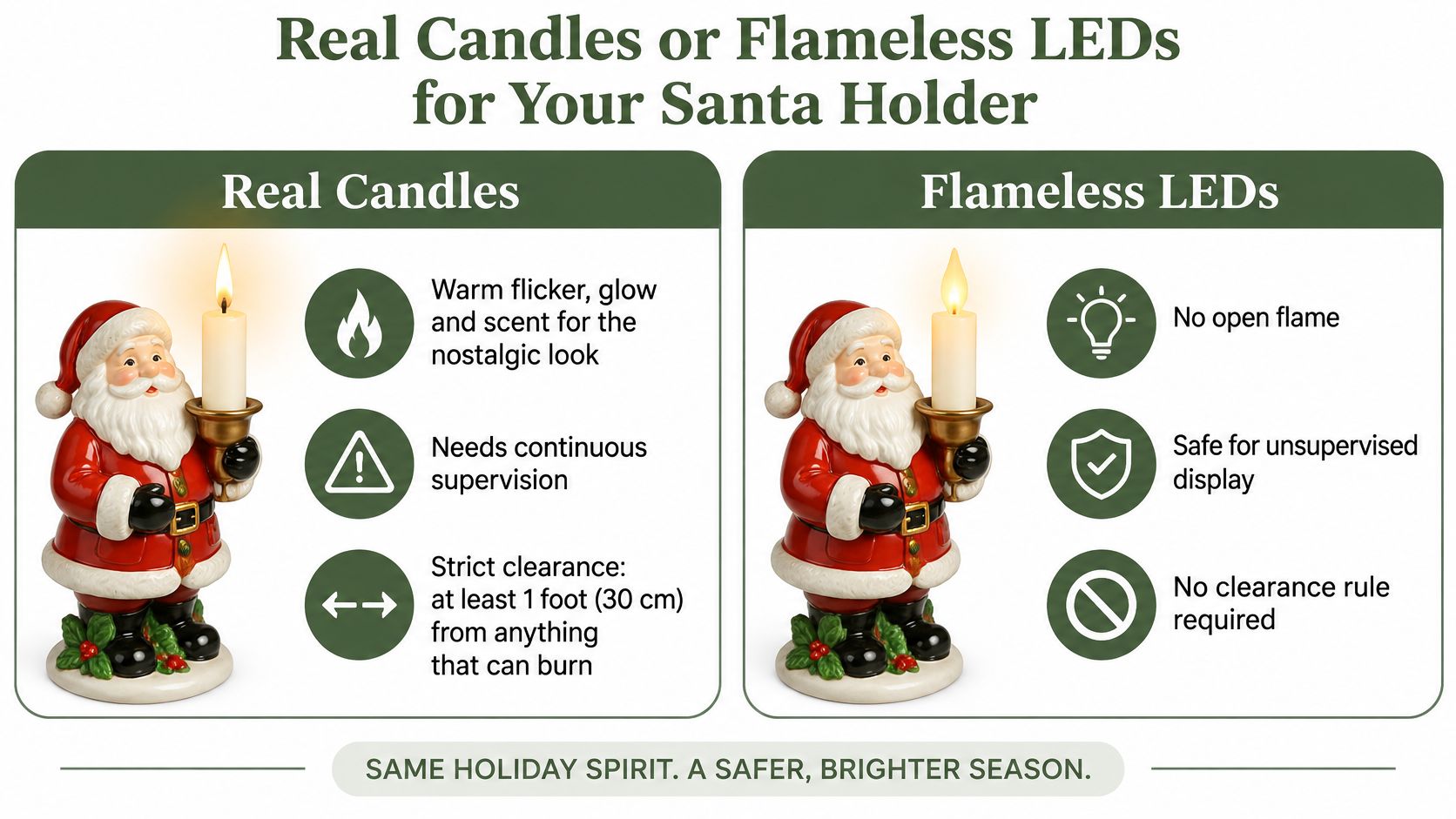
| Criterion | Real candle | Flameless LED |
|---|---|---|
| Ambiance | Natural flicker and warm glow | Steady glow or built-in flicker mode |
| Scent | Full fragrance from wax or soy | No scent |
| Open-flame exposure | Present while burning | None |
| Supervision needed | Continuous, with clearance zone enforced | Not required |
| Holder reuse | Holder must pass inspection and fit the candle | Works as a vessel after crack and paint check |
When the flame is worth keeping
Choose a real candle when three things are true at once. You can stay in the room, the surface is sturdy and uncluttered, and nothing combustible sits inside the clearance you can mark with a tape measure. Trim the wick the way the candle maker directs, and follow a simple candle care routine so a tall, smoky flame isn't your first surprise.
If you want fragrance without parking a flame inside the Santa, burn scent somewhere else. A separate warmer, including the kind of oil burners for home fragrance people use for a controlled scent throw, keeps the smell in the room while the figure stays cool.
A thrifted Santa as a light vessel
An inherited or thrifted holder can become an LED-light vessel or a display accent after you check for cracks, peeling paint, and materials you can't identify. You aren't throwing the memory away. You're changing the job.
A 2025 Better Homes & Gardens trend report found that 43% of homeowners prefer repurposing existing decorations instead of buying new ones. That "practical maximalism" habit fits a Santa you already own. LED gives up scent and a true flame. It keeps the silhouette, skips wax cleanup, and doesn't need a draft-free vigil.
Light a real candle only when you can hold the full clearance and watch the flame. Otherwise use an LED and keep the nostalgic look.
How to Inspect a Santa Holder Before Lighting It
You set a new Santa on the mantel, the cup looks deep enough, and the match is already in your hand. That sequence is how a decorative figure gets a job it was never built for. Painted surfaces, vent holes, a narrow opening, a top-heavy silhouette, and a supplied candle that may not match the well are the usual trouble spots. Run this check every time the piece is new to you, including a thrift-store find.
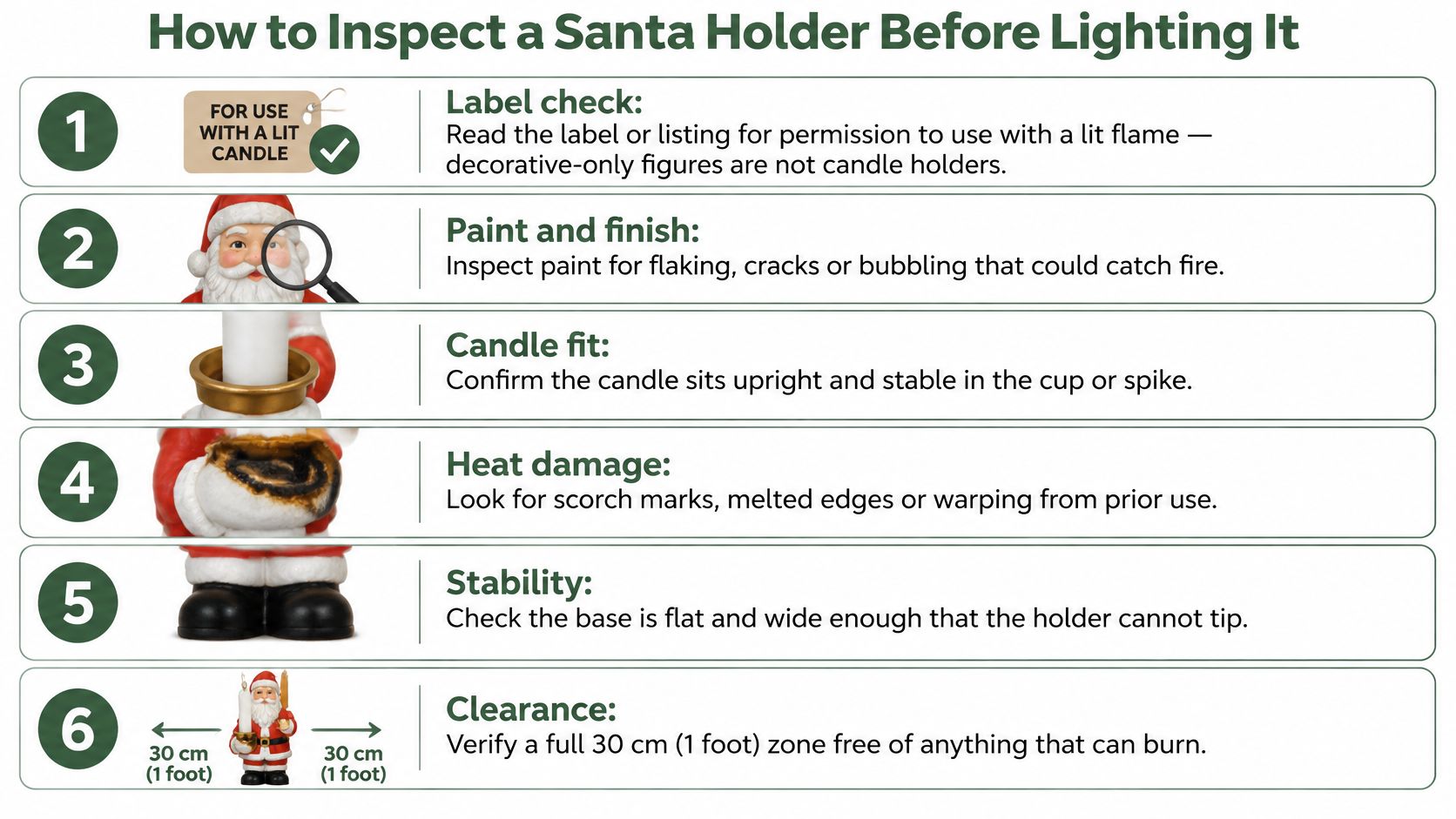
A plain glass cup fails in obvious ways: it cracks, or the wax pools over the rim. A Santa fails more subtly, because paint, vents, and a sculpted face sit close to the flame. Work through the six steps in order. One failed step is enough to keep the match in the box.
- Read the label or the listing for permission to use a lit flame. Decorative-only figures are ornaments. If the text never says the piece holds a burning candle, leave the flame out, even when the cup looks deep enough.
- Inspect paint around vent holes, narrow openings, and the candle well. Flammable paint can ignite when a flame flares or reaches the coating through ventilation. A U.S. Consumer Product Safety Commission recall covered 10,332 Santa Claus candle holders for that reason, and the agency told owners to stop using them. Flaking, bubbling, or paint that smells sharp when you warm the piece in your hands is a stop sign. Heat travels like it does along a metal spoon left in a hot pan: the part you are not watching can still get hot.
- Look for cracks, chips, peeling finish, and heat discoloration near the socket. A hairline in ceramic can open once the well gets hot, the way a fine crack in a mug only leaks after you pour boiling water. Dark scorch marks mean a previous flame already got too close.
- Confirm the candle fits without wobble. Use the manufacturer's candle or a properly fitting metal-cup votive. A defective or mismatched votive can ignite a holiday holder when the flame sits too high or the cup cannot contain the melt. If the candle rocks, leans, or sits proud of the cup, it is the wrong size.
- Do a tilt test on a flat counter. Nudge the figure the way a cat or a coat sleeve would. If it rocks, or the candle shifts in the socket, don't light it. Stability is something you can see: the figure stays put, and the candle stays seated.
- Retire anything with unknown materials, past burn marks, or a vintage finish you can't identify. Display it cold, or drop in an LED. You don't need to solve the chemistry of a 60-year-old glaze.
Ceramic construction and a charming face do not prove fire safety. The coating and the candle geometry are often the risk factors. A pretty Santa that fails one step is still a pretty Santa. It just isn't a candle holder anymore.
Placement Rules That Keep a Santa Holder Safe
Clearance is the control you can see. Keep a lit candle at least 1 foot (30 cm) from anything that can burn, and at least 12 inches from combustible decorations, following the winter candle guidance published by the Air Force Safety Center. Use a sturdy holder on a sturdy, uncluttered surface, and put the candle out before it burns down close to the holder.
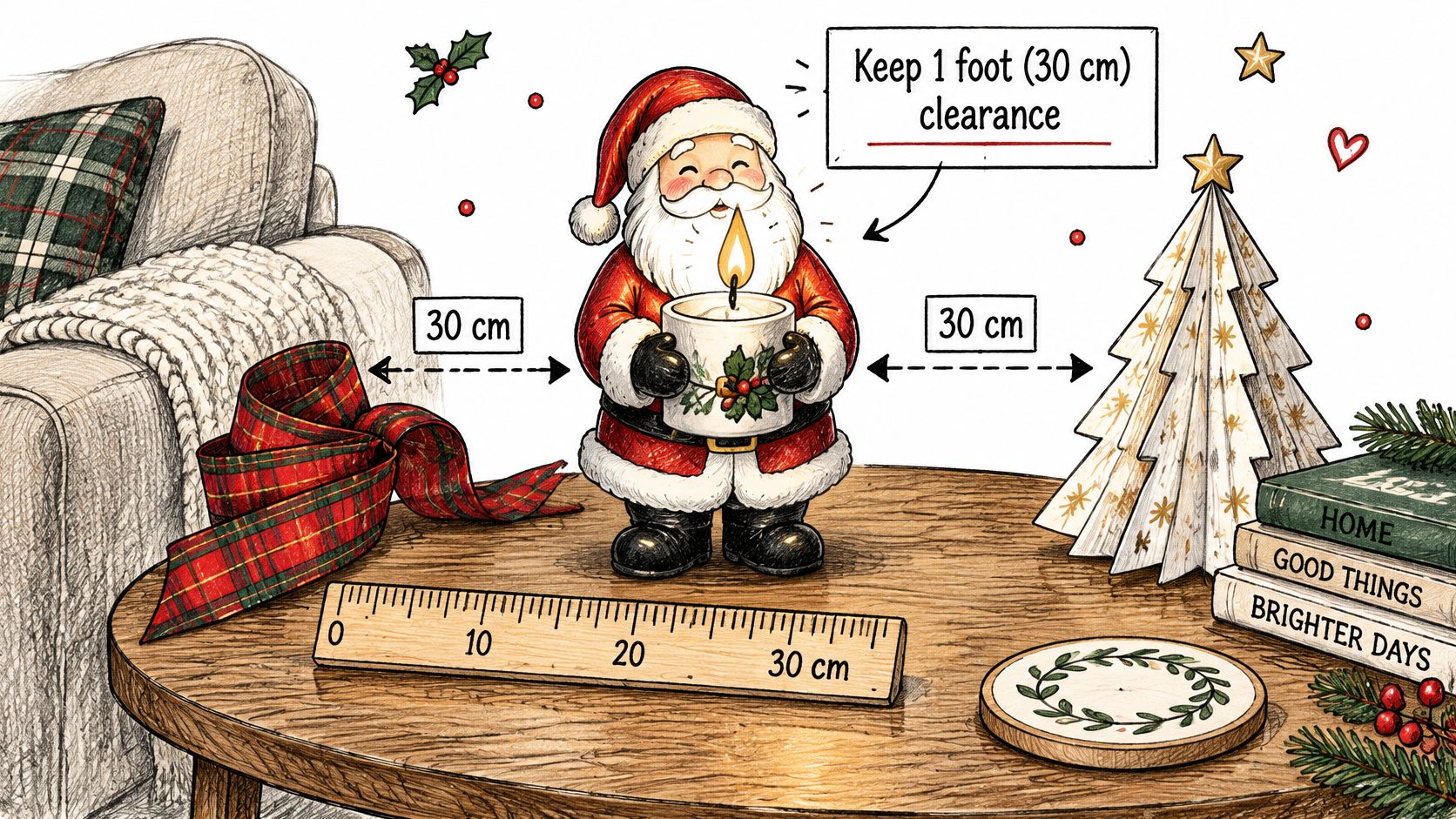
Character holders need that full radial zone, not a smaller one, because the silhouette invites you to tuck them into greenery. The same guidance notes that decorative character-shaped holders can let heat build up and flames project several inches beyond the holder. An open-front Santa can hide how tall the flame is. You see the beard. You don't see the tip of the fire.
Five rules for the spot you choose
- Surface: Use a level, heat-resistant, uncluttered top, away from garlands, wrapping paper, textiles, wooden signs, and mantel greenery.
- Air: Pick a draft-free spot. A vent, a doorway, or an open window leans the flame into paint and trim.
- Candle: Center it, and trim it to the candle maker's instructions so the flame stays short.
- Stop point: Extinguish it before the flame reaches the upper edge or any decorative feature, including hat trim and a painted rim.
- Watch: Never leave it burning unattended, including "just while I step into the kitchen."
Two rules apply on the day you burn it. Don't move the holder while the wax is liquid, because a shifted pool can spill onto a hot surface. If a flare-up starts, smother it with a wet cloth. Don't pour water on it.
A short safety briefing on open-flame habits is worth one watch before the first evening you leave a Santa lit on a table.
Check the holder every time you relight it. Heat can loosen a fitting or lift paint across several evenings, even when the first burn looked fine.
Styling a Santa Holder in a Farmhouse Display
Treat the table like a small stage. Santa is the lead. Everything else stands farther back and stays outside the clearance you already marked.
One figure, then a group
The simplest arrangement is a single holder as the focal point on a mantel or sideboard. In a typical setup, its height sits between about one-third and two-thirds of the mirror, window, or sign behind it, so the figure reads as a person in the scene rather than a speck or a blocker. Leave the surface around the base empty enough that a sleeve can't drag a runner into the well.
A pair or a trio on a tiered tray is the next step. Vary height and finish on purpose. Black metal beside mercury glass gives you contrast without a third material fighting for attention. Keep the lit piece, if any, on the lowest, widest tier, where it's less likely to tip if nudged.
The fullest look is a seasonal grouping with rustic textiles, a wood sign, and a runner in red, cream, or muted green. Hold the palette to two metals or finishes, one warm accent color, and natural texture. A three-piece holiday candle gift set can supply matching votives for holders you've already cleared for that size, so you aren't mixing random jar candles into sockets they don't fit. For the wider room, a rustic farmhouse Christmas décor layout works when the textiles and garland stay outside the clearance zone, not draped over the hat.
Step back across the room. If the Santa reads as a silhouette rather than a clutter of ribbons, tags, and extra candles, the arrangement is doing its job.
Decide Whether Your Santa Holder Is Ready for Use
Match the piece you have to one of these situations, then stop. Don't average them.
- It passed every inspection step, the candle fits, and you can keep the full 30 cm zone. Light it under continuous supervision, and put it out before wax or flame nears the figure.
- It failed any inspection step, or the candle doesn't fit. Display it unlit, or convert it to an LED vessel. Don't "try a smaller candle and see."
- You're buying new. Pick the format that matches the candle you already burn, confirm the maker names compatible candles, and choose a noncombustible body. Our Farmhouse Candle Holders are sold in 4 styles and are on sale for $74.95, alongside collections that include rustic candle holders, farmhouse scented candles, and eco-friendly table runners.
- It's a gift. Include the candle type, the diameter, and a placement note so the first evening isn't a guess.
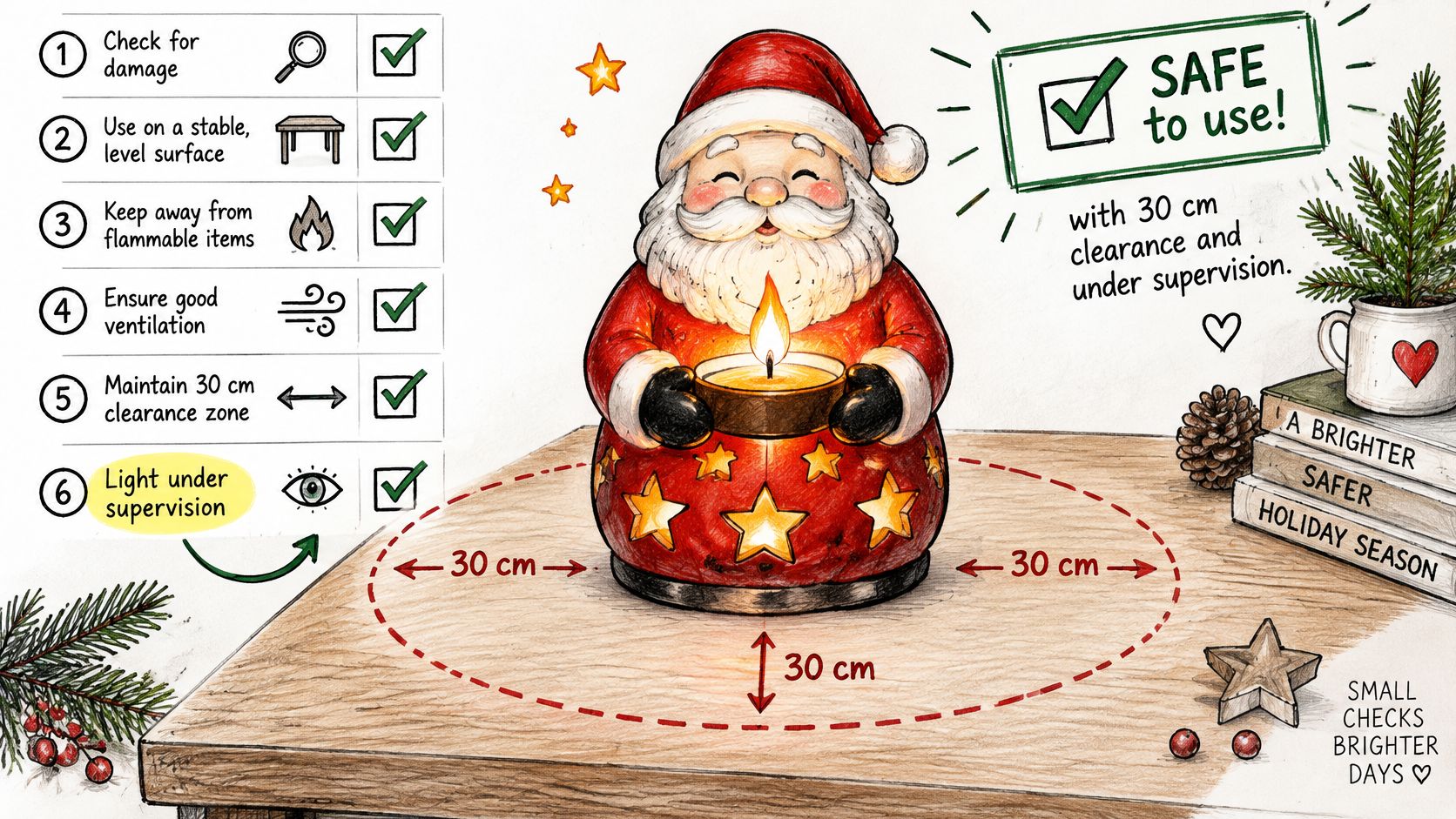
Before the first burn, measure your candle, mark the clearance on the surface with a bit of tape, and run the inspection with the piece cold. Don't light a holder whose candle type was never listed, including a display figure sold without that detail, until the maker confirms it.
Farmhouse World carries rustic candle holders, farmhouse scented candles, table runners, and Christmas ornaments that sit comfortably in the same farmhouse display once the flame question is settled. If you're styling a mantel or a gift table and want pieces chosen for that look, browse the holders and seasonal accents at Farmhouse World. Pick the format that matches your candle, or choose an unlit accent and keep the Santa on stage without a match.


