

The box is open, the mantel is bare, and the garland either stops short of the ends or looks ready to spill toward the firebox. That is the moment most hangs go wrong, before a hook is on the wall. Learning how to hang garland on a mantel starts with length and clearance, not ribbon. Stretch a short piece and the middle sags. Let greenery drift into the opening and you have built something that can feed a fire.
Table of Contents
- Measure the Mantel and Fireplace Clearance First
- Match the Hardware to Your Mantel Surface
- How to Hang Garland on a Mantel Step by Step
- Style Garland Through Each Season
- Choose Safe Materials and Plan Next Steps
Measure the Mantel and Fireplace Clearance First
Run a tape along the front edge from end to end, then note how far each side should drop. Measure from the wall to the front lip too. That depth sets the hook line, about 1 in behind the edge, so foliage doesn't roll forward off the shelf.
For end drapes, buy garland at least 3 ft (36 in) longer than the mantel. For a front swag, plan about 1.5 times the mantel length, plus any overhang past the shelf. A short strand gets pulled tight and collapses in the center. Extra length that isn't planned piles up and drifts toward heat.
Clearance is the next measurement, and it outranks the curve. Measure from the planned garland line to the firebox opening, the chimney opening, candles, and heat-producing lamps. Read the mantel-to-firebox distance in the appliance manual and in local code. One universal gap doesn't fit electric, gas, and wood-burning units.
The National Fire Protection Association reports that U.S. fire departments responded to an estimated average of 835 home structure fires per year between 2020 and 2024 that began with decorations other than Christmas trees. 47% of those fires started because decorations were too close to a heat source such as a fireplace, candle, heating equipment, or lamp. Fasten the garland. Don't balance it on the lip where a branch can fall toward heat, and take it down if you can't keep clearance while the fireplace runs. If you still want candlelight, keep it off the greenery and look at fall farmhouse candles for side-table ideas.
| Mantel length | End drapes (garland length) | Front swag (garland length) |
|---|---|---|
| 54 in | 90 in | 81 in plus overhang |
| 60 in | 96 in | 90 in plus overhang |
Say the mantel is 60 in and you want 4 in past each end. End drapes need about 96 in. A front swag starts at 90 in, then you add that overhang. Reverse the check too. A 90 in strand used for end drapes suits a mantel up to about 54 in.
Lay the garland on the floor, mark where each end should land, and confirm length and clearance before you buy or hang anything.
Clearance first: Visual fullness should never take priority over separation from ignition sources.
Match the Hardware to Your Mantel Surface
The surface, not the greenery, decides whether the hang lasts. Weigh the loaded piece before you shop for hooks. A 90-inch bell garland with 14 bells is about 2.2 lb before you add picks or ornaments, and a wooden bead strand gets heavier once tassels and extras go on. Test any adhesive on a hidden spot and wait the full set time on the package before you load it. Then match the hardware to the finish in front of you.
Architectural Digest notes temporary hooks and a tension rod as low-damage options, while designers describe large-scale garland as a 2025 statement trend for mantels. Heavier styling fails more often than lightweight paper or felt. Adhesive is the wrong tool on chalky paint, fragile wallpaper, dusty brick, and historic finishes. Where drilling isn't allowed, a tension rod or freestanding support keeps the load off the wall.
Painted plaster with a sound film can take rated adhesive hooks. Wallpaper tears if you stick anything to it. Brick and stone shed ordinary hooks because texture and dust kill the bond. Solid wood accepts screw-in cup hooks. Reclaimed boards need sound wood and midpoint supports, not glue over cracks and knots. Rentals and historic mantels stay on compression or gravity methods unless you have written approval and a successful test.
Uneven shelves and clean removal
Set a spirit level on the shelf and place each hook at a high point so the strand doesn't rest on a low edge. Shim a freestanding support if the shelf tilts more than a few millimetres. On the way out, pull adhesive tabs straight down along the wall, slowly, so you don't lift paint. Unscrew cup hooks and fill the holes with spackle matched to the wall.
| Mantel surface | Suitable hardware | Avoid |
|---|---|---|
| Painted plaster with a sound finish | Adhesive hooks rated above the loaded weight, tested first | Chalky or freshly painted walls |
| Wallpaper | Freestanding support or tension rod | Adhesive, which can lift the paper |
| Brick or stone | Masonry clips or mechanically anchored hardware | Standard adhesive hooks, which fail on texture and dust |
| Solid or painted wood | Screw-in cup hooks sized to the wood | A single hook per end carrying the full weight |
| Reclaimed wood | Screw-in hooks where the board is sound, plus midpoint supports | Adhesive over cracks, knots or uneven boards |
| Rental or historic finish | Tension rod or freestanding support | Drilling or adhesive without landlord approval or a test |
Spread the load across several small points. One heavy point at each end is how finishes peel and centers sag.
How to Hang Garland on a Mantel Step by Step
You want a level drape that stays up, with a soft curve through the center instead of a tight line. Pick the hook type for your mantel surface before you mark anything, and keep the lowest greenery clear of the firebox opening you already measured.
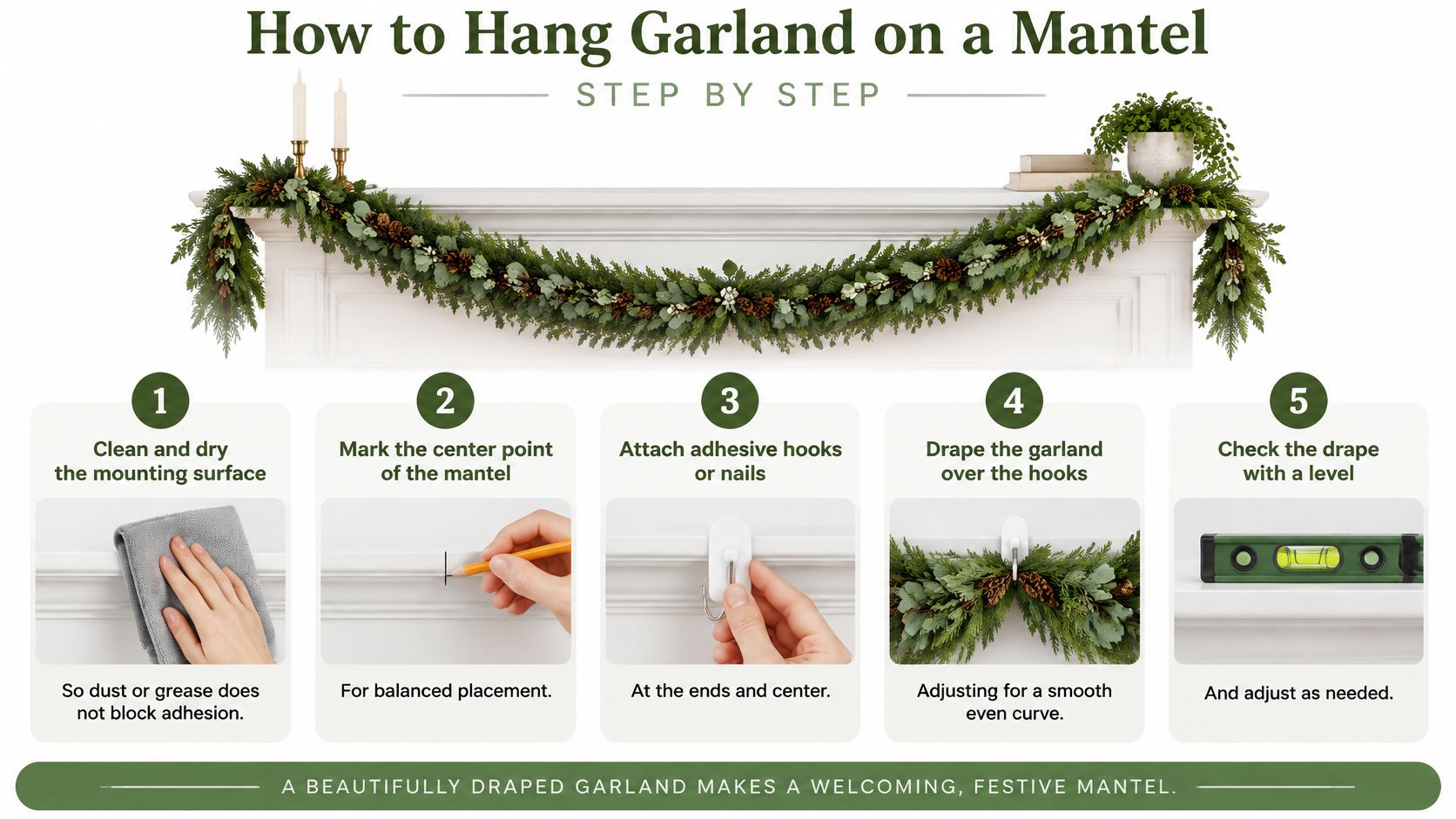
The Spruce mantel garland guide treats this as a low-damage install: clean the surface, set hooks about 1 in behind the front edge, and use a rated capacity comfortably above the actual weight. Heavier strands need grouped hooks, screw-in cup hooks on wood, or masonry-compatible clips on suitable brick. What fails later is usually an undersized strand, dusty paint, or too few supports for the length.
- Clean and dry the mounting line. Dust and grease stop adhesive and let clips skate. Wipe, then wait until the spot is dry. Skip that and a hook often lets go on day two.
- Set one hook at each end, then add midpoint supports. Spread the load the way the hardware section already called for. A center hook, or a pair on a long shelf, keeps the middle from sagging. On brick, use the clip or anchor you matched to that surface.
- Match each hook's rating to the loaded weight. If one hook's rating sits under the share it will carry, group two hooks. Don't force a rating you already know is low.
- Hang from the center outward. Set the middle, then match the overhang on both sides. Starting at one end is how you finish with a long tail and a short one. Keep loops off the opening so heat isn't sitting in the greenery.
- Tie loose sections with floral wire or twist ties. Hide the ties behind the greenery. Leave them visible and the drape looks tied up, not styled.
- Step back and re-seat anything that pulls. Check sag in the middle and at both ends the same day, then again the next morning. A strand that crept overnight is telling you a hook is undersized or the surface wasn't clean.
If you're still choosing the greens, fresh versus artificial Christmas garlands from Slone Brothers Furniture is a useful comparison before you commit to a weight and a look. Fresh cuts dry out and shed. Artificial holds its shape, but dense plastic can weigh more than a thin fresh swag once you add picks.
From across the room, both ends should land at the same height, the center should curve without a flat tight line, and no hook should show as a pinch point.
A short walk-through of the same sequence helps if you want to see hand placement before you start.
Style Garland Through Each Season
One garland is the anchor. Two or three objects around it are enough. Add a fourth layer and the shelf starts to look piled, and the hooks start to work harder than you planned.
Winter can stay simple. The Rustic Festival Bell Garland on Jute String Rope is 90 in long, with 14 antique gold bells, each about 2.25 in wide by 3.5 in tall, on jute with loops at the ends. The whole strand weighs about 2.2 lb. Pair it with a candle holder at each end and stop there. Bells add point weight, so keep a midpoint support even though the piece isn't huge.
Fall and boho styling wants texture more than shine. A 90" Boho Wood Bead Garland with Jute Tassels runs about 90 in overall, with 78 in of roughly 1 in beads and 6 in tassels on each end. Drape it from the center so the tassels land evenly. Beads are denser than paper garland, which means you recheck hook ratings after you add ornaments, not before.
A year-round farmhouse shelf
A neutral strand, a plain mirror or framed print above, and a few holders or planters read as finished without a holiday theme. For a fuller room plan, farmhouse mantel decor shows how those pieces sit together. Each look changes the load. Bells and beads need more support points than a light felt strand. Recount hooks when you swap seasons instead of reusing a winter layout on a heavier piece.
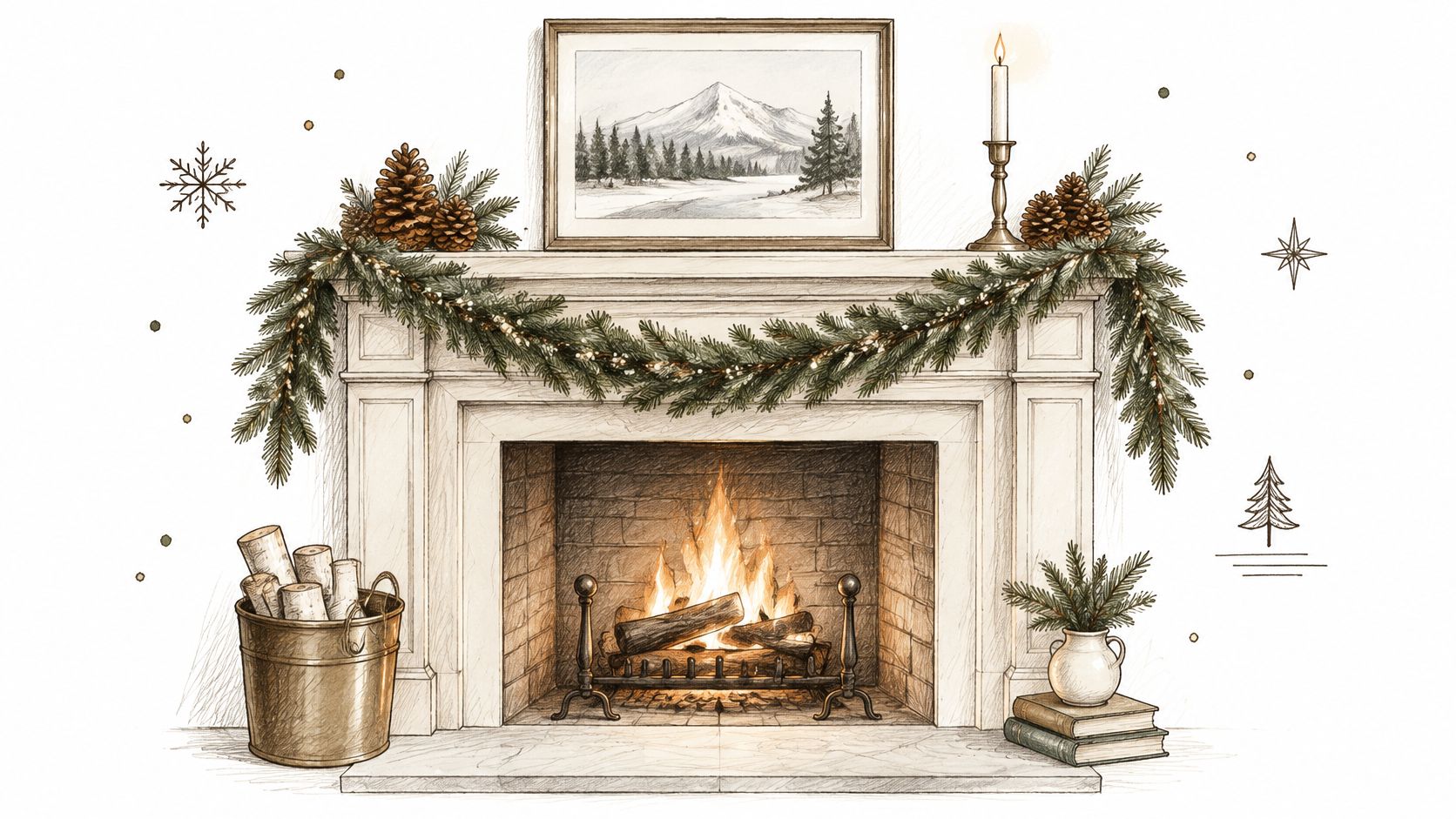
Overloading is the styling mistake that becomes a hardware mistake. Extra picks, wide ribbon, and a second light string add weight and cords. Keep the shelf to one garland, one light string, and a few objects. Warm-white C9 LEDs, such as Value Tools Co holiday lighting, stay easier to route than a tangle of mini lights if you limit yourself to a single strand. Step back to the doorway. If you can't see the mantel edge, take something off.
Choose Safe Materials and Plan Next Steps
The fire is already lit and the garland is still on the shelf. A secured garland is still unsafe if heat, embers, candles, or overloaded lighting sit next to it. Adhesive hooks do not move fuel farther from the firebox. Use a display-only arrangement, or take the garland down, whenever the fireplace will run.
Keep greenery, fabric, ribbon, and lighting off the firebox opening. Do not attach decor to the screen or set it inside the opening. Keep every tail and branch short enough that nothing can reach flame. Livingetc's mantel garland advice is to verify mantel-to-firebox clearance in the appliance manual and local code, not a single published distance.
Electric, gas, and wood-burning units do not share one clearance. Read the unit you own. For an active fire, choose flame-resistant or flame-retardant artificial greenery. Fresh greenery gets more flammable as it dries. Use LED strands because they stay cooler than incandescent bulbs, inspect every cord, and keep wires off hot surfaces.
What to change before you light anything
The Park City Fire District recommends keeping candles at least 2 feet from flammable objects, keeping the mantel free of flammable decorations, and maintaining a safe perimeter around the fire.
Skip real candles beside or under greenery. Flameless candles remove that ignition source.
Skip fresh greens, paper ribbon, and loose fabric tails near an active firebox. They move, and they burn once they dry.
Route pre-lit cords away from the mantel edge and any hot face. Before you light the fire, trace each cord from the plug to the last bulb. A cord that drapes over the front lip can shift toward heat even when the hooks hold.
Check the strand before you store it
Wrap the garland loosely so the wire spine does not kink, keep it dry, and label where each hook sat so next year starts from the same points. Ideas for the rest of the room sit in this rustic farmhouse Christmas decor guide, separate from the firebox.
Run this inspection when the season ends, and again before the strand goes back up:
- Flex the spine and retire it if the wire is broken or the shape no longer holds a shallow drape.
- Check cords for cracked insulation, loose bulbs, and plugs that ran hot last year.
- Confirm the flame-resistant label on artificial greens is still readable. Discard anything stored damp or smelling of mildew.
- Match your hook notes to the surface you still have. Brick, wallpaper, and a rental mantel need the same hardware class as last time, not a leftover adhesive strip.
- Test flameless candles and the LED strand on the floor before either one goes near the shelf.
Farmhouse World carries rustic garlands, candle holders, and farmhouse accents sized for real mantels, including bell strands and wood-bead garlands you can measure against your shelf before you order. Pair a single strand with a few holders and the shelf stays light enough to hang safely. Visit Farmhouse World to compare lengths and finishes for your mantel.


