
You're standing in the entryway with a tape measure in one hand and a metal sign on your phone screen. It could go above the bench, beside the door, or out on the porch, but the product photo doesn't tell you whether the finish will hold up, how much wall the design will cover, or whether the mounting holes will suit your spot.
That's why farmhouse metal wall art is a spec-driven purchase as much as a decorating choice. Substrate, coating, edges, size, and climate all affect whether a piece looks right and stays that way. Choose those details first, then settle on the silhouette, color, and personalization.
Table of Contents
- Why Farmhouse Metal Wall Art Deserves a Closer Look
- What Counts as Farmhouse Metal Wall Art
- Materials and Finishes Compared
- Choosing the Right Size for the Space
- Placement, Mounting, and Styling Tips
- Outdoor Durability and Climate Considerations
- Real Buying Scenarios and Personalization Choices
- Smart Buying Checklist and Final Decision Steps
Why Farmhouse Metal Wall Art Deserves a Closer Look
A good sign has to work in the space where you'll live with it. Above a bench, it should be scaled to the furniture and easy to see as you enter. Beside a door, it needs to fit a narrower wall without crowding the trim. On a porch, its material and finish have to suit the exposure, not just the style of the house.
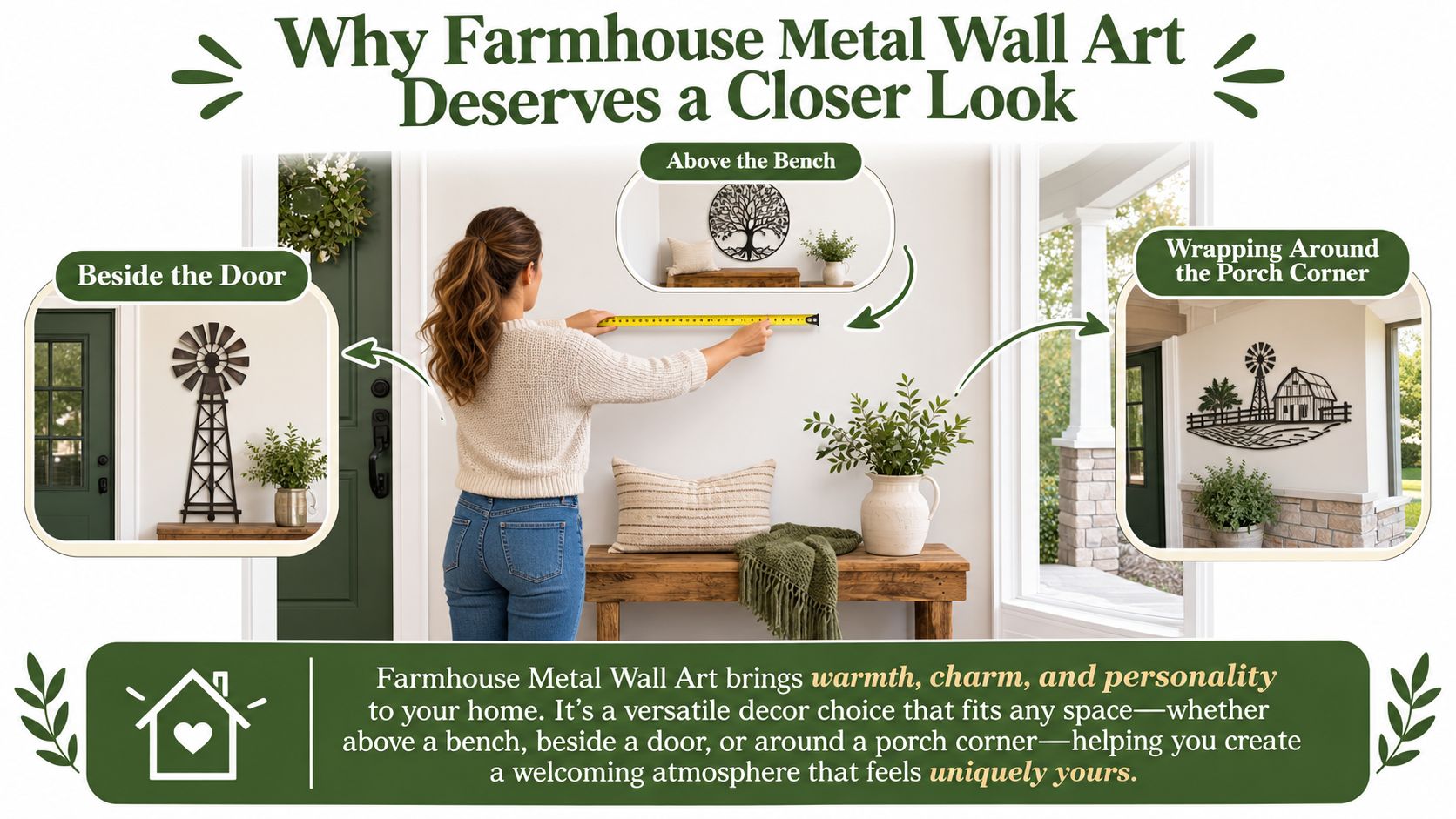
Start by deciding where the piece will hang and what job it needs to do. An address plaque should be readable from its approach. A decorative cross or windmill can be quieter, chosen for its shape and finish. A coop or ranch sign needs to communicate clearly while coping with the conditions around it.
The broader wall-decor category is substantial: one market estimate puts its global value at approximately $63.95 billion in 2025 and projects $68.72 billion in 2026, with North America identified as the largest regional market in 2025 and Asia-Pacific projected to grow fastest (global wall-decor market estimate). That category includes far more than metal signs, so treat it as context, not a measure of demand for any particular style or product.
Before buying, check the sign's overall dimensions, substrate, finish, edge protection, mounting method, and any personalization preview or return policy. For outdoor placement, ask what “weather resistant” means for that specific product. A clear answer is more useful than a rustic product photo.
Buyer's rule: Choose for the wall and the weather first. Choose the motif second.
What Counts as Farmhouse Metal Wall Art
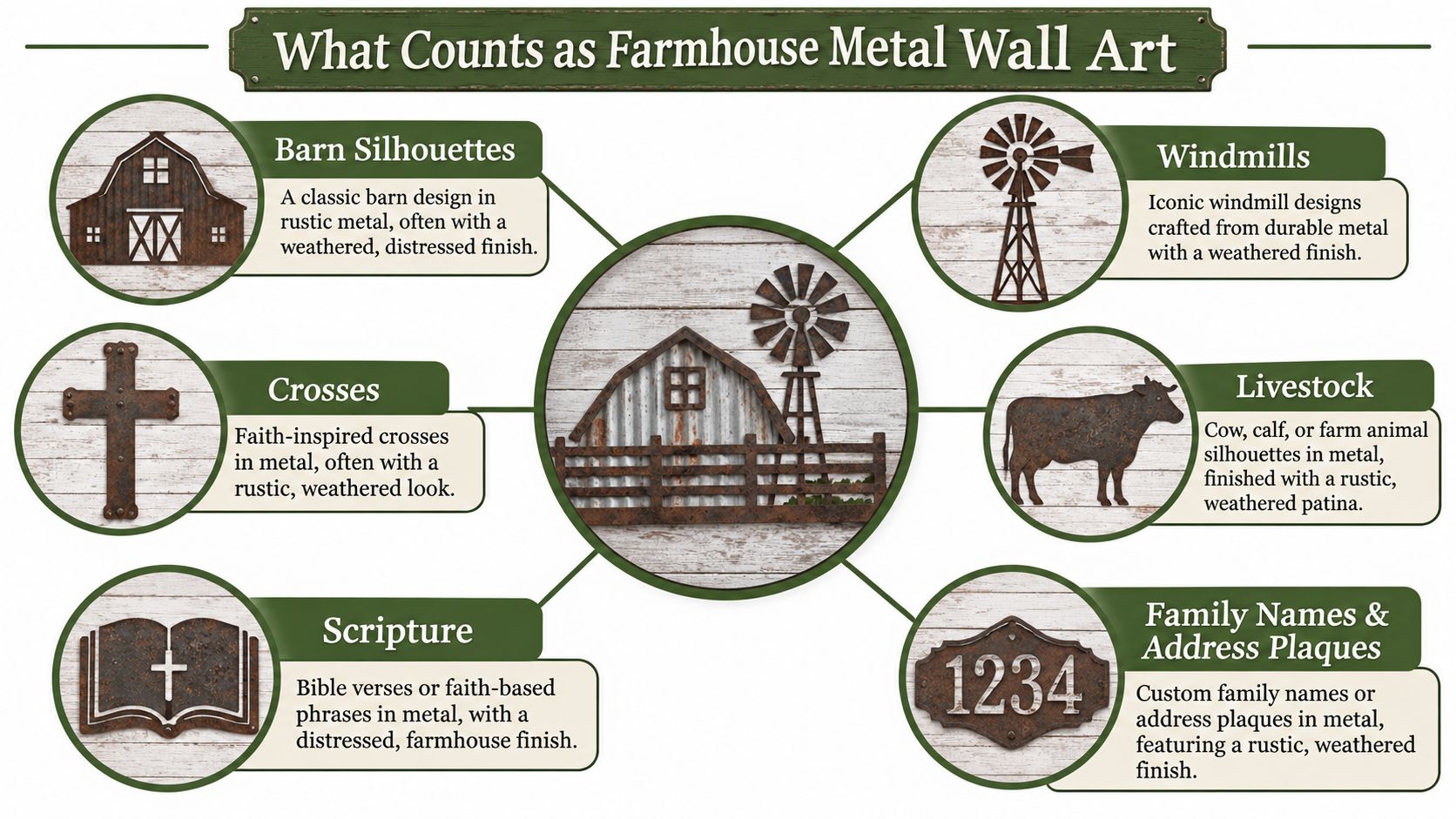
Farmhouse metal wall art uses metal to give familiar country and homestead motifs a dimensional presence. Common designs include barn silhouettes, windmills, crosses, livestock, scripture, family names, and address plaques. The look may be clean and modern, deliberately aged, or somewhere between the two. What makes it feel farmhouse is the combination of subject, material, and finish, not a required shade of brown or a layer of artificial rust.
Unlike canvas or framed prints, a metal piece projects from the wall and can cast a subtle shadow as daylight shifts. It may also carry more weight than a comparable flat print, especially when made from steel. That changes the practical checklist: buyers need to consider mounting points, wall type, and the sign's dimensions as well as its artwork. For a broader view of how rustic details meet cleaner lines, see farmhouse transitional styles.
Look closely at the construction. A flat, mass-produced cutout can suit a simple accent wall, but thin material and rough edges may make the piece feel less finished up close. A routed or carefully laser-cut sign should have clean outlines and tidy openings; inspect the edges, holes, and back as well as the face. A smooth powder-coated finish can make a design look crisp, while a distressed finish emphasizes a weathered character.
The category also has a defined place within decorative art. One commercial market estimate reports that metal made up 15% of global wall-art sales, compared with canvas at 45% and wood at 30%; it also attributes 65% of wall-art purchases to residential buyers (wall-art market estimate). These are directional industry figures, not audited totals, but they underscore that metal competes with other materials rather than replacing them.
Materials and Finishes Compared
A sign's appearance can be misleading. Two black farmhouse signs may look alike in a listing photo, yet one may be painted mild steel intended for an interior wall while the other uses a corrosion-resistant substrate and a finish specified for outdoor use. Ask about the base metal and the coating, not just the color.
| Substrate | Common finish | Corrosion behavior | Best for | Key trade-off |
|---|---|---|---|---|
| Mild steel | Paint or powder coat | Can rust if the protective layer is scratched, damaged, or missing at edges | Indoor signs and protected locations when properly finished | Strong and substantial, but vulnerable wherever protection fails |
| Galvanized steel | Zinc coating, sometimes with a decorative topcoat | Zinc provides sacrificial protection to steel, including near some exposed areas | Outdoor plaques and signs where the coating and detailing suit the exposure | Protection depends on coating condition, cut edges, holes, and fasteners |
| Aluminum | Paint or powder coat | Naturally corrosion-resistant, though the finish and mounting details still matter | Lighter signs and humid locations | Doesn't have the same weight and feel as steel |
| Weathered or decorative steel | Aged finish, clear coat, or intentional oxidation | Behavior depends on the material and finish; runoff may stain nearby surfaces | Locations where an aged look and its maintenance are acceptable | Can mark light siding, stone, or masonry |
Powder coating and paint aren't interchangeable labels. Powder coating is applied electrostatically and cured to form a protective film. Cleaning and pretreatment, including phosphating or zinc phosphating, help the coating adhere and resist corrosion. Conventional paint may also protect steel, but the product specification should identify the intended use and system rather than relying on a color name.
For comparison, an industrial coating data sheet specifies no more than 1/8 inch of creep and no blistering after 500 hours in ASTM B117 neutral salt-spray testing for an interior polyester-epoxy system. Guidance for outdoor electrical enclosures identifies 1,000 hours or more as a target for outdoor use (powder-coating performance guidance). Those tests help compare coatings; they don't promise a particular number of years in the field. Sun exposure, moisture cycles, impacts, film thickness, pretreatment, and uncoated edges also affect performance.
Hot-dip galvanizing bonds zinc–iron alloy layers to steel and can offer sacrificial protection when a scratch exposes the base metal. Coating specifications range from Z100 to Z600, corresponding approximately to 7–42 µm of zinc per surface; a Z600 coating may provide service life of up to 80 years under suitable conditions (coated-steel guidance). Those conditions matter. Cut edges, drilled holes, welds, and fasteners need attention, especially in salty environments.
When you shop, ask for the substrate, coating type, pretreatment, indoor or outdoor classification, and edge protection. For a wider perspective on bringing metal finishes into a room, this metal accent furniture guide offers useful styling context. And if a flatter, softer material suits the wall better, compare your options with farmhouse canvas wall art.
Choosing the Right Size for the Space
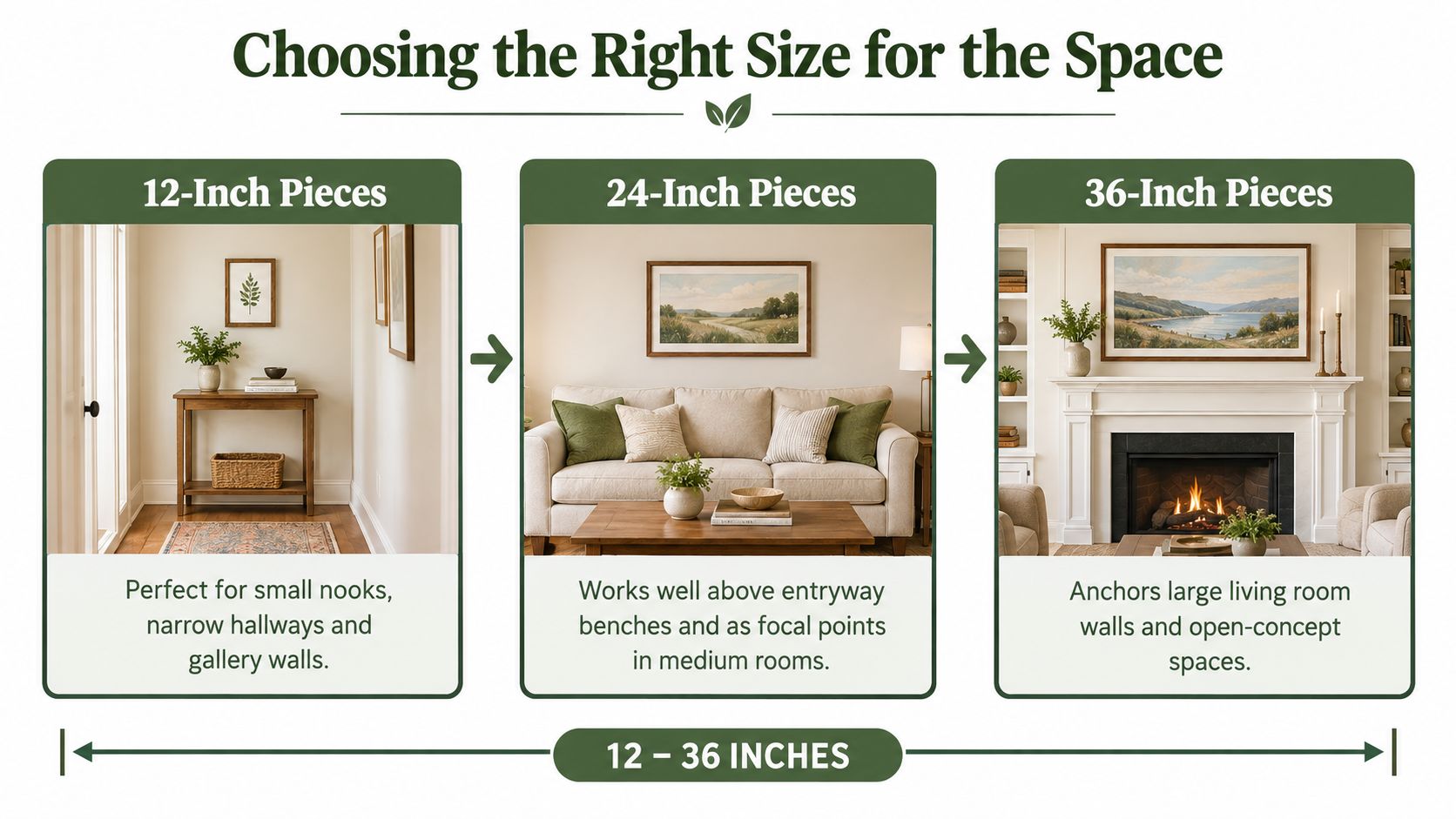
A sign can have a lovely design and still look wrong if it's out of scale. Many farmhouse metal wall-art listings fall within a 12-inch to 36-inch range. Treat those numbers as a starting point, then measure the wall and the furniture beneath it.
Match the dimensions to the setting
- 12-inch pieces suit narrow walls, small nooks, and accents beside a door. They also work in a gallery arrangement, where the sign isn't expected to anchor the whole wall.
- 18- to 24-inch pieces are a dependable choice above a bench or console. They can read clearly without overwhelming a modest entryway.
- 30- to 36-inch pieces make more sense over a broad mantel, on an open porch wall, or on a coop or ranch building where the sign needs to be visible at a distance.
Measure the full area you want the art to occupy, including the space around the design. Then check whether the seller's listed dimensions describe the overall sign or only the visible cutout. Mounting tabs, borders, and custom lettering may affect how much of the piece reads from across the room.
For a bench or console, use the furniture width as a visual guide: the sign should feel related to it, not stranded above it or spread awkwardly beyond its edges. Tape the proposed outline on the wall before ordering. That simple test reveals whether doors, trim, lights, and nearby decor leave enough breathing room.
A larger sign isn't automatically a better focal point. If the lettering or silhouette has fine detail, make sure it'll remain legible from the usual viewing distance. For a personal name or address, prioritize readability over elaborate cutouts.
Placement, Mounting, and Styling Tips
A metal sign should sit comfortably within its surroundings, not compete with every other object on the wall. In an entryway, center it above the bench or console and check the view from the doorway. If you're combining it with other pieces, decide which one leads and let the rest support it.
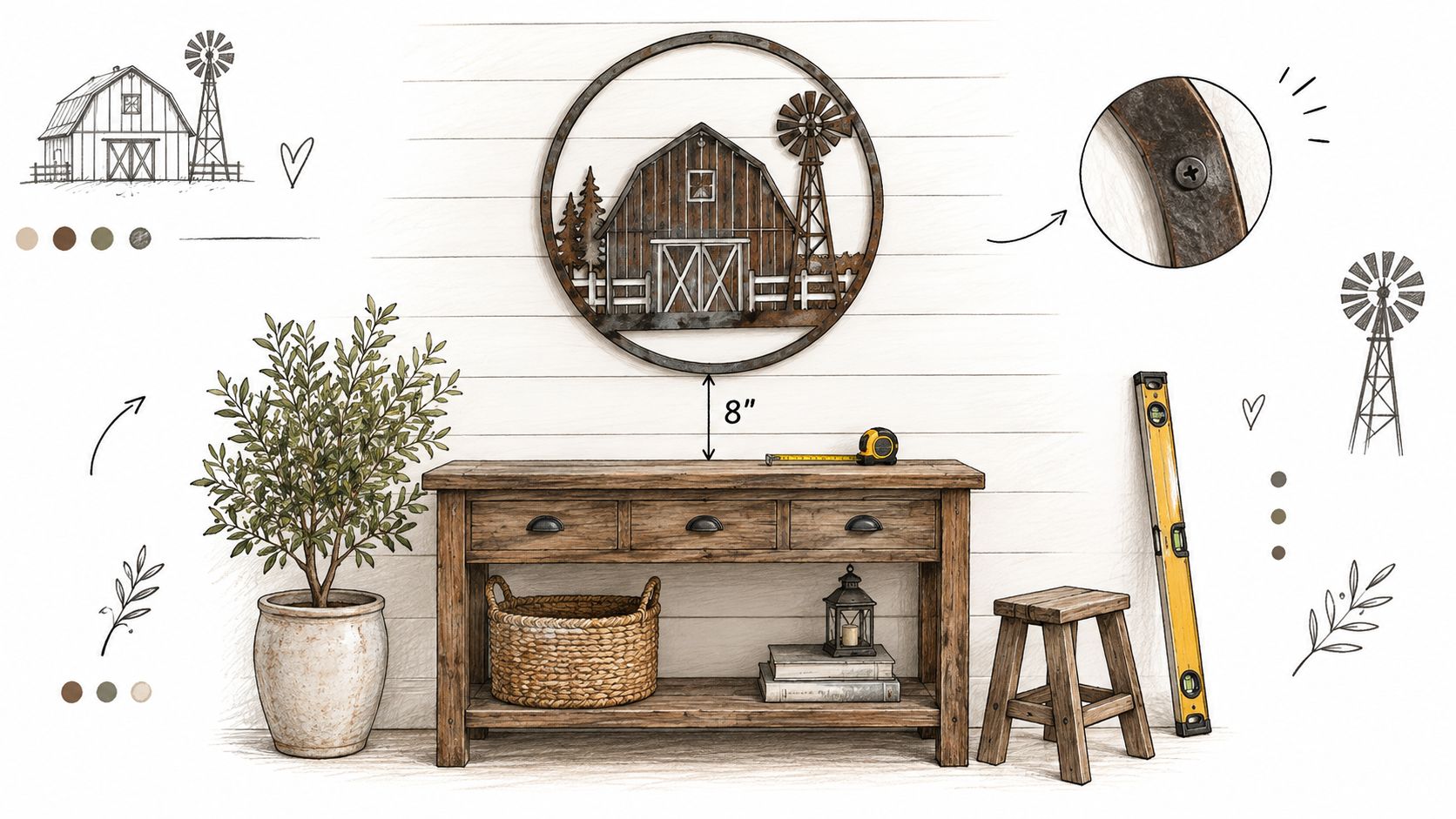
Leave 6 to 12 inches of clearance between the bottom of a sign and the furniture below when that spacing suits the room and the object's scale. A tight entryway may call for less; a tall console or a larger sign may need more. Check the composition from normal standing and seated positions rather than judging it from a close-up.
Make the finish work with the room
Black metal gives strong contrast against a light wall and suits a graphic silhouette. Copper and gold add warmth, while white blends more gently into pale walls. A weathered finish brings texture, but don't place it where runoff could stain a light surface. Pair a metal sign with canvas, wood, or shiplap thoughtfully; too many competing textures can make a small wall feel cluttered. For ideas on balancing cozy accents, compare cozy home styling.
Before drilling, identify the wall material and choose a stud or an appropriate anchor for the sign's weight. Use spacers if you want a little separation from the wall and a stronger shadow line. Level the piece before tightening its fasteners, and use washers where they help spread pressure.
Overtightening can chip a powder-coated surface. If you need to drill or cut a piece for a special fit, protect the newly exposed area rather than leaving bare steel. For a broader mix of placement ideas, browse these farmhouse wall decor ideas.
Indoor walls are the simplest location for a finished sign. A covered porch still sees humidity and wind-driven moisture, so choose suitable hardware and inspect the edges. A fully exposed placement needs a coating and substrate designed for that exposure, plus drainage that prevents water from sitting behind the panel. For a visual walkthrough of styling, use the video as a reference after you've settled the sign's location and mounting plan.
Outdoor Durability and Climate Considerations
“Weatherproof” isn't a complete specification. Outdoor performance depends on the substrate, the coating, exposed edges, fasteners, and the climate where the sign will hang. A painted steel sign under a sheltered porch roof and a sign on an exposed coastal gate face different risks, even if both listings use the same broad claim.
Choose for the exposure
- Interior: The sign avoids direct weather, but still needs a finish that suits the room and a mounting method that supports its weight.
- Covered porch: The roof limits direct rain, but moisture and humidity can still reach the surface and mounting points.
- Fully exposed location: Ask whether the substrate and complete finish system are intended for outdoor use. Don't assume a decorative topcoat protects bare edges.
- Coastal or salt-exposed site: Chlorides accelerate corrosion, so choose more conservatively and use corrosion-resistant fasteners. Avoid trapping water behind the panel.
- Snowy or de-icing-salt environment: Salt can reach the sign and hardware through splash and runoff. Check fasteners and vulnerable edges as part of ongoing care.
A decorative aged finish can look right on a barn or ranch gate, but it may shed rust-colored runoff onto pale siding or masonry. Weathering steel also needs an environment where continued oxidation and staining are acceptable. Rustic doesn't mean maintenance-free. A climate-based guide to protecting metal from rust can help you assess the risks before mounting.
Inspect cut edges, holes, welds, fasteners, and any sealant during routine cleaning and maintenance. Remove dirt gently, look for chipped coating or early rust, and touch up small damaged areas with a compatible product. Don't overtighten mounting hardware, since that can damage the finish; avoid contact between dissimilar metals where it could create a corrosion problem.
Treat durability claims as questions to verify. Ask whether the sign's coating has test results, what those results measure, and whether the seller considers the product suitable for your specific exposure. Salt-spray data can compare coatings, but it can't stand in for every combination of sunlight, rain, impacts, and seasonal temperature changes. If the seller can't describe the substrate, finish, and edges, keep the piece indoors or choose a better-documented option.
Real Buying Scenarios and Personalization Choices
Coastal porch: You want a sign that reads clearly near an entry and won't rely on a vulnerable finish alone. Favor aluminum or suitably galvanized construction, use stainless fasteners, and avoid a finish that could leave rust-colored runoff on light siding. Keep the design legible and straightforward. Before ordering, confirm the product is intended for outdoor use and ask how its cut edges and mounting holes are protected.
Chicken coop or ranch gate: Visibility and readable lettering matter more than intricate detail. A sign in the 24- to 36-inch range can suit a larger surface, depending on the wall and viewing distance. Choose a durable finish, make the family or property name prominent, and check the gate or coop material before selecting hardware. A personalized sign can identify a space while still looking considered rather than purely utilitarian.
Housewarming or family gift: Personalization works best when the wording is checked carefully. A family name, established date, or monogram can turn a familiar silhouette into a keepsake, but the recipient's wall space and finish preferences still matter. A Jesus Cross Wall Art design can suit a home where a religious motif is welcome; a Personalized Windmill Steel Sign offers a country-inspired form with room for personal details. Check whether the seller provides a design preview and confirm spelling before production.
Farmhouse World offers custom metal signs for homes, farms, coops, and ranches, with options for names, dates, and design variations. Treat that as one route to personalization, and compare its material, finish, mounting details, and preview process with any other seller you're considering.
Smart Buying Checklist and Final Decision Steps
Before you order, run through this checklist:
- Confirm the location and size. Measure the available wall, account for surrounding trim, and check whether the listing gives overall dimensions.
- Match the substrate and finish to the climate. Ask about outdoor classification, pretreatment, edge protection, and hardware.
- Choose a design and color that suit the wall. Check contrast and readability, especially for names and addresses.
- Review personalization details. Confirm spelling, layout, preview availability, and production approval.
- Check mounting and order policies. Verify hardware, shipping expectations, return terms, and what happens if the piece arrives damaged.
A lighter, less costly interior accent may be the right choice for a dry wall; a more protective build makes sense where weather reaches the sign. A neutral motif is easier to place, while personalization makes the piece more specific to its owner. Choose for the conditions you have, not the ones implied by a product photo.
Once you've measured the wall and confirmed the material and finish, you're ready to buy with confidence.
Farmhouse World offers personalized metal signs, rustic wall art, and farmhouse accents for entryways, porches, coops, and ranches. Browse Farmhouse World to compare designs and personalization options, then choose a piece that fits your wall, climate, and purpose.


