

You're standing in the hallway between the kitchen and living room, looking at the empty wall above a slim console table. A small framed print feels lost, but a wide piece would block the walkway. The wall seems to ask for something tall, yet you're not sure whether that means a sign, a shelf, a planter, or a collection of smaller pieces.
That's the central challenge of vertical rustic wall decor. You're solving a spatial problem before choosing a style. A successful arrangement follows the wall's proportions, leaves enough breathing room for movement, and then brings in the wood, metal, woven texture, or aged finish that makes the room feel warm.
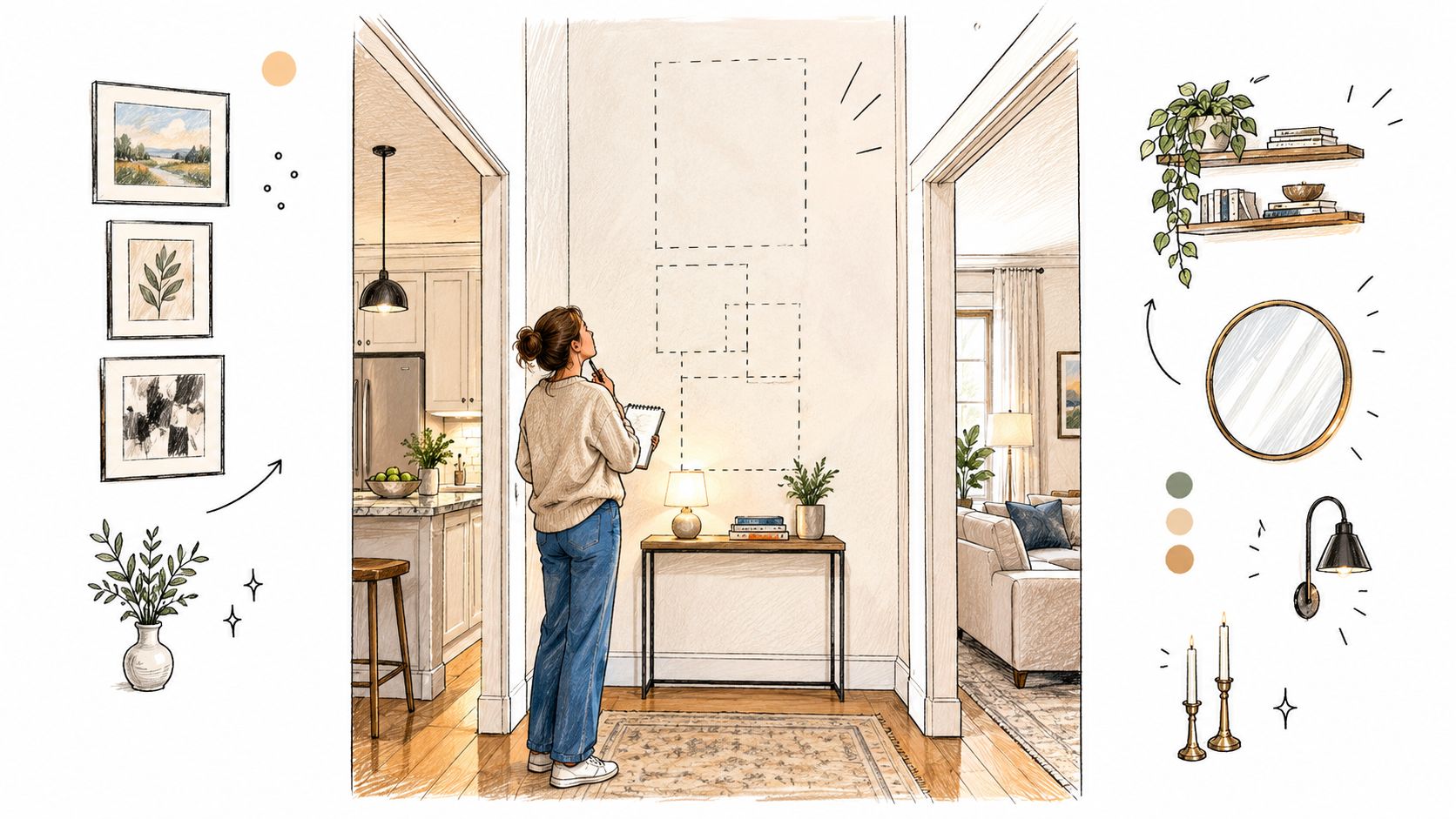
Table of Contents
- Why a Tall Empty Wall Feels Hard to Decorate
- What Vertical Rustic Wall Decor Actually Means
- Popular Item Types Worth Knowing
- Sizing and Placement for Narrow Walls
- Styling Small and Narrow Spaces Well
- DIY Versus Ready-Made Pieces
- Care, Cleaning, and Final Styling Checklist
Why a Tall Empty Wall Feels Hard to Decorate
A narrow wall gives you less room for error than a broad living-room wall. Horizontal artwork can make the space feel compressed, while a small square print leaves too much unused wall above and below. The eye needs a clear path upward, so the strongest solutions use height, repeated vertical lines, or a stack of related objects.
Consider a framed print that's only a foot wide on a wall that rises eight feet. The artwork may be attractive, but its scale tells the eye that the wall is still empty. A tall plank sign reaching several feet upward creates a stronger visual relationship, especially when it sits above a slim console or beside a doorway.
Read the wall before choosing the decor
Stand at the entrance to the room and note what you see first. Is the wall visible from the kitchen, the stairs, or the front door? A piece that looks balanced straight on may feel too deep when viewed from the side, particularly beside a passageway.
Measure the open wall area, then mark the furniture, trim, light switches, and door swing. You're not decorating a blank rectangle. You're working around the way people move through the home.
Practical rule: Treat the wall like a narrow window. Choose decor that fills its height without closing off the view around it.
A slim console benefits from a tall, shallow sign or a vertical arrangement of framed botanicals. A wider empty section beside a sofa can handle a ladder shelf or layered architectural piece. If the wall feels especially bare near the floor, a plant can help balance the composition. For compact homes, this guide to the best tall planters for apartments can help you compare ways to add height without using much floor space.
The same principle applies to a rustic accent wall. Before adding multiple objects, study how rustic accent wall ideas use texture and direction to support the room rather than compete with it. Your goal isn't to fill every inch. It's to give the wall a deliberate visual starting point, a strong upward movement, and enough negative space to keep the hallway comfortable.
What Vertical Rustic Wall Decor Actually Means
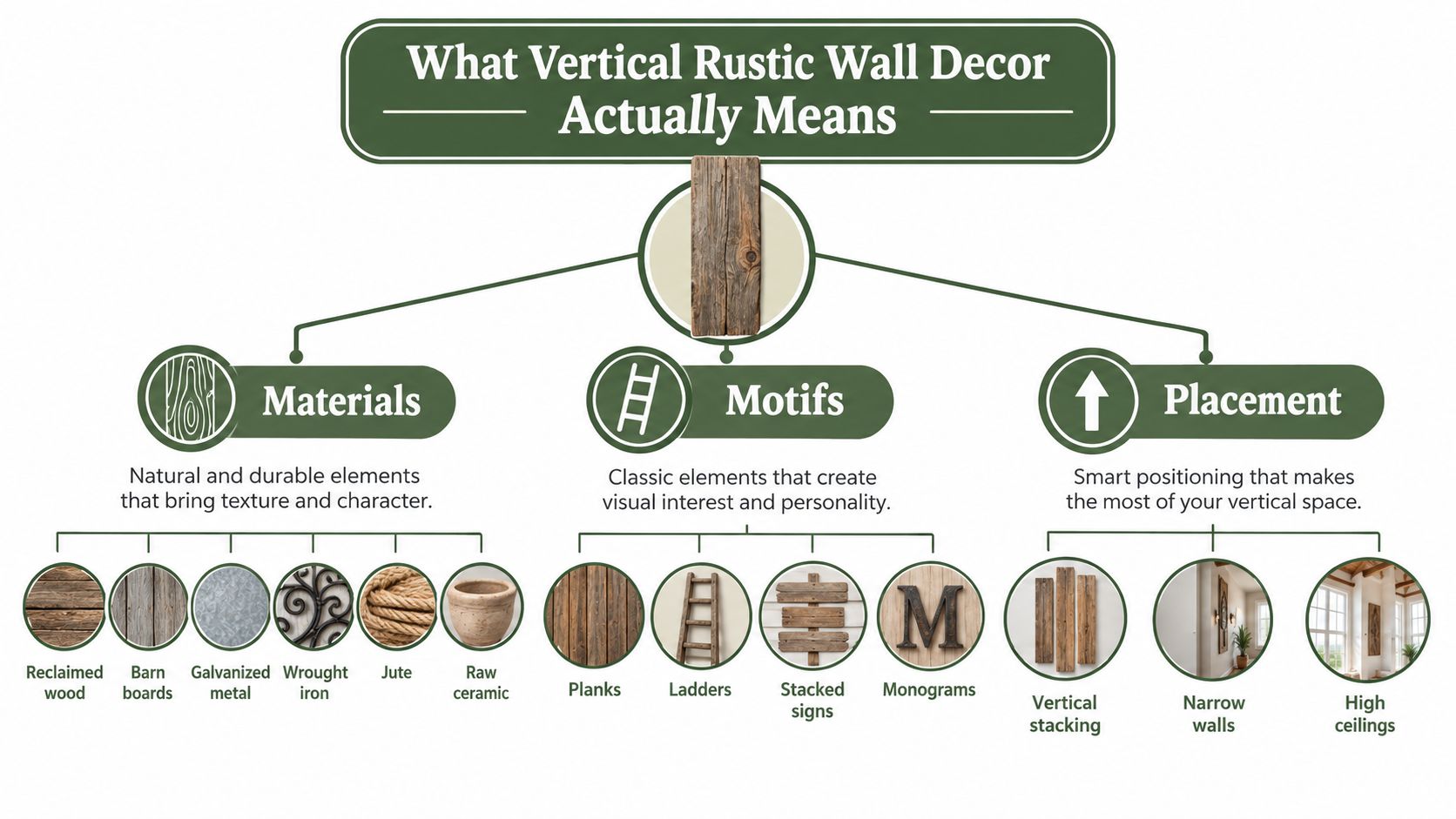
Vertical rustic wall decor combines material character, recognizable rustic motifs, and tall proportions. Remove any one of those elements and the result may still be attractive, but it may no longer solve the same decorating problem.
Start with the materials
Look for reclaimed wood, weathered barn boards, galvanized metal, wrought iron, jute, and raw ceramic. These materials show variation through grain, texture, patina, or an intentionally imperfect finish. A smooth factory surface can still work, but the piece needs some visual warmth if you want a rustic result.
Metal can bring a sharper outline to a room, while wood softens the arrangement. Woven fibers add movement without much visual weight. Ceramic vessels create a handcrafted feeling, especially when their surfaces remain matte rather than glossy.
Recognize the motifs
Common rustic motifs include planks, ladders, stacked signs, monograms, botanical prints, grain sacks, and antlers. You don't need every motif in one room. A single ladder shape may be enough to establish the direction, while a series of herb prints can create a quieter interpretation.
Orientation matters just as much as subject matter. A tall frame with a botanical print can feel rustic because of its aged wood surround and restrained palette. A horizontal sign with the same finish won't create the same upward rhythm.
Rustic style also isn't the same as country kitsch. The difference often comes from editing. A few weathered surfaces and purposeful motifs feel collected. Too many slogans, distressed edges, and unrelated symbols can make the wall feel themed rather than lived in. Generic modern farmhouse may use clean white finishes and simple geometry, while vertical rustic decor usually keeps more visible grain, patina, or handcrafted irregularity.
For a broader visual reference, browse these rustic canvas wall art collections and compare how frame texture, subject, and orientation change the mood of a room. The most useful question isn't whether a piece looks rustic on its own. Ask whether its proportions and surface character fit the wall you're trying to furnish.
The style has deep roots in rural American interiors, with origins commonly traced to the nineteenth century and, in some accounts, as far back as the 1870s. The Adirondack Great Camps helped shape the cabin and country aesthetic that later reached mainstream homes, which helps explain why natural materials and simple forms still feel familiar today. Wall art also remains a major part of the wider wall decor market, with one projection assigning it about 38% of demand in 2026 and another estimating roughly 35.8% of global wall decor share in 2026 (historical context and market figures).
Popular Item Types Worth Knowing
The right item depends on what the wall needs to do. A decorative sign can add personality, a ladder shelf can provide function, and a planter can soften a hard passageway. Compare depth, visual weight, and maintenance before you choose based on appearance alone.
| Item Type | Typical Height | Weight | Best Wall | Ideal Room |
|---|---|---|---|---|
| Vertical plank sign | Tall and narrow | Light to medium | Above a console or beside a doorway | Entryway or kitchen |
| Reclaimed ladder shelf | Tall with usable depth | Medium to heavy | Empty wall with floor clearance | Living room or bathroom |
| Stacked shadow boxes | Layered from top to bottom | Light to medium | Narrow wall needing a curated display | Hallway or dining area |
| Vertical wall planters | Tall, with projecting vessels | Medium | Wall needing texture and greenery | Entryway or covered porch |
| Graduated woven baskets | Tall arrangement with soft depth | Light | Blank wall beside furniture | Bedroom or sitting room |
| Antique window frame | Tall, with strong internal lines | Medium to heavy | Broad vertical gap | Dining room or living room |
| Botanical or herb prints | Tall framed grouping | Light | Above a bench or beside a cabinet | Kitchen or breakfast area |
| Corbels and shutters | Tall or layered architectural pieces | Medium to heavy | Wall with farmhouse character | Porch, entryway, or dining room |
How the main options behave
Vertical plank signs work when the wall needs a clear focal point. Hand-painted lettering, laser-cut names, or a simple botanical motif can make a slim entryway feel intentional without adding much depth. Choose a restrained message if the surrounding room already contains patterned textiles.
A reclaimed ladder shelf solves a different problem. Its rungs create vertical lines, while the shelves hold small plants, folded towels, candles, or framed photographs. It needs enough clearance for people to pass without brushing against the contents, so it's better on a stable wall away from a tight door swing.
Vertical planters add texture and life, but their containers, soil, and plants create more load than flat artwork. They're useful beside a kitchen entry, in a covered outdoor area, or on a blank wall that feels too hard and architectural.
Stacked frames, woven baskets, and shadow boxes make a curated display. Use related finishes or a shared subject so the collection reads as one composition. Architectural salvage, including shutters, corbels, and antique window frames, suits rooms that already have substantial wood or metal details.
For inspiration on combining materials, explore these examples of wood and metal wall decor. As a quick decision guide, choose ladder shelves for storage plus style, plank signs for personality, vertical planters for organic texture, and stacked frames for a collected gallery effect.
Sizing and Placement for Narrow Walls
Measure before you shop. Record the wall's height and width, then note the distance from the floor to the underside of any console, bench, headboard, or cabinet. Include trim and nearby openings, because a tall piece that technically fits may still look crowded beside a door casing.
A useful starting point is to let the decor occupy roughly two-thirds of the available vertical span. That leaves visible wall above and below, so the piece feels placed rather than wedged into the space. For a composition above furniture, keep the lower edge close enough to relate to the furniture without making the two elements look fused together.
Use the viewing point as your guide
If nothing sits below the artwork, place the focal point around eye level rather than pushing the piece toward the ceiling. A common hanging reference centers the focal point roughly 57 to 60 inches from the floor, but you should adjust it for the people who use the room and for the way the wall is viewed from a hallway or staircase.
When a console, bench, or headboard sits below the piece, the furniture becomes the visual anchor. Leave a comfortable gap above it, then judge the arrangement from the doorway. The exact distance matters less than the relationship. Artwork that floats too high feels disconnected, while artwork that nearly touches the furniture looks cramped.
Give projecting pieces room
Thin plank art needs little lateral clearance. A ladder shelf or planter needs more because its contents project into the walking path and create shadows on the wall. If you're decorating a narrow passage, tape the proposed width and depth on the wall or floor before drilling.
Keep some wall visible at both sides. For a tall wall, allow a few inches of breathing room per side for every foot of wall height rather than selecting a piece that stretches from edge to edge. The composition should feel like a vertical column within the wall, not a panel forced into a narrow slot.
The process flow shown above is useful because it separates three decisions. Measure the actual space, scale the decor to the furniture and wall, then place it according to the viewer's eye line and walking distance. That sequence prevents a beautiful rustic piece from becoming the wrong piece for the room.
Styling Small and Narrow Spaces Well
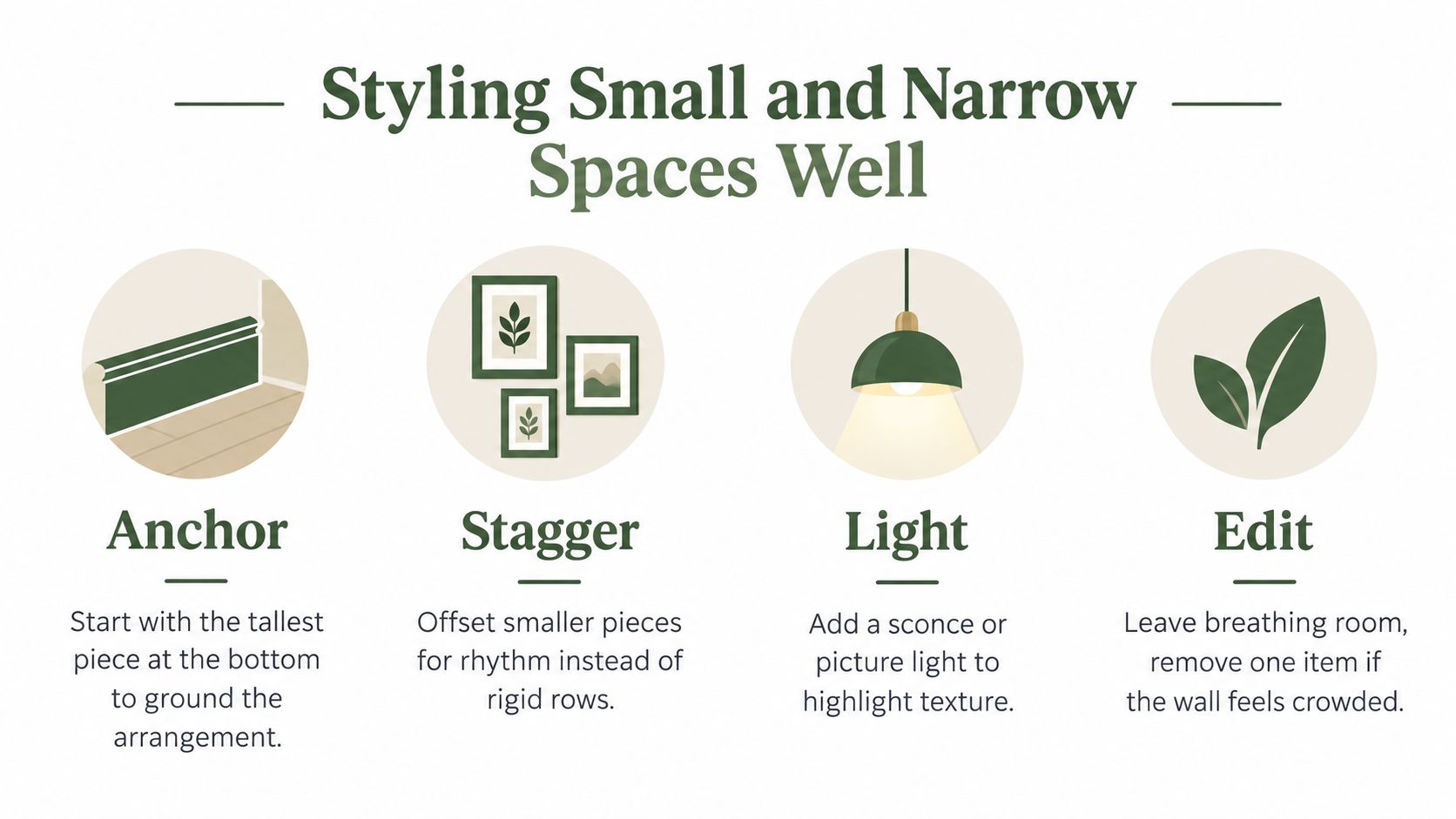
Small spaces benefit from restraint. Instead of lining up several objects at equal intervals, anchor the arrangement with one strong vertical element and let smaller accents support it. A tall sign can sit slightly off-center, with a small frame or basket offset on the open side.
Build a loose visual triangle
A loose triangle gives the eye movement without making the wall look rigid. Place the tallest element toward the lower portion of the arrangement, add a shorter object to one side, and use a small accent to balance the opposite side. The shapes don't need to form a perfect geometric triangle. They only need to vary in height and position.
For example, place a narrow shutter near the floor, hang a small botanical frame above and to one side, then add a woven basket on the other side. Leave enough negative space between the pieces that each silhouette remains clear. A narrow wall becomes busy when every object touches or competes for the same visual center.
Choose between a statement and a grouping
A single statement piece is usually safer beside a doorway or in a hallway. A vertical plank sign, antique window frame, or tall metal design can fill the wall without adding multiple attachment points or competing textures.
An anchor-and-accent grouping works better where people pause, such as above a bench or beside a console. Start with the main piece, then add only objects that contribute a different scale or texture. If the wall feels crowded after you step back, remove one item before changing everything else.
Lighting can reveal the texture that makes rustic pieces interesting. A small picture sconce can wash light over wood grain, a clip-on LED strip can highlight a ladder shelf, and a warm puck light can bring out the relief in a metal sign. Aim the light at the surface rather than directly into the room, especially in a hallway where glare becomes distracting.
Hardware should match the object and the wall, not just the look you want. A sawtooth hanger may suit a light sign, D-rings can support a medium framed piece, and a stud-mounted French cleat gives a more substantial vertical planter or stacked sign a secure attachment. On gypsum board, a technical hanging guide recommends self-drilling threaded anchors or plastic expansion plugs for roughly 2 to 9 kilograms, while toggle bolts or stud-mounted fixings are recommended above about 9 kilograms because the gypsum core can crush and loosen under repeated load (framed-art hanging guidance).
DIY Versus Ready-Made Pieces
DIY decor gives you control over width, finish, and personalization. A reclaimed cedar planter can be made to fit an unusually narrow wall, while a ready-made piece saves time and usually arrives with more consistent joints, coatings, and hardware.
The best choice depends on the part you value most. If you enjoy sanding, drilling, staining, and testing finishes, a plank sign or simple stacked arrangement can be rewarding. If the wall is difficult to access or the piece will hold weight, ready-made construction may reduce the risk of uneven cuts and weak attachment points.
| Piece Type | DIY Cost | Ready-Made Cost | Skill Level | Build Time |
|---|---|---|---|---|
| Pallet plank art | Materials vary | Varies by finish and personalization | Beginner | Short to moderate |
| Ladder shelf | Materials and hardware vary | Varies by wood, depth, and finish | Intermediate | Moderate to substantial |
| Vertical planter | Materials vary by wood and vessels | Varies by construction and planting system | Beginner to intermediate | Short to moderate |
| Stacked wood signs | Materials vary by lettering and finish | Varies by design and customization | Beginner | Short |
| Metal wall sign | Requires cutting or commissioned metalwork | Varies by size and personalization | Advanced DIY or ready-made | Moderate to substantial |
Compare the hidden work
A DIY piece may have a lower purchase price, but the true commitment includes sourcing straight boards, removing old fasteners, preparing the surface, choosing a sealant, and correcting mistakes. Ladder shelves demand accurate square cuts so they don't rock or twist. Planters require attention to drainage and wall protection, not just attractive containers.
Ready-made pieces can offer more predictable proportions and finish quality. Commercial sealants may withstand handling better than a quick wipe-on coating, although every product still needs suitable placement. Check how the item is meant to hang before buying, especially if it contains metal, glass, soil, or several attached objects.
A personalized sign is a useful middle option. You can select a finished piece and still control the name, monogram, address, or wording. For DIY guidance and approachable project ideas, browse these rustic home decor DIY projects, then decide whether the project's required tools match what you already own.
Choose DIY when exact fit and hands-on creativity matter most. Choose ready-made when reliable construction, repeatable finish, or a faster installation matters more than the satisfaction of building the piece yourself.
Care, Cleaning, and Final Styling Checklist
Rustic materials age well when you respect their surfaces. Wood, metal, woven fibers, ceramic, and living plants each need a different routine, so avoid treating the entire arrangement as though it were one object.
Match care to the material
Dust wood plank art with a dry or barely damp microfiber cloth. Avoid spraying cleaner directly onto reclaimed boards, since moisture can settle into joints and unfinished grain. Keep wood-heavy pieces away from damp zones and strong direct sun where possible.
Reclaimed-wood signs and ladder shelves deserve a regular hardware check. Look for shifting, loose screws, tilted brackets, or a gap developing between the piece and the wall. Metal accents can usually be wiped with a dry cloth, while small rust spots need careful treatment that won't spread moisture across nearby wood.
Metal is often a practical choice for entryways, covered porches, and kitchens because it resists humidity, temperature swings, and sunlight more readily than wood-based decor. Guidance on rustic home accents also identifies natural wood, wrought iron, and hammered metal as common materials, while noting metal's resistance to moisture absorption and shape changes (material guidance for rustic accents).
Vertical planters need their own inspection. Empty standing water from saucers, check that containers drain correctly, and choose greenery suited to the available light and indoor conditions. Trailing plants such as pothos can soften a rigid vertical frame, while dried eucalyptus can provide texture without adding ongoing soil care.
Woven baskets and textile hangings collect dust in their texture. Use low suction, handle them gently, and rotate the arrangement so fading doesn't concentrate on one side.
Use a simple weekend plan
- Measure the wall: Record the open height, width, furniture position, and walking clearance.
- Photograph the space: Take a straight-on image and another from the main doorway.
- Collect references: Save two or three examples that match the room's material palette.
- Choose the construction: Decide whether your tools and time suit DIY or whether ready-made is more sensible.
- Install at eye level: Adjust for furniture, viewing distance, and the object's depth.
- Review the arrangement: Return after a month and refine spacing, plant growth, or lighting.
The finished display should look collected, not frozen. Leave room for the wood to show, the metal to catch light, and the surrounding wall to remain part of the composition.
Farmhouse World offers farmhouse wall art, personalized metal signs, frames, planters, and decorative ladders that can help you build a coordinated vertical display. Visit Farmhouse World to compare rustic pieces for entryways, living spaces, kitchens, and outdoor walls.


