

A complete farmhouse kitchen styling and buying guide starts with three practical questions: how the material handles moisture, what load the wall can safely carry, and how the basket's history of utility can translate into modern decorative storage. The oldest known baskets date to 10,000 to 12,000 years ago, so today's kitchen wall baskets belong to a craft tradition that began long before pottery.
You've probably got the blank patch of wall already: above the breakfast nook, beside the pantry, or behind the sink where a framed print feels too formal. A basket arrangement can warm that surface, free up useful space, and make a kitchen look collected rather than staged. But the attractive arrangement is only half the job. A natural-fiber basket near steam, a heavy tray on textured plaster, or a cluster fixed with undersized hooks can age badly or fall without warning.
The farmhouse look works best when material, mounting method, and purpose agree. Use shallow baskets for visual texture, stronger hardware for substantial pieces, and moisture-tolerant materials where condensation is part of daily life. The result should look relaxed, but it should never depend on guesswork.
Table of Contents
- The Hidden History of Kitchen Wall Baskets
- Choosing Materials for Humid Kitchens
- Installation and Safety Guidelines
- Styling for a Cohesive Farmhouse Look
- Natural Fiber vs Metal, A Decision Matrix
- Maintenance and Care Tips
The Hidden History of Kitchen Wall Baskets
A kitchen wall covered with woven baskets can look like a recent farmhouse styling idea, especially when the display includes dried flowers, pottery, and a weathered wooden shelf. Its visual language is older than the room around it. Basketry served practical household needs long before anyone treated a woven object as wall art.
The oldest known baskets have been carbon dated to between 10,000 and 12,000 years ago in Faiyum, Egypt, while the oldest known complete basket, found in the Negev, is about 10,500 years old. These dates come from the documented history of basket weaving, which also records basket impressions and bitumen fragments at early Middle Eastern sites including Tell Sabi Abyad II and Çatalhöyük.

From working tool to wall display
Early baskets helped households carry goods, store food, and handle materials during preparation. Their flexible construction suited tasks that needed a container to be light, breathable, and easy to move. In that context, the woven surface wasn't decoration. It was the technology.
Large, flat baskets used for food preparation and grain processing, often called winnowing trays, later found a second life as wall decor. As plastic and metal replaced baskets in many everyday jobs during the 19th and 20th centuries, owners increasingly displayed these broad forms instead of using them for labor. That shift explains why a shallow tray feels so natural above a range-free farmhouse table. Its shape still hints at its original work.
Stylist's insight: A wall basket feels authentic when its form suggests a job. Broad trays, handled carriers, and tightly woven storage shapes look more convincing than random objects chosen only for color.
Basketry traditions also remain globally continuous. Native North American examples use coiling, plaiting, and twining for domestic and food-related purposes, showing that the craft isn't tied to a single region or decorative vocabulary. When you hang a basket in the kitchen, you're bringing in at least ten millennia of fiber craft with a practical origin, not adding an arbitrary rustic accessory.
That history should influence buying decisions. Look for visible structure, a convincing weave, and a silhouette that could plausibly have served a household purpose. A basket with uneven fibers, small variations, and a useful profile often contributes more character than a perfectly uniform piece.
Choosing Materials for Humid Kitchens
Material choice determines whether a basket remains attractive beside a sink or starts showing damage after repeated exposure to steam, heat, and cleaning products. The kitchen zone matters as much as the style. A dry wall near a dining table gives you more freedom than a backsplash rail beside a dishwasher.
For metal baskets, stainless steel is the safest baseline in humid conditions. The reason is material science, not marketing language. Chromium helps create a passive oxide layer that slows rust formation, and corrosion resistance generally rises with chromium content. 304 stainless steel contains 18% chromium and 8% nickel, making it a common specification for wet kitchens, as explained in this guide to choosing basket materials for humid spaces.
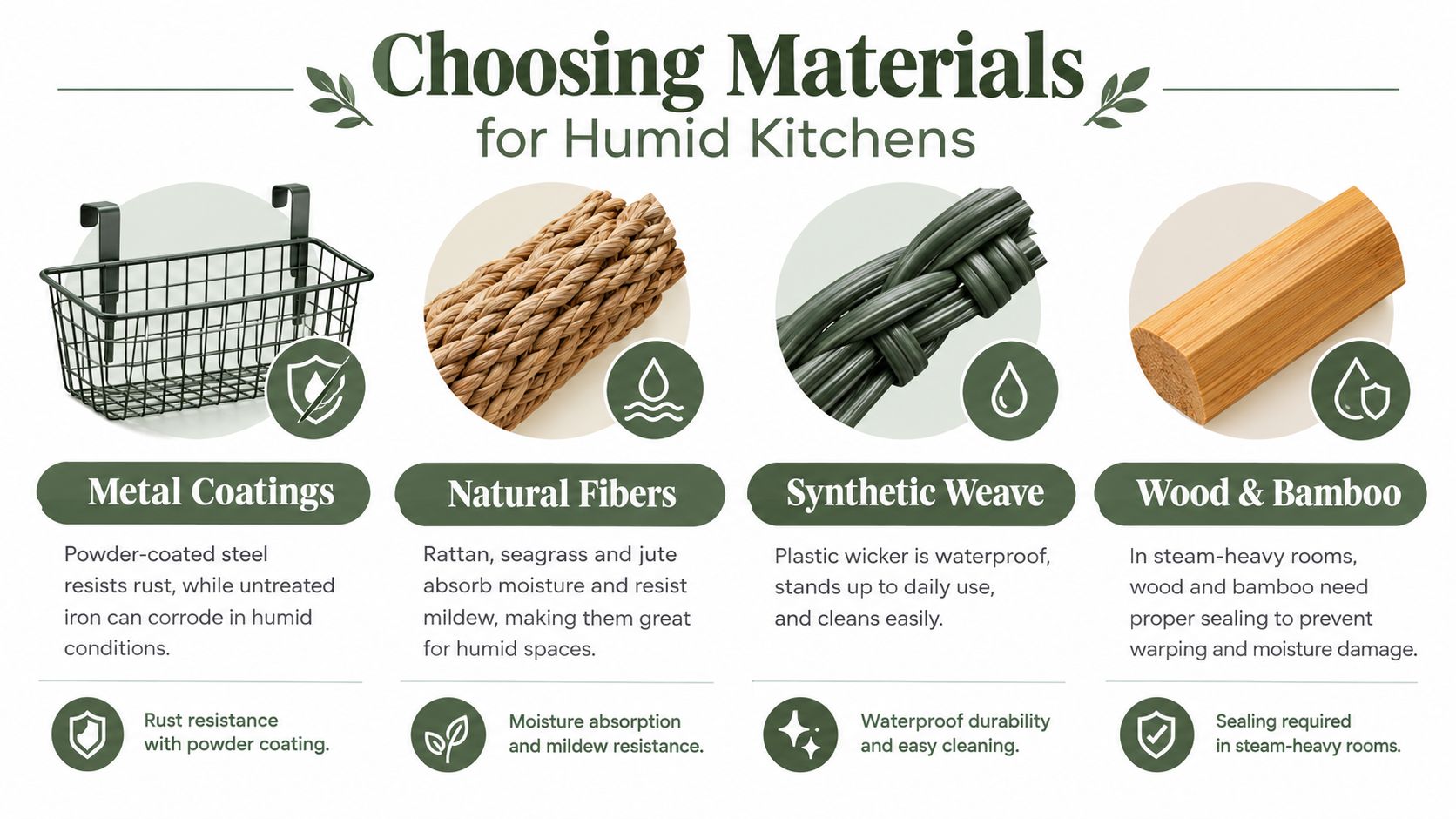
Metal, fiber, and sealed wood
Lower-nickel 201 stainless steel is more vulnerable to visible corrosion over time in steamy storage areas. Plain steel should be avoided unless it has a reliable protective finish, because moisture and cleaning chemicals can attack exposed surfaces. Powder-coated steel can work well away from direct splashing, but inspect the coating for chips around hooks, rims, and welded joints.
Natural fibers bring the warmth farmhouse decor is known for, but they absorb moisture. Rattan, seagrass, and jute can work on a dry wall with good air circulation. They aren't the first choice beside a kettle outlet, sink, or frequently steamed backsplash. Let wet items dry before placing them inside, and don't use a woven basket to contain damp cloths unless the product is specifically designed for that purpose.
Synthetic weave is easier to wipe clean and suits utility zones where spills are likely. It usually looks less irregular than a handmade natural basket, so balance it with wood, ceramic, or aged metal if the room starts to feel too uniform. Wood and bamboo can also work, but steam-heavy rooms require a sound seal and careful inspection of joints and end grain.
Match the finish to nearby surfaces
A basket wall becomes more intentional when its materials repeat something already present. Pair black wire with dark cabinet pulls, pale fiber with oak or ash, and sealed bamboo with light wood shelving. If you're coordinating a broader storage update, these wardrobe stone options by Varun Marbles can help you compare hard-surface finishes that sit alongside woven textures without making the room visually busy.
Use the most moisture-resistant option at the problem point, not necessarily across the entire display. A natural-fiber focal piece can sit on a dry adjoining wall while a coated or stainless basket handles the area nearer the sink. That division preserves the farmhouse character without asking one material to perform everywhere.
Installation and Safety Guidelines
A basket is only useful when the wall connection is stronger than the object's everyday movement. Opening a cabinet, brushing past a narrow walkway, or removing a handled basket can create more stress than its static weight suggests. Treat installation as a small hardware project, not as a finishing touch.
Begin by weighing the basket and the items you plan to store. Product listings can be inconsistent, and the wall may be the limiting factor rather than the basket itself. Some Q&A-style coverage describes sets with capacities ranging from 11 to 50 pounds per basket, but the practical limit depends heavily on the mounting method and wall type, as noted in this coverage of kitchen wall hanging baskets.
Build the attachment around the wall
- Find a stud first. On drywall or shiplap, use a stud finder and anchor directly into framing whenever the layout allows. Stud mounting gives a screw a solid structural target instead of relying only on the face of the wall.
- Choose an anchor for the actual surface. For drywall without a stud, use a heavy-duty anchor rated above the fully loaded basket. For plaster, tile, or masonry, choose hardware designed for that substrate. Don't assume a drywall plug will behave properly in plaster or grout.
- Treat texture as a stability issue. On heavily textured paint, a hook may touch only the raised points. Use a mounting plate, spacer, or bracket that creates a flatter contact area, and tighten it without crushing the texture. On shiplap, confirm whether the screw reaches framing or only the thin board.
- Use a bracket for substantial pieces. An L-bracket or French cleat distributes force better than a small picture hook when the basket is broad, rigid, or loaded. The hardware should sit where the basket's rim or back has enough structure to resist twisting.
- Load gradually. Hang the empty basket first, then add the intended contents while watching for movement, tilting, cracking, or anchor pullout. Leave decorative pieces empty if the wall connection feels marginal.
The infographic's practical limit is clear: keep a single fully loaded basket at or below 5 kilograms, or roughly 11 pounds, as shown in the installation guide below. That limit still isn't a substitute for checking the hardware rating, wall construction, and manufacturer instructions.
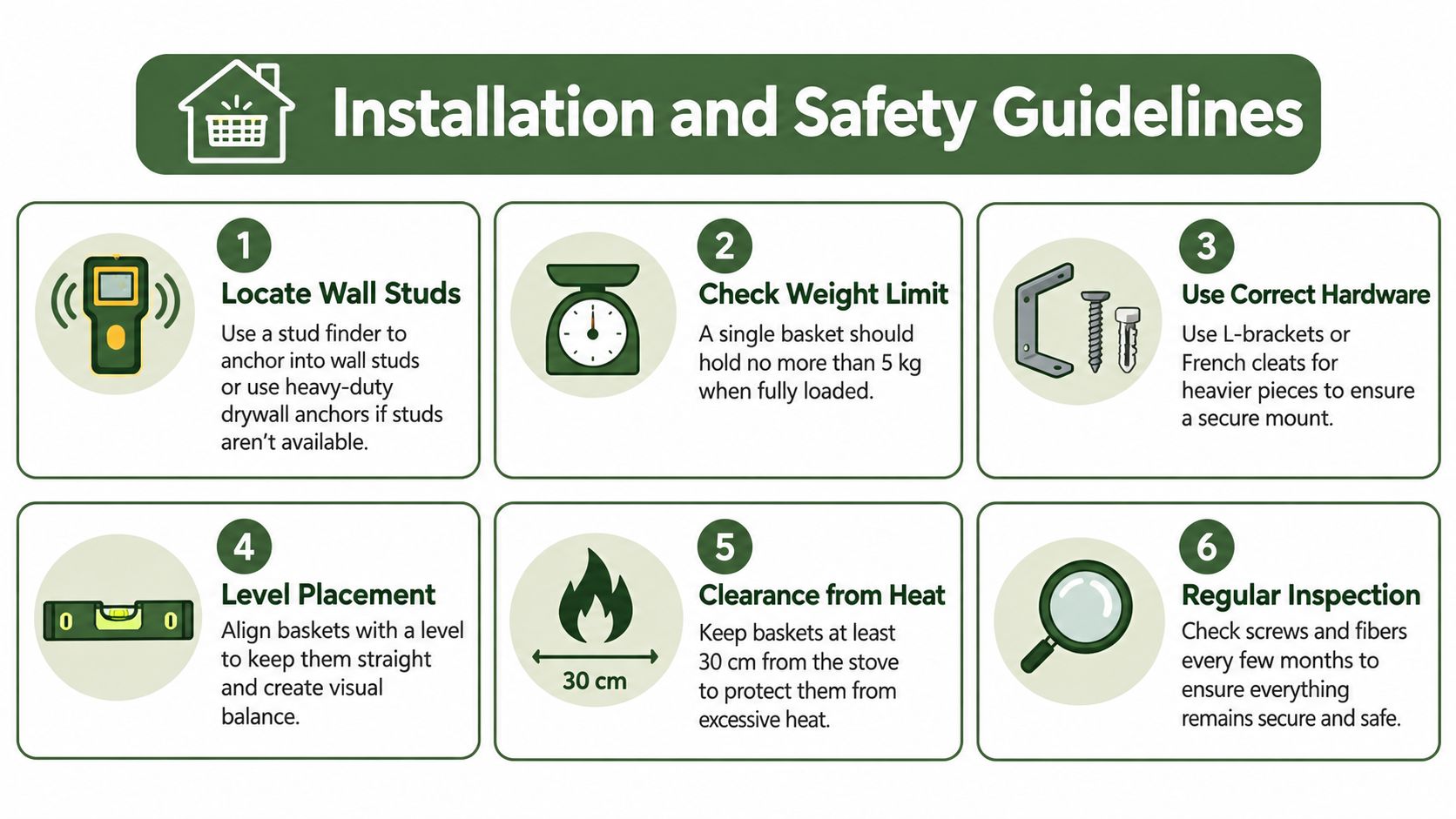
Keep baskets at least 30 centimeters from the stove, following the safety guidance represented in the infographic. Heat can dry natural fibers, weaken finishes, and turn decorative contents into a hazard. Check screws, brackets, basket rims, and fibers every few months, particularly after a move or a change in what the basket holds.
For a visual demonstration of hanging methods, use the following installation reference:
Renters can use removable systems only when the product's rating, wall condition, and basket weight all align. Adhesive strips are a poor choice for heavy trays, dusty texture, humid areas, or anything placed above a work surface. A lighter, empty arrangement on a smooth painted wall is the safer application.
Styling for a Cohesive Farmhouse Look
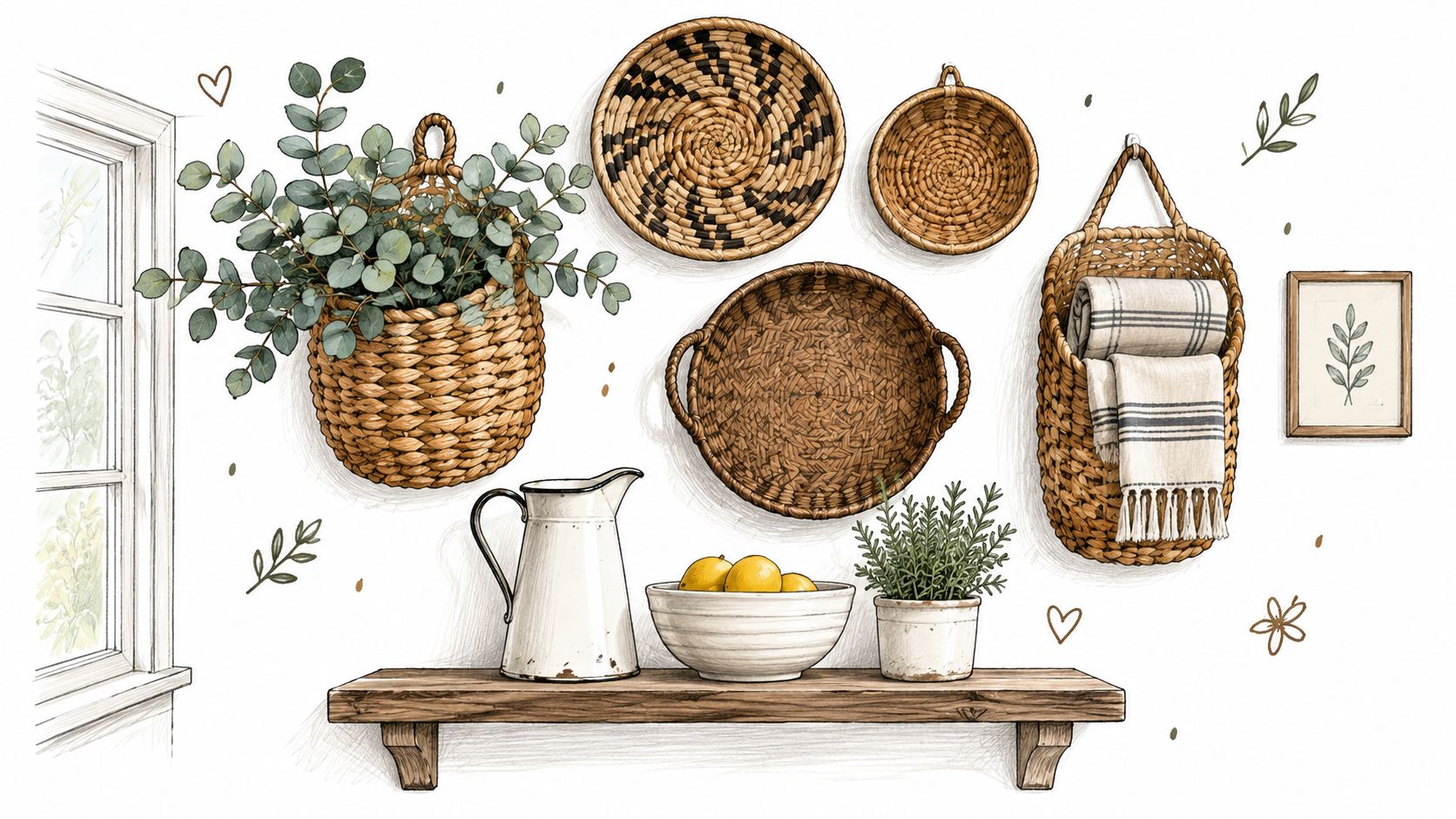
Farmhouse styling works when the basket wall feels gathered rather than manufactured. Start with one basket that has the strongest shape, usually a broad tray or an unusually deep woven form. Place it slightly off center, then build around its texture with smaller pieces instead of arranging every rim into a rigid grid.
Use contrast deliberately. Combine a pale seagrass tone with dark metal, a tight weave with an open weave, or a rounded basket with a shallow oval tray. Keep one visual thread consistent, such as warm natural fibers, black hardware, or muted wood, so the differences read as collected rather than chaotic.
Make the wall useful, not merely busy
The strongest kitchen wall baskets have a job, even when that job is mostly visual. A shallow basket can hold unopened mail near an entry point into the kitchen. A sturdy handled form can gather cloth napkins or produce, provided it stays away from heat and moisture. An open wall basket can display dried herbs or utensils, but only if cleaning and food-contact requirements are clear.
Lay the arrangement on the floor before drilling. Photograph it, turn the image upside down, and check whether one side carries too much visual weight. This quick test reveals gaps and awkward clusters before holes appear in the wall.
For small kitchens, don't force storage onto a wall that needs breathing room. Compare the basket display with custom cabinetry ideas for small kitchens, especially if closed storage could remove more visual clutter than another open container. A wall basket adds texture, but cabinetry may handle daily-use items more hygienically and efficiently.
Use height and repetition
A low ceiling benefits from a vertical arrangement with a taller central form. A wide wall can take a looser horizontal composition, especially above a sideboard or breakfast bench. Repeat one finish across the grouping, but vary scale and profile so it doesn't resemble a retail display.
Keep the contents edited. Dried eucalyptus, a wooden spoon, or a folded linen can provide a point of color, but filling every basket makes the wall look like storage overflow. For further arrangement ideas, see this guide to basket wall decor, then adapt the layout to your wall's texture, traffic, and mounting limits.
The current farmhouse direction favors kitchens that look lived in and personal rather than perfectly staged. That doesn't mean adding more objects. It means choosing pieces with visible utility, leaving some negative space, and allowing the wall to support the room instead of competing with it.
Natural Fiber vs Metal, A Decision Matrix
Natural fiber and metal create distinctly different experiences. Fiber softens tile, stone, and painted cabinetry with irregular texture, while metal brings cleaner lines and usually tolerates wiping better. Neither is universally superior. The correct choice depends on the kitchen zone, the intended load, and how much maintenance you're willing to accept.
| Kitchen condition | Natural fiber | Metal | Practical choice |
|---|---|---|---|
| Dry wall near a dining area | Warm, tactile, and visually relaxed | More structured and graphic | Choose fiber for softness, metal for contrast |
| Wall near a sink or dishwasher | Moisture can shorten service life | Stainless or sound coated metal is more suitable | Favor corrosion-resistant metal |
| Decorative display with little handling | Offers handmade variation | Holds a sharper silhouette | Choose based on the surrounding finishes |
| Basket used for frequent access | Can flex or fray at the rim | Usually easier to wipe and inspect | Favor metal when contact is constant |
| Textured wall or uncertain anchors | Lightweight pieces may be easier to manage | Rigid pieces can need stronger hardware | Match weight and bracket to the substrate |
The matrix isn't a reason to exclude natural fibers from a kitchen. It's a reason to place them intelligently. A seagrass basket on a dry adjoining wall can create the warmth that a stainless piece can't provide, while a coated wire basket near a splash-prone zone handles practical exposure more comfortably.
Metal also has aesthetic trade-offs. Untreated iron can develop an attractive aged surface, but that finish may transfer residue or continue corroding in steam. Powder-coated steel offers a cleaner appearance, although scratches and chipped edges need attention. If you're combining metal baskets with other rustic accents, this guide to wood and metal wall decor can help keep the contrast intentional.
Choose fiber for texture and a dry setting, metal for inspection and wipe-downs, and a mixed arrangement when the wall includes both sheltered and humid areas. Keep the strongest material closest to the source of moisture, and reserve delicate pieces for the visual center.
Maintenance and Care Tips
Maintenance starts with placement. Keep natural fibers out of direct splash zones, allow air to circulate around the weave, and remove anything damp before it sits against the basket. Dust woven surfaces with a soft brush or vacuum attachment on low suction, moving with the weave instead of catching the fibers.
For a spill, blot rather than scrub. A lightly damp cloth can remove surface residue from many sealed or synthetic materials, but natural fibers should dry fully afterward. Avoid saturating the basket, particularly around stitched rims, glued joints, and tightly packed bases.
Metal needs a different routine. Wipe condensation and cooking residue promptly, use a mild cleaner suited to the finish, and dry the surface completely. Inspect welds, corners, screw holes, and cut edges because small coating failures often appear there first. For additional guidance on preventing oxidation, use this practical resource on protecting metal from rust.
Every few months, remove the basket and inspect the wall hardware as well as the basket itself. Look for pulled anchors, loosening screws, sagging rims, broken fibers, and corrosion. If anything has changed, unload the basket and repair the attachment before returning it to the wall.
Farmhouse World offers rustic wall art, custom metal signs, kitchen textiles, and complementary accents that can help tie a basket arrangement to the rest of your home. Visit Farmhouse World to browse farmhouse-style pieces and choose an accent that supports your kitchen's materials, colors, and practical needs.


