

You know the moment. The coop door swings open, the hens rush the fence, and a plain board that says nothing makes the whole corner of the yard feel unfinished. A funny sign fixes that fast. It gives the coop a voice, makes guests smile before they even meet the flock, and turns a practical little structure into part of the home's personality.
That's why funny chicken coop signs work so well in farmhouse spaces. They're decor, but they're also a label, a welcome, and a small badge of pride for anyone who gathers eggs before breakfast and checks the run before coffee. In a backyard where chickens are often treated as pets, food producers, and yard companions, the sign does more than decorate a door. It tells people this flock belongs here, and it belongs to someone who cares how the space looks.
Table of Contents
- Introduction to Funny Chicken Coop Signs and Farmhouse Charm
- Why Funny Chicken Coop Signs Are Taking Over Backyards
- Funny Chicken Coop Sign Ideas and Wording Examples You Will Love
- How to Personalize Your Funny Chicken Coop Sign
- Choosing Materials Finishes and Visibility That Last Outdoors
- Mounting Placement and Care for Your Chicken Coop Sign
- Gifting Styling and Final Tips for Your Perfect Coop Sign
Introduction to Funny Chicken Coop Signs and Farmhouse Charm
A coop sign feels small until you hang one. Then the entire yard changes character. A plain enclosure becomes a place with a name, a mood, and a little story, which is exactly why humorous farmhouse decor fits chickens so naturally. A pun on the door says the keeper has a sense of humor, but it also says the flock is part of everyday life, not hidden off to the side.
Why the joke lands so well
Chickens already invite personality. One hen has a bossy stance, another acts like a tiny escape artist, and roosters make their opinions known whether anyone asked or not. A sign can mirror that energy without needing a full makeover, just like a porch sign can make a front entry feel more welcoming without repainting the house.
The best part is that the humor works for guests who know chickens and guests who don't. A clever line gives them something to read while they look around, and that tiny pause makes the coop feel intentional instead of improvised. In farmhouse style, that's often the whole game, making a useful thing also feel loved.
Practical rule: if the coop is visible from the path, the sign should read clearly in one glance before it tries to be clever.
What this guide helps you decide
A funny sign can be rustic, polished, playful, or a little cheeky. The choice depends on where the coop sits, how far away people will read it, and whether you want the sign to act like decor, a nameplate, or both. That's the difference between a joke that disappears on the wall and one that becomes part of the homestead's identity.
The safest approach is to think about three things at once, wording, size, and durability. If one of those gets ignored, the sign can look cute on day one and tired by the first hard season. If you balance all three, the result feels like it has always belonged there.
Why Funny Chicken Coop Signs Are Taking Over Backyards
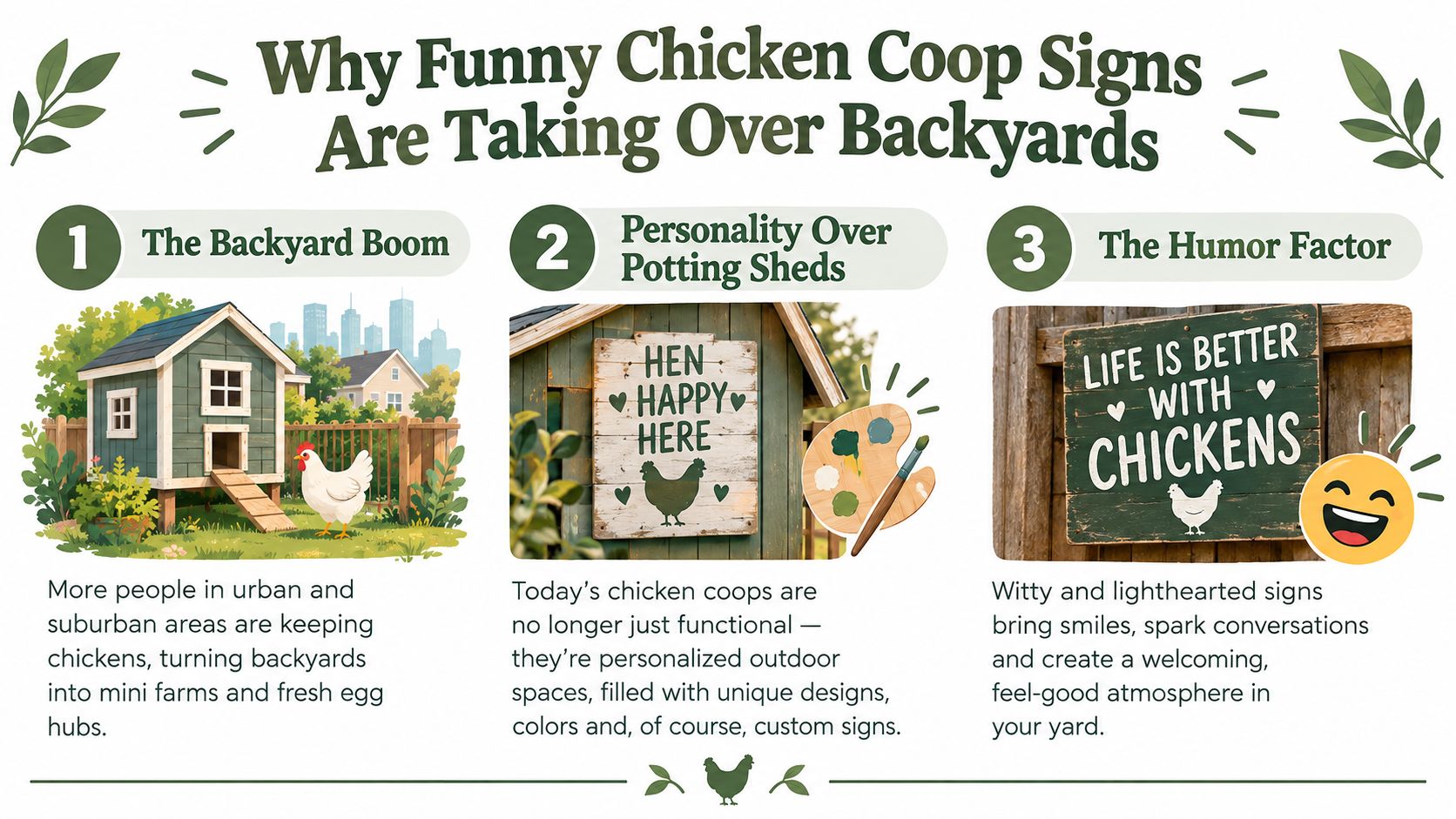
A coop sign starts making sense once the birds move from hobby status to part of the household routine. Recent reporting cited 11 million U.S. households with backyard chickens in early 2025, up from 5.8 million in 2018, and another Texas A&M AgriLife summary put the estimate at about 13 million households, or roughly 5% of all U.S. households. That same summary also noted that 93% of the top 150 U.S. cities allow backyard hens in some form, which shows how often the coop now sits in everyday neighborhoods, not only on rural acreage. News Observer summary of backyard chicken data
The coop became part of the yard
Once the coop is visible from a patio, a side gate, or a kitchen window, it stops feeling like a plain utility box. People see it every day, so they start treating it the way they treat a porch sign or a welcome mat, as part of the home's visual identity. A funny sign fits that role because it gives the coop a voice without making it look fussy.
The flock adds another reason. Backyard hens commonly produce 200 to 300 eggs per year according to the Texas A&M AgriLife summary, so the coop becomes tied to routine, harvest, and the daily rhythm of the house. A sign that names the flock or jokes about eggs feels natural because the coop is already doing more than housing birds.
Chickens now sit at the center of mixed household roles
A PubMed survey of 1,487 backyard flock owners found that 71% kept fewer than 10 chickens, 70% had kept chickens for less than 5 years, 95% kept chickens for food at home, 63% as gardening partners, and 57% as pets. That mix helps explain why coop decor has moved beyond pure farm utility. When birds are pets, helpers, and food sources at the same time, a sign needs to do more than label a shed. It has to match the household's identity. PubMed survey of backyard flock owners
By January 2026, poultry extension reporting counted 4,605 egg producers registered in the U.S., with 3,612 small producers and 993 large producers, so small-scale ownership clearly dominates the category. In that setting, funny coop signs stop looking like a novelty and start looking like normal homestead branding. Small-scale keepers increasingly treat the coop as part of the home's visual identity, which is why signage has become a normal purchase rather than a novelty.
Funny Chicken Coop Sign Ideas and Wording Examples You Will Love
The strongest coop sign ideas usually fall into a few humor styles. That makes choosing easier, because you can match the tone to your yard instead of scrolling through endless pun options and hoping one lands. A sign for a playful family coop can sound very different from one for a tidy little backyard flock, and both can work beautifully.
Compare the humor styles
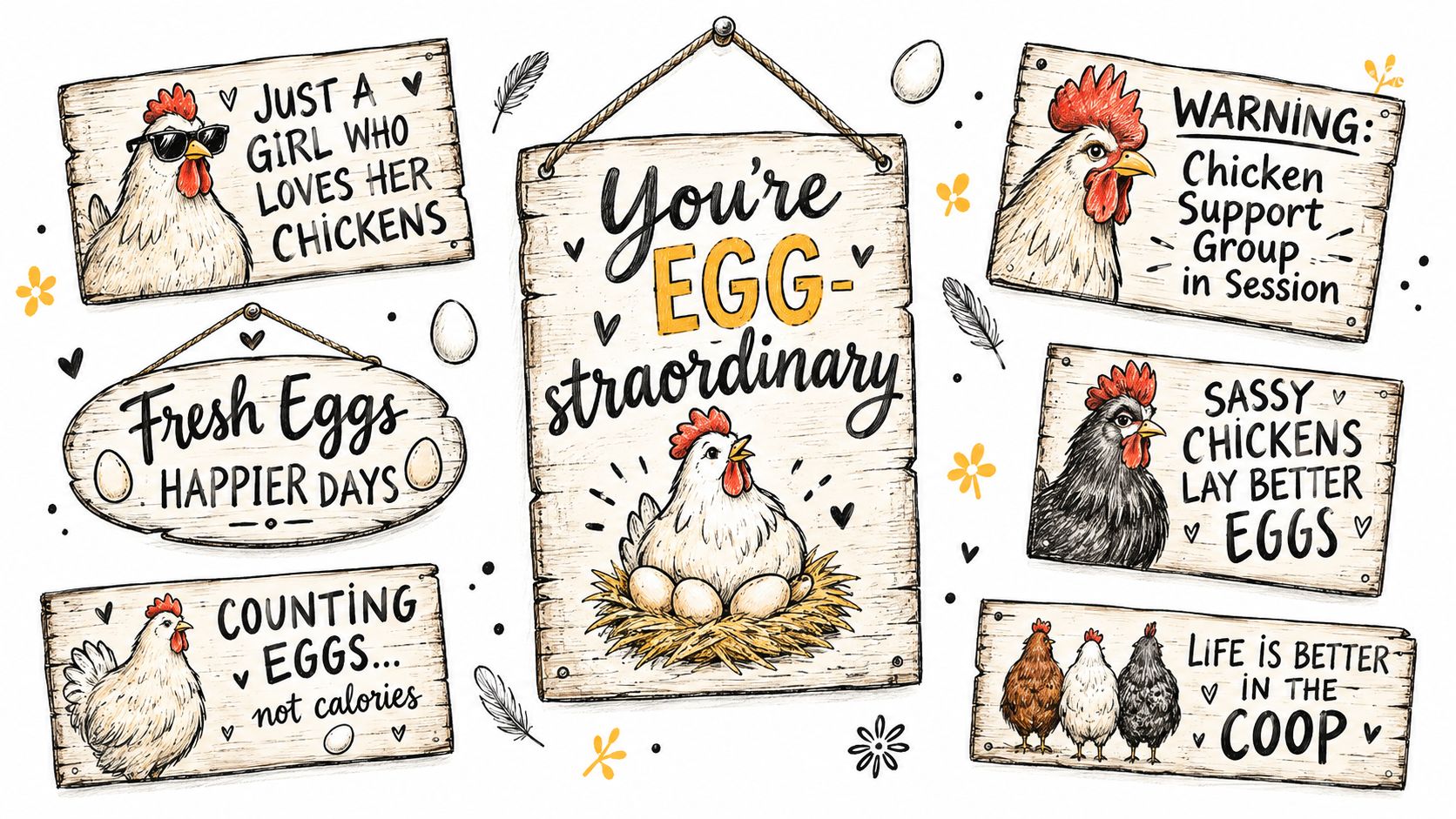
Egg puns are the easiest entry point. Lines like “Egg House,” “No Eggs-cuses,” or “Eggs and More Eggs” read fast and feel friendly. They work best when the lettering is large and the joke is short, because the humor comes from quick recognition rather than a long sentence.
Hen sass gives the sign a little attitude. Phrases such as “Hens Rule the Roost,” “Cluck Off,” or “Mind Your Own Coop” feel bolder and a bit cheekier. These are great if the coop is part of a family backyard and you want the sign to feel like it has personality, not just polish.
Rooster jokes lean into the drama of the flock. Something like “The Roost Is Loud” or “Warning, Rooster on Duty” makes sense if your birds are especially vocal. Those signs usually read best on a door or gate, where visitors are close enough to catch the humor before stepping in.
Farmhouse name twists are calmer and often more timeless. “The [Family Name] Coop,” “Established at the Coop,” or “Hens at Home” feel more like identity markers. They're a good fit when you want the sign to stay charming for years instead of relying on a one-time joke.
“Short usually wins. If the joke takes too long to read, the sign starts working against you.”
Match the wording to the audience
If kids visit the coop often, choose a light pun that reads instantly. If the sign is more for adults, a slightly sharper joke can work, but it still should feel warm, not mean. The best coop signs make people smile first and squint second.
For inspiration beyond the coop itself, the farmhouse sign ideas at Farmhouse World's farmhouse sign ideas show how naming, lettering, and rustic finishes can work together across different rooms and outdoor spaces. That's useful because a coop sign should feel like part of the same home story, not a one-off gag taped to a fence.
A good shortcut is to write three candidates, then say them out loud while standing at the coop. The one that sounds natural aloud usually reads naturally on wood or metal too.
How to Personalize Your Funny Chicken Coop Sign
Personalization is what turns a joke into a real marker. A flock name, a date, or even a simple nickname can make the sign feel like it belongs to your birds instead of to a generic chicken theme. If you're choosing a sign for a coop that everyone can see, the easiest mistake is adding too much text and then losing the joke in the clutter.
Build the sign in the right order
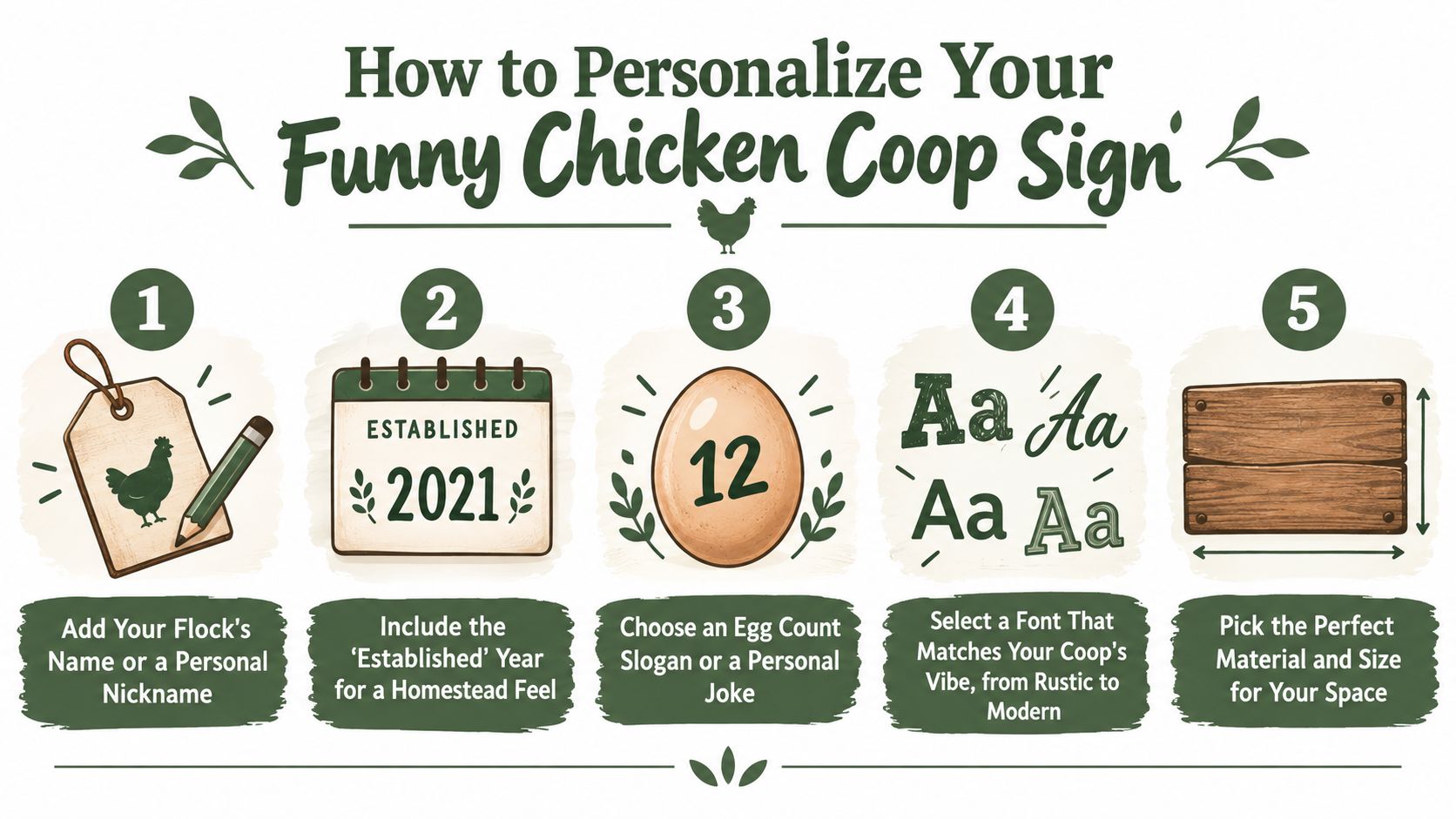
Start with the name. If your flock already has a title, put that first, because names give the sign a clear anchor. If you don't have a flock name yet, a family surname, a property nickname, or a simple coop label can do the same job.
Then decide whether the sign needs an established year. That detail gives the sign a homestead feel, but it's most useful when it's readable at a glance. If the sign is small, the year can compete with the main line, so it belongs only when the layout has room to breathe.
After that, add a joke only if it still reads cleanly. A line about eggs, feathers, or roosting should support the sign, not crowd it. Think of the layout like a good porch arrangement, one strong focal point, then supporting pieces around it.
Simple rule: if you have to step closer to understand the whole sign, it's too full.
Pick the finish based on where the coop sits
Color affects mood and legibility. Black feels crisp, Copper and Gold lean warmer and more traditional, Silver reads clean and simple, while White, Red, Blue, and Green can help the sign stand out against darker siding or painted wood. A bright coop wall may call for contrast, while a weathered wood backdrop may need something bolder to avoid disappearing.
Size matters just as much. Farmhouse World offers chicken coop and homestead signs in sizes commonly ranging from 12 inches to 36 inches, which makes it easier to fit a door, gate, or wall without squeezing the design. Small signs work well for close viewing. Larger signs are better when the path to the coop is longer or the wording includes a name plus a joke.
| Decision Point | Best Choice for Close View | Best Choice for Distance |
|---|---|---|
| Wording length | Short pun or name | Fewer words, larger type |
| Size | Smaller sign for door or interior wall | Larger sign for gate or exterior wall |
| Color | Any finish that matches the coop palette | High-contrast finish with strong readability |
A personalized sign should look intentional from ten steps away and still feel charming when you're standing right in front of it. That balance is what keeps the humor from turning into visual noise.
Choosing Materials Finishes and Visibility That Last Outdoors
A coop sign lives outdoors, so the joke and the surface have to work together. If the material fails, the punchline may still be funny, but no one will want to read it after a season of sun, rain, and dust. For a backyard flock, the sign is part humor and part identity marker, like a nameplate on a barn door that also makes you smile.
Start with the substrate
Aluminum is a practical choice for a chicken coop sign because it does not rust like iron or carbon steel and is widely used for permanent outdoor signage. The printed layer usually wears first, so UV-stable inks or a protective laminate help the lettering stay clear when sunlight and moisture are part of daily life. A stable metal base can outlast the graphic if the finish is weak. Outdoor sign material durability guide
If you are comparing outdoor materials more broadly, the guide from The Knotty Lumber Co. is a good reminder that weather exposure changes the result. Even a solid material can age quickly if moisture and sunlight keep working on the finish.
Farmhouse World's farmhouse metal signs show how a finished metal surface can support both clean lettering and custom outdoor use. A powder-coated aluminum sign in the 12 to 36 inch range with simple lettering is a clear example of the tradeoff shoppers should look for, a sealed surface that keeps the joke readable through a full season.
Decide whether you need nighttime visibility
If the sign needs to be read from a driveway, a side path, or a dim yard, reflective sheeting makes the biggest difference. Reflective materials bounce headlight or flashlight illumination back toward the viewer, which helps the words stand out after dark, and higher-grade systems are commonly used for long outdoor service depending on exposure and sheet type. That makes the finish more functional than decorative, especially for visitors arriving at dusk. Reflective sign materials guide
Be cautious with rustic looks
Distressed or weathered finishes fit farmhouse style, but they are not always the smartest choice in humid, coastal, or freeze-thaw climates. Neutral signage guidance says powder-coated aluminum can last a long time outdoors, stainless steel can last even longer, and corrosion risk rises with salt, trapped moisture, and coating failure. The prettiest worn look is not always the best long-term choice if the coop sits in rough weather. Metal signage durability guide
A personalized sign should still read clearly from the yard, then feel charming when you stand beside it. That balance keeps the humor from turning into visual clutter.
Mounting Placement and Care for Your Chicken Coop Sign
A great sign still needs good placement. If it sits too low, gets blocked by feeders, or traps moisture behind it, the whole thing can age badly no matter how cute the wording is. Installation is the part that protects your purchase, so treat it like part of the design, not just a hardware chore.
Place it where people actually read it
The best spot is usually the place visitors naturally look when they approach the coop, often near the main door or gate. Keep the sign level and high enough to avoid mud splash, scratching, and contact with curious birds. If the coop is set back from a walkway, think about how far away someone will stand when they first see it.
Use standoff mounting when you can, because a little space behind the sign helps airflow and drainage. A flush mount can work on some walls, but if moisture gets trapped, the back of the sign and the mounting surface can suffer. That matters most on wood coops, where trapped dampness can leave marks or encourage wear around fasteners.
Match the hardware to the surface
Wood and metal walls need different fastening habits. Wood accepts screws more easily, while metal surfaces often benefit from hardware that avoids stress around the panel. The goal is to hold the sign securely without bending the face or creating a spot where water sits and lingers.
Care note: a sign that stays dry behind the panel usually looks better for longer than one that's mounted flat against a damp wall.
Keep up with simple seasonal maintenance
A quick cleaning with a soft cloth removes dust and grime before it builds up. Check the fasteners when the weather changes, especially after heavy wind or repeated wet weather. If you see coating wear on the edges, deal with it early instead of waiting for the damage to spread.
For a broader rust-prevention mindset, the how to protect metal from rust guide is a useful companion when you're thinking about outdoor hardware, mounting points, and finish care. The same basic habit applies here, keep moisture from hiding where you can't easily see it.
Gifting Styling and Final Tips for Your Perfect Coop Sign
A funny coop sign makes a thoughtful gift because it's personal without being risky. It works for a housewarming, a new flock, a birthday for the chicken keeper in your life, or a homestead milestone when someone finally names the birds and hangs the gate. If you don't know the exact wording, a gift card can be the safer choice, because the right joke depends on the household's voice.
The strongest sign choices usually do three things at once. They make the coop easier to identify, they match the style of the yard, and they bring a smile without crowding the face of the sign. That's why the best version is rarely the funniest one on paper, it's the one that still reads clearly after it's mounted and weathered into place.
Pair the sign with a few farmhouse accents if you want the space to feel finished, a rooster rug by the entry, a planter nearby, or a simple coordinated wall piece can make the coop area look intentional. If the keeper is new to flocks, a personalized sign can also function as a small ownership marker, which is helpful in a backyard chicken world that's growing fast and getting more visible all the time.
If you're ready to turn a plain coop into something that feels welcoming and easy to identify, take a look at Farmhouse World. Their custom metal signs and farmhouse accents make it simple to choose a sign that fits your flock, your yard, and your style.


