

You've found a Christmas metal sign you like, but the product photo doesn't answer the questions that matter at your house. Will the name show up against the door? Can visitors read it from the approach? And will the finish cope with winter rain beside a lighted wreath?
A good choice starts with the location, not the artwork. Treat size, contrast, finish and mounting as practical specifications, and it becomes much easier to choose a sign that looks right and works where you put it.
Table of Contents
- What a Christmas Metal Sign Is
- Sizes That Stay Readable From the Right Spot
- Styles and Wording That Cut Cleanly
- Finishes That Survive the Local Weather
- Rooms and Porches That Can Carry One Sign
- How to Hang It Beside Lights and Wreaths
- Confirm the Proof and Lead Time
What a Christmas Metal Sign Is
A Christmas metal sign is a rigid plaque with a seasonal greeting, image, family name or address. Manufacturers commonly use steel or aluminum, then paint, print or cut the design through the metal. Some signs have a solid background; others use open silhouettes so the wall becomes part of the picture.
Say you're decorating an entry with a family name beneath a Christmas tree. A printed plaque carries the tree and lettering on its surface. A cut-metal version leaves openings around the branches and words, which means your door color affects how the finished design looks.
Neither version needs electricity unless it includes a separate lighting system. That makes a metal plaque different from an illuminated sign or inflatable, even when you display it among powered decorations.
Why metal feels familiar at Christmas
Metal has a long place in seasonal decorating: The Conversation's history of Christmas decorations describes domestic decorations in Thomas Tusser's 1558 Christmas song, silver-strip tinsel in Nuremberg around 1610, and candles held in metal clips in the 1800s. A contemporary plaque uses a different form, but its reflective surface and symbolic imagery fit that established tradition.
The useful distinction today is between decorative appearance and fitness for the location. A distressed finish can suit a living room without being suitable for an exposed gate.
Start with the job
Before choosing a motif, settle these decisions:
- Reading position: Decide where someone should be able to recognize the words.
- Artwork and lettering: Choose shapes that remain clear at the finished size.
- Exposure: Separate an indoor wall from a sheltered porch or open exterior.
- Installation: Identify the supporting surface and nearby decorations.
A family-name sign might remain useful after Christmas, while a nativity scene may be deliberately seasonal. Choose according to how you'll use it, rather than assuming every metal plaque belongs outdoors or needs to stay up year-round.
Sizes That Stay Readable From the Right Spot
Choose the farthest reading position first, then choose the size. Stand where a visitor will see the sign, whether that's the doorstep, the garden path or the driveway approach.
Overall width isn't the same as letter height. A wide scenic design can devote most of its metal to trees, stars or figures, leaving little room for the name. A simpler design of the same width may be much easier to read.
The Alibaba Seller guide to outdoor powder-coating performance contrasts a 12-inch front-door sign with 24- to 36-inch signs for more distant viewing, while emphasizing contrast, simple lettering and surface glare. Those are useful starting points, not guaranteed reading distances.
Work from close viewing to distant viewing
Use this table as a layout shortlist, not a certified visibility chart. The locations describe where to trial each size; the lettering still needs to pass an on-site check.
Christmas metal sign size by viewing distance
| Nominal size | Reads well from | Lettering that works |
|---|---|---|
| 12 inch | Front door or mantel, viewed nearby | Short name or one word, simple cutouts |
| 15 inch | Covered entry at eye level, checked from the doorstep | Family name plus a small motif |
| 18 inch | Stair landing or narrow porch, checked from the approach | Name and a short greeting |
| 24 inch | Porch, gallery wall or large mantel | Name, year or a short two-line greeting |
| 30 inch | Driveway approach or barn face, subject to an on-site test | Large block letters, few flourishes |
| 36 inch | Rural-road approach or wide exterior wall, subject to an on-site test | Bold name only; skip thin script |
Make a paper template using the proposed finished width and height, then tape it where the sign will hang. Add a rough version of the lettering rather than testing a blank rectangle. Step back to the reading position and check whether you can identify the words without already knowing them.
Practical rule: If you have to walk closer to decode the name, simplify the design before adding more decoration.
Contrast can matter as much as width
Light lettering against a dark background, or dark lettering against a light background, gives the eye a clearer boundary. Dark red against brown siding or deep green foliage can disappear, especially after sunset.
Cut-through lettering needs particular attention because the background isn't supplied with the sign. A black silhouette may look crisp against pale siding but become difficult to distinguish against dark brick. Snowflake openings and fine script also need enough separation from the surface behind them.
Check the proposed finish under your actual porch light. Gloss can reflect the lamp toward the viewer, while a matte or low-sheen surface may be easier to read.
Before ordering, record:
- Actual dimensions: Width and height, not just the nominal size.
- Lettering method: Painted, printed or cut through.
- Product specification: Substrate, finish, mounting orientation and intended indoor or outdoor use.
Choose the table row closest to your location, test that footprint, and write the selected size beside your doorway measurements.
Styles and Wording That Cut Cleanly
A nativity scene, a family initial, and an address plaque each have a different job. Choose the main message first, then keep the artwork and wording simple enough to read at the intended viewing distance.
These common formats show how the balance changes between artwork and words.

Christmas metal sign styles that stay legible
| Style | Best text | Cut that survives | Weak choice |
|---|---|---|---|
| Nativity or faith scene | Family name under the scene | One focal figure and wide gaps | Tiny figures and stacked sentences |
| Monogram with star, tree or wreath | One initial or a short name | Thick strokes and a single motif | Dense script and tiny antlers |
| Short farmhouse greeting | One line | Bold, simple letterforms | A long slogan or thin flourishes |
| Address plaque with seasonal color | Street number | Large block numerals | A full scene plus the number |
A faith scene puts the Christmas story first. A monogram highlights the household, while a short greeting welcomes visitors without competing with a detailed picture.
An address plaque has a practical job: make the number easy to find. Keep it dominant, and use seasonal color or removable greenery for decoration.
Understand the cut-metal constraint
Slender bridges in cut metal are the parts most likely to bend during handling. Check how each letter, antler, branch, or small star connects to the surrounding panel, especially where the sign will be gripped during installation. Intricate artwork can work when its connections are sturdy and its fine details are not fragile.
The Nativity Monogram - Steel Sign is one example of a scene paired with a family name. Before ordering, check the product listing for the material, finish, and size details relevant to your intended placement.
Edit the wording before adding ornament
A name, monogram, street number, or meaningful year gives the design a clear purpose. Long messages compete with the artwork and leave less room for lettering, which can make the words harder to read.
Choose color as part of the layout. Black and white can create clear separation from a wall; copper, gold, and silver provide a metallic look. Red and green signal a seasonal theme, but the background still needs to distinguish the sign's shapes and letters.
For more examples of how lettering and decoration can share a wall, browse these farmhouse sign ideas.
Before settling on a design, apply three checks:
- One focal image: Remove scenes that compete for attention.
- One clear text treatment: Keep the name, number, or greeting visually dominant.
- A contrasting color: Judge the sign against the surface where it will hang, not only against its product photograph.
Finishes That Survive the Local Weather
Metal isn't a weather rating. The substrate supports the sign, while the coating, edge preparation and installation determine how readily moisture reaches it.
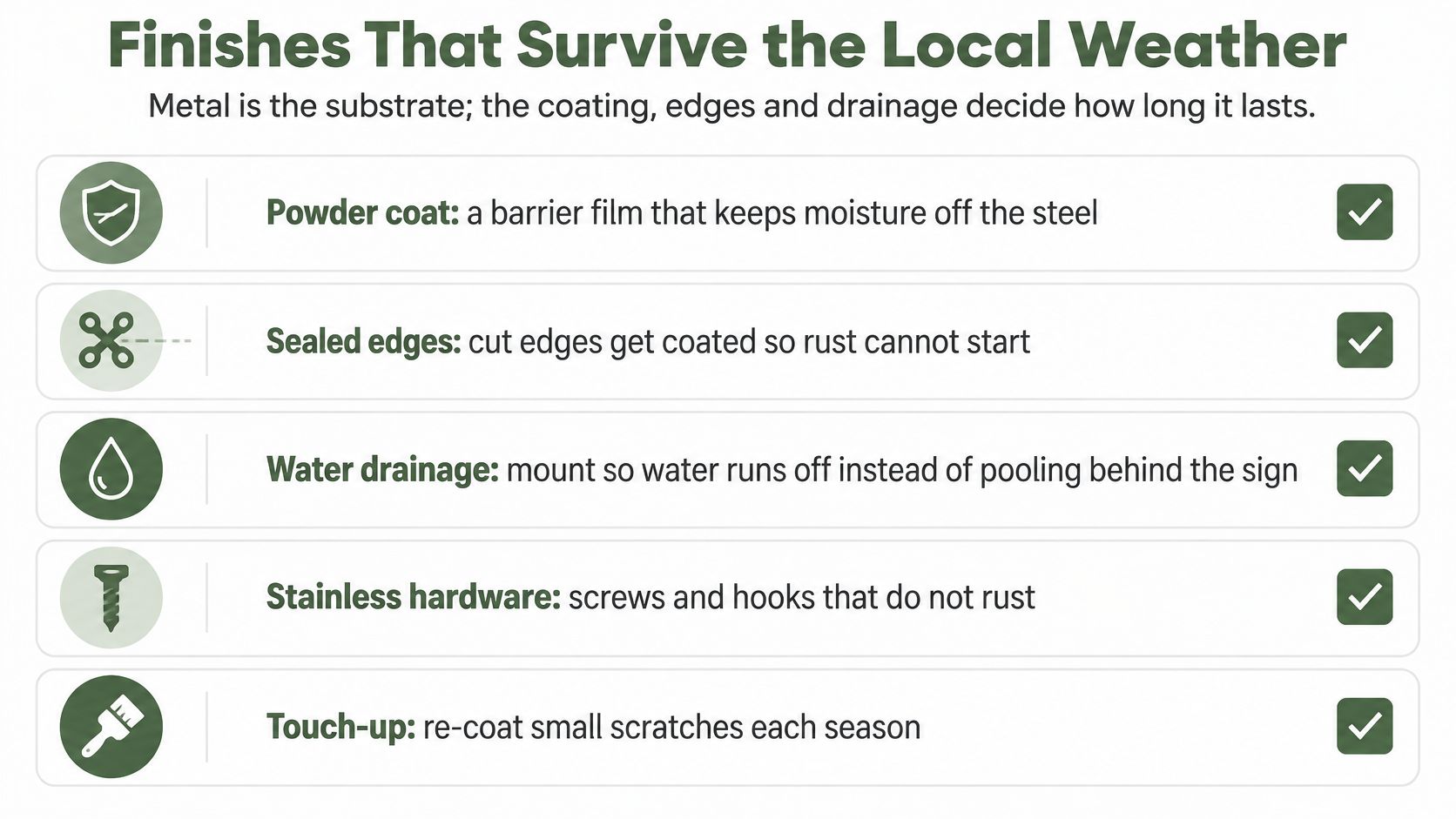
Powder coating forms a protective film over steel. According to Sizemarker's powder-coating specification guidance, scratches, cut edges and mounting holes can become corrosion starting points, so exposed installations need more than an attractive painted face.
The same guidance identifies ASTM G85 Annex A5 and ISO 9227 as testing references to evaluate alongside a stated failure criterion, such as blistering, adhesion loss, under-film creep or visible red rust. A test-hour claim without that context doesn't explain what condition the coating was in when the test ended.
Match the protective system to the exposure
A sheltered porch and a salt-exposed mailbox post aren't equivalent locations. Coastal air, road spray, trapped meltwater and strong sunlight create different maintenance demands.
Coating and care by climate
| Exposure | Main failure | Specify | Seasonal care |
|---|---|---|---|
| Covered porch, mild weather | Edge rust if the film is nicked | Pretreated steel, outdoor powder coat | Wipe after rain; inspect mounting holes |
| Coast or road salt | Crevice rust at cuts and screws | Galvanized or pretreated steel, sealed holes, finished edges | Rinse salt deposits; don't rely on decorative paint |
| Snow and freeze-thaw | Water trapped behind the plaque | Rigid panel, corrosion-resistant fasteners, drainage gap | Keep meltwater paths open; store an unrated sign |
| Strong sun | Fading, chalking, gloss loss | Exterior coating with stated UV performance | Compare color and surface condition each season |
| High wind | Movement against siding or decorations | Appropriately rigid panel and fixed mounting | Recheck fasteners after storms |
| Indoor only | Dust and handling marks | Decorative finish suitable for the room | Use a soft, dry cloth and secure indoor hardware |
SignKnights' climate-based material guidance also identifies corrosion-resistant stainless steel or coated aluminum as options for coastal exposure. For a steel design, ask whether the substrate is galvanized or otherwise pretreated and whether the coating system is specified for the actual environment.
Use this checklist to inspect the vulnerable parts, not just the front surface.
Keep water out of the installation
Don't create a pocket behind the plaque where water can collect. Use compatible spacers when needed, keep drainage paths clear and avoid mounting arrangements that hold wet greenery against unfinished edges.
For maintenance, wash off loose dirt with mild soap and water, rinse, and dry the sign before storage. Treat scratches with a touch-up product compatible with the existing coating, rather than covering rust with an unrelated craft paint. Our guide to protecting metal from rust provides further care context.
A rust-resistance claim isn't a promise that a red or green finish will retain its color in strong sunlight.
If the listing doesn't establish exterior suitability, choose an indoor location rather than testing it through winter. When deciding between decorative media for that room, the wall art advice from That Blanket Co offers context for comparing metal prints and canvas, though those aren't necessarily made like cut-steel plaques.
Rooms and Porches That Can Carry One Sign
Treat the sign as the fixed point and let garland, ribbon and textiles change around it. That gives the display a clear center without requiring you to replace the whole arrangement each Christmas.
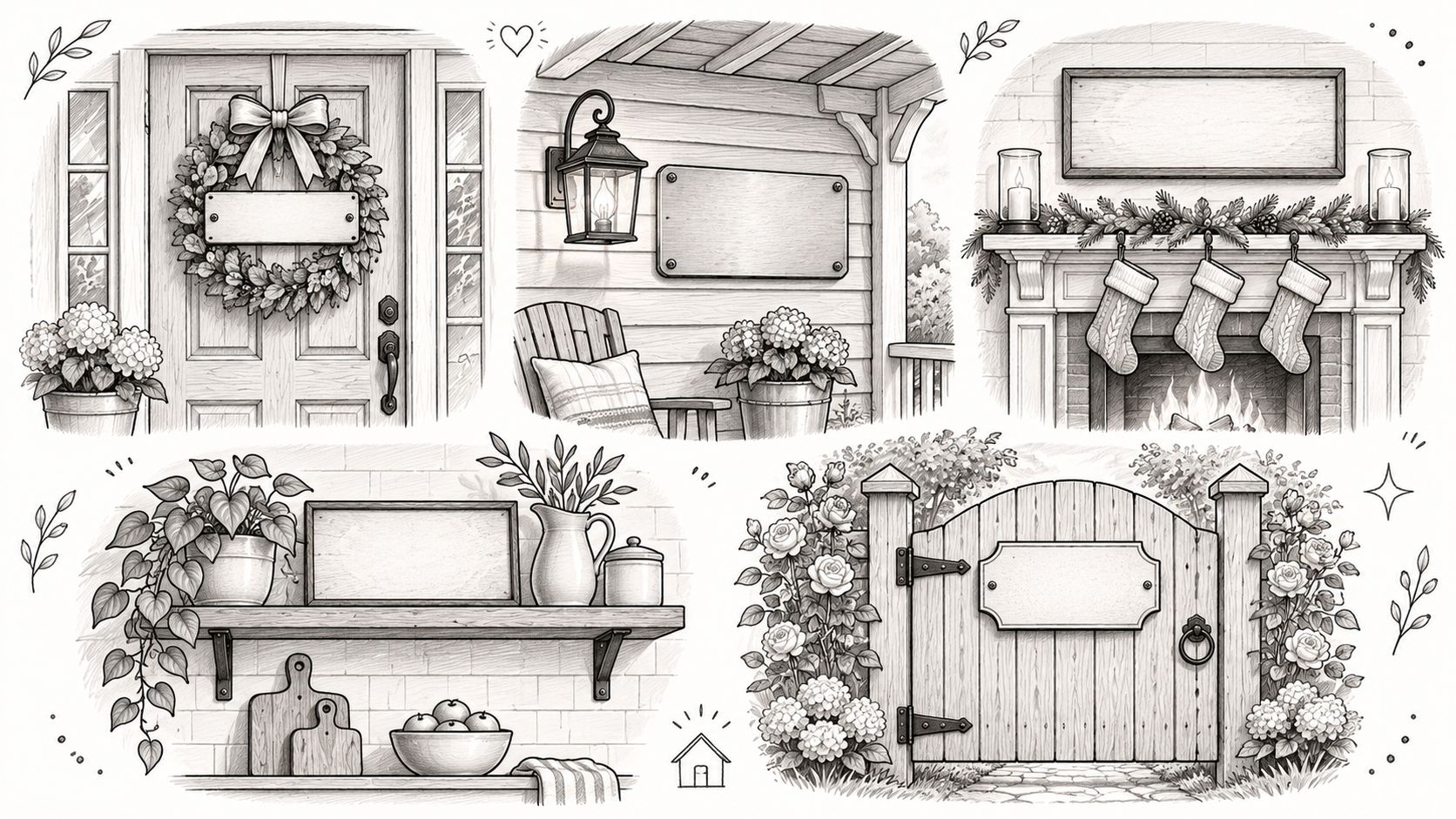
These placement sketches offer different ways to give a single piece enough breathing room.
Begin at the entrance
At the entry door, center a compact name plaque or place it on the wall beside the door. Offset the wreath so its needles don't cross the lettering, and open the door fully before committing to the position. The sign shouldn't strike a wall, interfere with the handle or obscure the peephole.
On a covered porch, use the wall between posts as the main display surface. A planter or unlit decorative lantern below can balance the composition without surrounding every edge with objects. Leave enough room to sweep, clear snow and move deliveries without knocking the plaque.
For renters, confirm which attachments the lease permits. A removable hook still needs a suitable surface and a load rating appropriate to the sign; adhesive mounting isn't automatically suitable for painted exterior doors.
Give indoor displays some space
A mantel suits a wide design because the shelf already establishes a horizontal line. Hang the sign securely above it or use a purpose-made support, rather than balancing a sharp-edged piece behind picture frames. Keep working fireplaces and candles clear of the display.
On a living-room gallery wall, a seasonal metal piece can replace an existing picture instead of being squeezed into a gap. A red or green accent among wood frames and neutral artwork can communicate Christmas without covering every surface.
If you're preparing the room for visitors too, Willis Furniture & Mattress's ideas for guest-ready seating for Virginia Beach homes offer a complementary room-planning resource. Keep chairs and circulation routes usable rather than letting decorations spread into them.
For another visual reference while arranging the surrounding decor, this video can accompany your planning.
Let exterior signs do a clear job
A barn face, coop gate or mailbox post needs a design selected from the actual approach. Don't add a full scenic composition if the main purpose is identifying the property, and keep a gate-mounted plaque clear of latches and moving joints.
A personalized scene can make a meaningful household gift, but a recipient still needs an appropriate surface. A Christmas ornament is a smaller parallel gift when wall space is uncertain, not a substitute for a readable sign.
Name the surface before buying the sign. Once that surface has a clear focal point, stop adding competing plaques.
How to Hang It Beside Lights and Wreaths
A passive metal plaque doesn't need electricity to work. Its installation can still damage a cable or bring metal into contact with hot lighting equipment.
In its nationally representative 2025 survey of 2,019 U.S. adults, the ULSE Holiday Safety Guide found that 83% inspected lights and 84% inspected power cords, yet 52% reported daisy-chaining power strips or extension cords. Inspection matters, but so does the arrangement you build afterward.
Install in a safe order
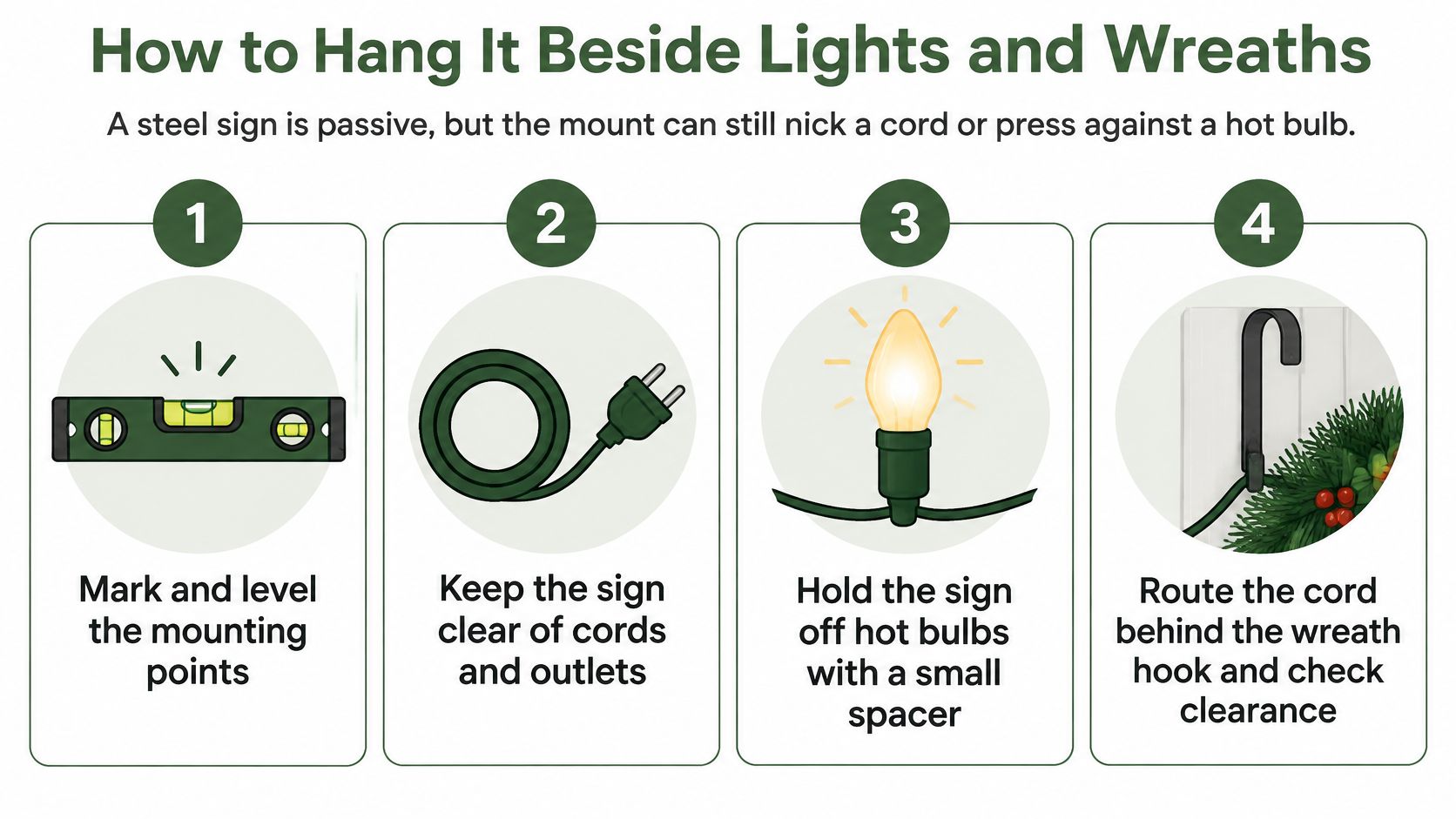
- Choose a solid support. Locate a stud, sound post or suitable door attachment, then select hardware for the sign's weight and substrate. Check whether hardware is included before installation day. Use a stable ladder, not a porch rail or chair.
- Separate metal, greenery and bulbs. Arrange the plaque and wreath while the lights are unplugged. Leave clearance so branches and ribbon can't press lamps against the metal, and account for movement when the door opens.
- Route cords away from edges. Use outdoor-rated electrical products outdoors. Keep cables clear of cutouts, screw points, door pinch points and walking routes, and never pass a fastener through a cable.
- Avoid daisy-chaining. Don't connect power strips or extension cords end to end. Plan a suitable power route and follow the connected equipment's instructions and ratings rather than extending an unsuitable arrangement.
- Prevent swinging. Secure the plaque so wind can't move it into a lit wreath, siding or an inflatable. Keep protruding cutouts away from children's reach and position the display outside normal head and shoulder movement.
- Unplug before removal. Disconnect the lighting supply before lifting the sign or loosening hardware. Inspect cord jackets for cuts and abrasion, and remove damaged electrical products from use before storage.
This visual checklist highlights the mounting and clearance decisions.
Check the whole display
Use our farmhouse Christmas porch decor guide for arrangement ideas after establishing the safe mounting and cable routes. If the display also includes candles, consult Shivora Candles holiday setup tips rather than treating open flames like decorative electric lights.
Perform a final clearance inspection with the supply disconnected, then observe the completed display when illuminated. No part of the sign should touch a bulb, connector or cord, including when the door moves or the wreath shifts.
Confirm the Proof and Lead Time
The final decision belongs on the product page, not in another round of browsing. Match the selected design to the surface, reading position and exposure you've already chosen.
A personalization proof should show exactly what you intend to order. Read the name letter by letter, including spaces and capitalization, rather than glancing at it as a familiar word. Check the selected color and size separately, since a text preview may not establish the finished physical proportions.
Review the order as a specification
- Text: Verify spelling, spacing and the exact wording shown in the preview.
- Characters: If a preview drops hyphens, use periods or slashes where appropriate. Leave out emojis when the production process doesn't support them.
- Location rating: Confirm the listing supports the intended indoor or exterior installation.
- Mounting: Add suitable hardware if the plaque is supplied without it.
- Timing: Separate production time from shipping transit, and check whether either estimate uses business days.
Don't assume a personalized order will arrive on the same schedule as an item already sitting in a warehouse. Read the current production estimate, allow for seasonal delays and leave time to inspect the delivered piece before gifting or hanging it.
Resolve uncertainty before paying
If the preview is unclear, contact the shop before submitting the order rather than relying on a note that contradicts the displayed design. Keep a copy of the confirmed wording and order details so you can compare them with the delivered sign.
The strongest purchase is the one with no unresolved questions: the dimensions fit, the words read clearly, the finish suits the location and the hardware is ready. Submit that checked design with enough time for production and delivery, rather than making a last-minute compromise on the name or mounting plan.
Farmhouse World offers custom metal signs, rustic home accents and personalized gifts for entryways, living spaces and seasonal displays. Visit Farmhouse World with your wall measurements, chosen wording and intended location ready, then compare designs that fit those requirements.


